
News
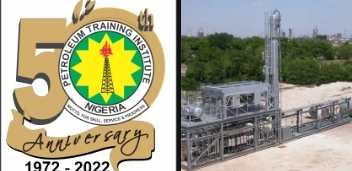
Petroleum Training Institute, Effurun Completes Assembly of First Homegrown Modular Refinery, 50 Years After Establishment.

Petroleum Training Institute, Effurun Completes Assembly of First Homegrown Modular Refinery, 50 Years After Establishment.
By Anthony Beauty
Effurun, Delta State – The Petroleum Training Institute (PTI), the foremost manpower development vehicle of the Federal Ministry of Petroleum Resources, has achieved a significant milestone with the successful construction of a modular refinery, 50 years after it building foundations were laid. This groundbreaking development is part of PTI’s commitment to advancing technology in the field of crude oil refining and addressing the challenges posed by artisanal refiners.
Located in Effurun, Delta State, PTI has not only ventured into building a modular refinery but has also taken up the mantle of training artisanal refiners in the essential skills required for responsible crude oil processing. Adebowale Adimula, the Chief Executive of PTI, unveiled this remarkable achievement during a press conference in Abuja, in anticipation of the 3rd Biennial International Conference on Hydrocarbon Science & Technology scheduled to take place in the Federal Capital Territory next week.
Mr. Adimula emphasized the institute’s primary focus on training but acknowledged the need to address the prevailing issues in the artisanal refining sector. He stated, “One of the areas that we have been looking at over the past few years is developing technologies in the modular refinery space. We are a training institution primarily, but when you look at the country today and the lack of technology among the artisanal refiners, one of the things we have done is to develop concepts.”
The PTI is not only building modular refineries but is actively involved in training individuals to ensure that their refining activities do not harm the environment. Adimula elaborated, “We also help in training the individuals so that whatever they do will not adversely affect the environment. We at the institute have built up our own. Now what is next is to scale it up, to find ways to make it commercial.”
He emphasized the importance of equipping those in the field with necessary skills, saying, “What we have today are people who know next to nothing about refining, they just go into the creeks, break pipes and begin to boil or cook oil. No, we are doing it differently by training and equipping them with the necessary skills that will make them able to contribute meaningfully to the economy.”
Adimula clarified that the PTI’s modular refinery does not compete in scale with major refineries like Dangote’s facility in Lekki, Lagos. Instead, it serves as a technology advancement initiative in the modular refinery sector. He stated, “The facility we are working on is not to create a refinery that will now be like the Dangote refineries of this world, no. Our primary focus, which we are not losing sight of, is that we are a training institution, and whatever we develop will help the advancement of technology in that space.”
The completion of this modular refinery and the institute’s dedication to training mark a significant step forward in the quest for responsible and advanced crude oil processing in Nigeria. The PTI’s efforts align with the nation’s objectives of ensuring a safer, more environmentally friendly, and economically viable approach to oil refining.
IduwiniVoice recall that this is not the first time the institute is making wave in tech. development. It remains on record that Graduating Students in collaboration with their lecturers have built pilot size automobile engine blocks, automobile, and aircrafts in the past.
Should Nigeria desire true technological growth, then the government, industry giants, and financial institutions must invest heavily in what the institution is doing in order to breach the technology gap in the country.
It is pertinent to call on regional development blocks like the BRACED Commission, NDDC, and of course the niger Delta Ministry to champion the development and deployment of this rich tech. potentials.











By Favour Bibaikefie
LAGOS — Operatives of the Nigeria Security and Civil Defence Corps have uncovered a suspected baby factory in Badagry area of Lagos State, rescuing 28 persons during a late-night raid.
Authorities said those rescued included 18 adults and 10 children. Among the adults were 17 pregnant women, while one case involving a suspected miscarriage was also recorded. Two persons were arrested in connection with the operation.
The Lagos State Commandant of the NSCDC, Adedotun Keshinro, disclosed that the raid followed weeks of intelligence gathering and surveillance.
According to him, the facility, located in Okuju-Ilado, Badagry, was made up of several apartments and had been monitored for about three weeks before security operatives moved in around midnight on Wednesday.
Keshinro alleged that the operators targeted vulnerable pregnant women by offering them financial inducements. He further claimed that the women were made to sign agreements and were subsequently restricted from leaving the premises freely.
Investigators also suspect that the syndicate used a fake social media profile to attract unsuspecting victims before moving discussions to private channels.
However, one of the arrested suspects denied wrongdoing, insisting that the women came willingly and that no unlawful activity took place.
A woman rescued from the premises reportedly told officials that she entered the facility voluntarily after being abandoned by the man responsible for her pregnancy.
Some community leaders in the area said residents had observed unusual movements around the compound but did not know the true nature of activities there until the security operation was carried out.
The NSCDC said both suspects and rescued victims would be transferred to the appropriate anti-human trafficking agency for further investigation and necessary action.

By Tama Peretengboro
ABUJA — President Bola Ahmed Tinubu has stirred public discussion after making a remark in which he said he “took over leadership from myself” and described the late Muhammadu Buhari as being inseparable from his own political identity.
The statement, made during a public appearance captured in a viral video, quickly generated widespread reactions across political and social circles, with many Nigerians debating the meaning and context of the President’s comments.
Observers said the remarks appeared to underscore Tinubu’s close political association with Buhari and the continuity of governance between both administrations. Others interpreted the comments as an attempt to highlight the shared vision and alliance that existed between the two leaders during Buhari’s tenure.
Since assuming office in May 2023, Tinubu has repeatedly acknowledged Buhari’s role in the formation and electoral success of the All Progressives Congress, as well as the political transition that brought the ruling party to power.
The resurfaced clip has since fueled fresh commentary online, with supporters defending the statement as symbolic and critics questioning its phrasing.
As of the time of filing this report, the Presidency had not issued any formal clarification regarding the viral video.
See video: https://www.instagram.com/reel/DXOOaYSCG23/?igsh=MTF6MzJlOWptanJlYQ==
By Divine Perezide
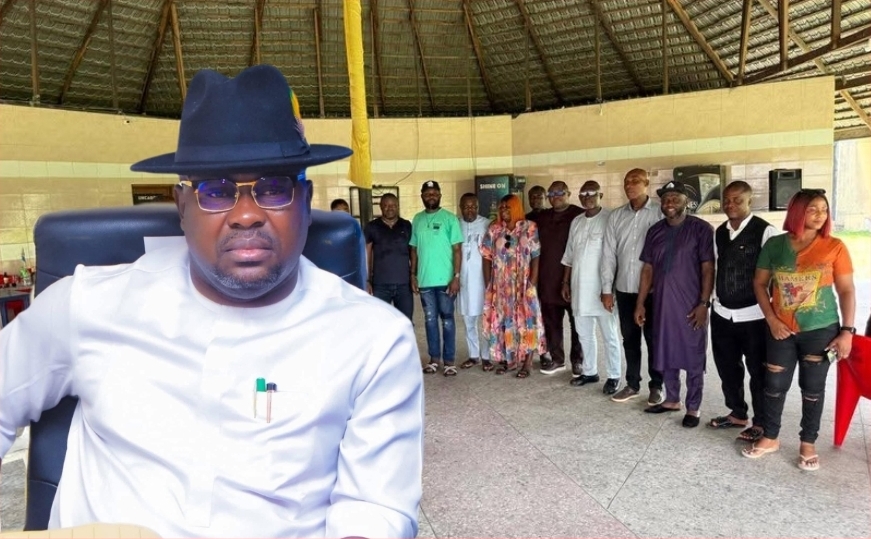
BURUTU — The member representing Burutu State Constituency I in the Delta State House of Assembly, Hon. Alapala Anthony Ebitonmo, has officially announced his intention to seek re-election in the 2027 polls.
Hon. Alapala made the declaration while addressing executives of the All Progressives Congress in Burutu Local Government Area, shortly after the release of the Independent National Electoral Commission timetable and the party’s schedule for the May 16 State Houses of Assembly primaries.
During the meeting, the lawmaker expressed gratitude to party leaders and members for their support during the 2023 general elections, particularly commending members in Burutu LGA for their steadfastness throughout the legal disputes that followed the polls.
He recalled that after his initial victory was overturned by the Court of Appeal, party loyalists remained committed until he eventually emerged victorious in the rerun election.
Speaking on his stewardship, Alapala said his administration had recorded notable progress despite the challenges that marked the early period of his tenure. He noted that the political developments in Delta State, including the alignment of major political blocs and the emergence of Rt. Hon. Sheriff Oborevwori as leader of the APC in the state, had created a more favourable atmosphere for governance.
The legislator stated that several constituency projects are ongoing across the six wards of Burutu North, stressing that grassroots development remains central to his agenda.
On human capital development, he disclosed that more than 50 constituents are currently serving in various appointments under his office, with beneficiaries drawn from all six wards to promote fairness and inclusion.
He further revealed that over 20 students from the constituency have benefited from scholarship opportunities facilitated through his office, while more than 790 students are receiving regular stipends under the Alapala Ebitonmo Students’ Support Scheme.
According to him, the initiative was introduced to reduce financial hardship among students and encourage academic success.
Hon. Alapala also said he had assisted several indigenes of Burutu North in securing empowerment opportunities as well as pensionable employment.
Reaffirming his commitment to public service, the lawmaker assured party stakeholders that if re-elected, he would build on the achievements already recorded and deliver greater democratic dividends to the people.
He also pledged continued loyalty to the APC and its guiding principles.