
IduwiniVoice Social
CHIEF OKRIKA: HONOURING A LEGACY, ADVANCING A STRUGGLE FOR DEVELOPMENT (Excerpt of IduwiniVoice Chat with the INC President, Prof. Okaba)

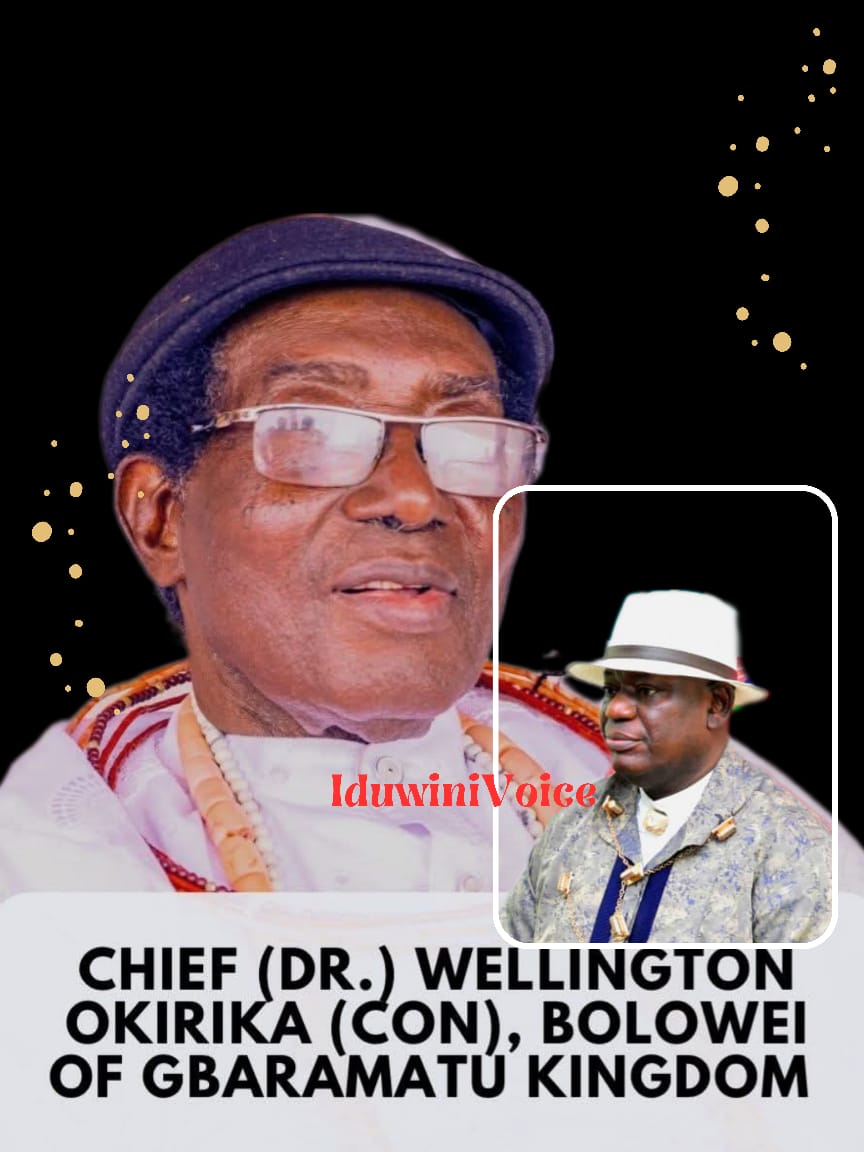
Earlier today, IduwiniVoice News crew ran into the President of the Ijaw National Congress (worldwide), Professor Benjamin Ogele Okaba, in Warri on his way from the grand tripatide event organised in honour of no less a person but the man fondly refered to as “Mr. 13%,” High Chief (Dr.) Wellington Okrika (JP), the Bolouwei of Gbaramatu Kingdom. Such an opportunity couldn’t have been missed for the world, hence our correspondent Favour Bibaikefie had a robust chat with the Ijaw National Leader. See Excerpt below;
Favour:
Good day Prof., we’ve heard a lot from you in recent times, especially on the Rivers state political crisis and the subsisting Emergency Rule. But away from that, we believe you’re in town for the Birthday Ceremony, Book and Foundation Launch of High Chief (Dr.) Wellington Okrika, what can you say about the man, Okrika?
Prof:
First, I must state it clearly that came here today not only as a leader but also as a student of history and the Niger Delta Question – and what a history we gather to honour and celebrate a man whose legacy continues to define and resonate in our collective struggle for justice, equity, and development – High Chief (Dr.) Wellington Okrika (JP.), Alias Mr. 13% Derivation Fund, CON, BOLOWEI OF GBARAMATU KINGDOM. The official unveiling of the Chief Wellington Okrika Foundation and launch of his Biography is not only an occasion for tribute but a solemn re-commitment to the unfinished project of emancipating our people and our land.
Favour: What are the main take aways the world must know about this man, sir?

Prof:
1. A Life Dedicated to Service and Strategy: To appreciate one important perspective to understanding the modern trajectory of the Ijaw and the Niger Delta struggle for Self-determination, is to trace the steps of iconic figures such as Chief Okrika. From the mangrove-lined creeks of the Niger Delta to the hallowed chambers of power in Abuja, where his name and voice echoed – loud and clear, resolute, courageous, and unrelenting. He is not merely a leader, he is a strategist, a negotiator, and most importantly, a bridge-builder – between generations, ethnic divides, and political ideologies. He fought and still fighting, not for applause or reward but for legacy – and today, we bear witness to that legacy.
2. An Excellent Student and Collaborator: One can not speak about Chief Okrika’s journey without paying homage to his profound and forthright relationship with the Late sage of the Niger Delta and Elder-statesman, Chief (Sen.) Dr. Edwin Kiagbodo Clark (1927 – 2025). Chief Okrika was a devoted disciple, trusted confidant, and loyal foot soldier in the lifelong struggle of Chief E.K. Clark to reposition the Ijaw Nation and the Niger Delta and ensure equity in Nigeria’s federal structure. Together, they formed an indomitable intellectual and political alliance – advocating for resource control, environmental justice, and constitutional recognition of oil-producing communities. Whether on the floor of national conferences, behind closed doors with Heads of State, or at the barricades of grassroots, Chief stood shoulder-to-shoulder with Pa. Clark as not twin but a single, strong pillar – wise, unyielding, and committed to the cause of the Niger Delta. Their joint interventions shaped the course of history – from 1.5% to OMPADEC, from 13% to NDDC, (1.5% – 1982, 1% – 1990, 3% – 1992, 13% – 1999), from the Niger Delta Ministry to Amnesty Programme. They were not just products of advocacy; they were nation-building thrusts of “Mr. Resource Control” whose robust relationship with our late father and leader, and other spirited Niger Deltans yielded.
Favour: Please, tell us how he earned the “Mr. 13%” nickname, sir.

Prof:
Permit me to take you back a bit to the very beginning. And I’ll start from his achievements like;
1. Architect of OMPADEC and NDDC Frameworks: Chief Okrika’s pivotal role in advocating the application of the Derivation Principle under Gen. Ibrahim Badamasi Babangida paved the way for the establishment of OMPADEC – the first federal initiative directed at addressing the developmental deficits of oil-producing communities. We are all witnesses to how many of our riverine communities got concrete landing jetties, rural electrification with stand-alone power generating sets, school classroom buildings, etcetera, as he led the first and only board of the OMPADEC. Later, during Nigeria’s Fourth Republic, Chief Okrika was again instrumental in policy dialogue that led to the creation of the Niger Delta Development Commission (NDDC) in 2000 under President Olusegun Obasanjo. Not only was he instrumental in the push for the Commission’s creation, but he also helped define its scope, ensuring it was rooted in grassroots development and community participation. At a time when federal focus wavered, Chief Okrika stood firm. His policy papers, advisory roles, and behind-the-scenes negotiations ensured that the voices from the creeks were heard at the highest levels of power.
2. The 13% Derivation Fund, HOSTCOM Movement, and DESOPADEC One of the most consequential victories of the post-military era was the institutionalization of the 13% Derivation Principle – a landmark provision of the 1999 Constitution. But that victory was not won in silence or comfort. It was fought for by tireless leaders of the Niger Delta – and Chief Wellington Okrika was amongst the men at the heart of that campaign. The Delta State Oil Producing Areas Development Commission (DESOPADEC), Edo State Oil Producing Areas Development Commission (ESOPADEC), etcetera which are products of the 13% Derivation Act – Chief Okrika’s sweat has no doubt added value, no matter how negligible. It is on record that Chief Okrika-led DESOPADEC’s local and international educational sponsorship programmes remain a panacea for educational development in the Niger Delta. His work also birthed and inspired HOSTCOM (Host Communities of Nigeria Producing Oil and Gas) – a revolutionary platform to empower indigenous oil-producing communities and demand direct benefits from oil revenue. Through HOSTCOM, Chief Okrika gave voice to forgotten communities and brought structure to their aspirations. He did not stop there;
3. His Role in the Creation of the Niger Delta Ministry and Presidential Amnesty Progamme: By the late 2000s, the Niger Delta reached a boil-over. Armed agitation escalated, and militarization of our communities became a stock in trade for the powers that be, as the nation’s daily oil output hit rock bottom. The federal government had no choice but to turn to leaders of the region. Chief Okrika was amongst the leaders who worked tirelessly with the former President Umaru Musa Yar’Adua to push for a political solution which eventually birthed the game-changing creation of the Niger Delta Ministry and the proclamation of the Presidential Amnesty Programme that have since realved up Nigeria’s daily oil production gradually to the peek we now find today. The Ministry of Niger Delta Affairs (now Ministry of Regional Development) and the Presidential Amnesty Programme (PAP) are no doubt, moves, that brought hope, employment, and relative peace to the region. Today, thousands of ex-agitators are engineers, entrepreneurs, and scholars across the world because men like Chief Okrika refused to give up on their future.
4. Championing the Nigerian Maritime University, Okerenkoko: Among Chief Wellington Okrika’s most historic contributions is his crucial role in the establishment of the Nigerian Maritime University, Okerenkoko. When skeptics dismissed the dream, Chief Okrika remained unshaken. He recognized the potential of a world-class Maritime institution in the heart of the creeks – one that would tranform the education, employment, and economic landscape of not just Ijaw land but the riverine area, and Nigeria at large.He worked tirelessly with other critical stakeholders to lobby decision-makers and helped navigate bureaucratic landmines until the university received Presidential assent and commenced operations. Today, that institution stands as a beacon of knowledge, innovation, and regional empowerment empowerment – a testament to Okrika’s vision and that of other forward-thinking great Niger Deltans.
Favour: Quite interesting. Prof., what do you think prompted Chief to launch a foundation at this time of his life?

Prof:
Chief Okrika has always been a addent humanitarian, to put it correctly;
1. Human Capital Development: A Life of Giving: Beyond politics and policy, Chief Dr. Wellington Okrika (JP) has invested deeply in human capital development across Ijaw land, the Niger Delta. He has sponsored countless students through university, both locally and abroad. He has facilitated the employment of Niger Deltans in federal institutions and multinational companies. He has supported widows, women cooperatives, youth groups, and local entrepreneurs. He has built civic infrastructure, schools, community halls, and worship centres – in undeserved communities. His philanthropy is quiet but far-reaching. His generosity is enduring. His passion is grounded in the empowerment of people, not in political gain. That brings us to why and what to expect from Mr. 13%.
2. The Foundation: A New Chapter Begins As we launch the Chief Wellington Okrika Foundation, we are not merely celebrating a man, we are launching a platform for generational change. The Foundation will mentor young leaders, support academic research, engage in policy advocacy, and uplift the socio-economic realities of the Niger Delta.Let it be a living legacy – one that continues to speak, build, and inspire long after us.
Favour:
What are your final words to Nigerians especially Niger Deltans, Prof?

Prof:
We Must Carry the Torch: To the Ijaws and Niger Deltans, the message is simple: The baton is in our hands now. Chief Wellington Okrika has paid his dues. The time for us all to build upon his legacy is now that he is still alive and healthy to experience it.
Permit me, esteemed ladies and gentlemen, to leverage on the opportunity provided by this rare occasion to emphasize that the ljaw Nation has over the years articulated and advertised a number of precinct conditions to remain committed to the Nigerian Project. These irreducible minimum conditions include, the ownership, control, and management of our God-given resources. We consider this as a fundamental human right that is firmly backed by historical antecedents and the principles of True Federalism. 13% derivation translates to 87% deprivation and, therefore, unreasonable, unjustifiable, and unacceptable. The 3% allocated as host communities’ funds remain grossly inadequate. An upward review of these provocative palliatives to a minimum of 50% is very imperative. Let us all unite across various ethnic and language divides to speak boldly and also use whatever financial, political, and intellectual advantage we have to defend our rights and attract rapid development to the Niger Delta, particularly the riverine Ijaw areas. Let us rise as proud associates of Chief Okrika’s vision and Chief E.K. Clark’s courage. On behalf of the Ijaw National Congress, I salute this great man. I honour this noble foundation. And I pledge our continued support in the cause of justice, dignity, and sustainable development. We are not backing down from where the Late Pa. Clarks and the Chief Okrikas of this world have taken this struggle to, but shall do all that is necessary to make tangible progress.
Thank you.
IduwiniVoice Social
INC Election: Delegate Gbegha Commends Electronic Voting Process, Urges INEC to Adopt Model
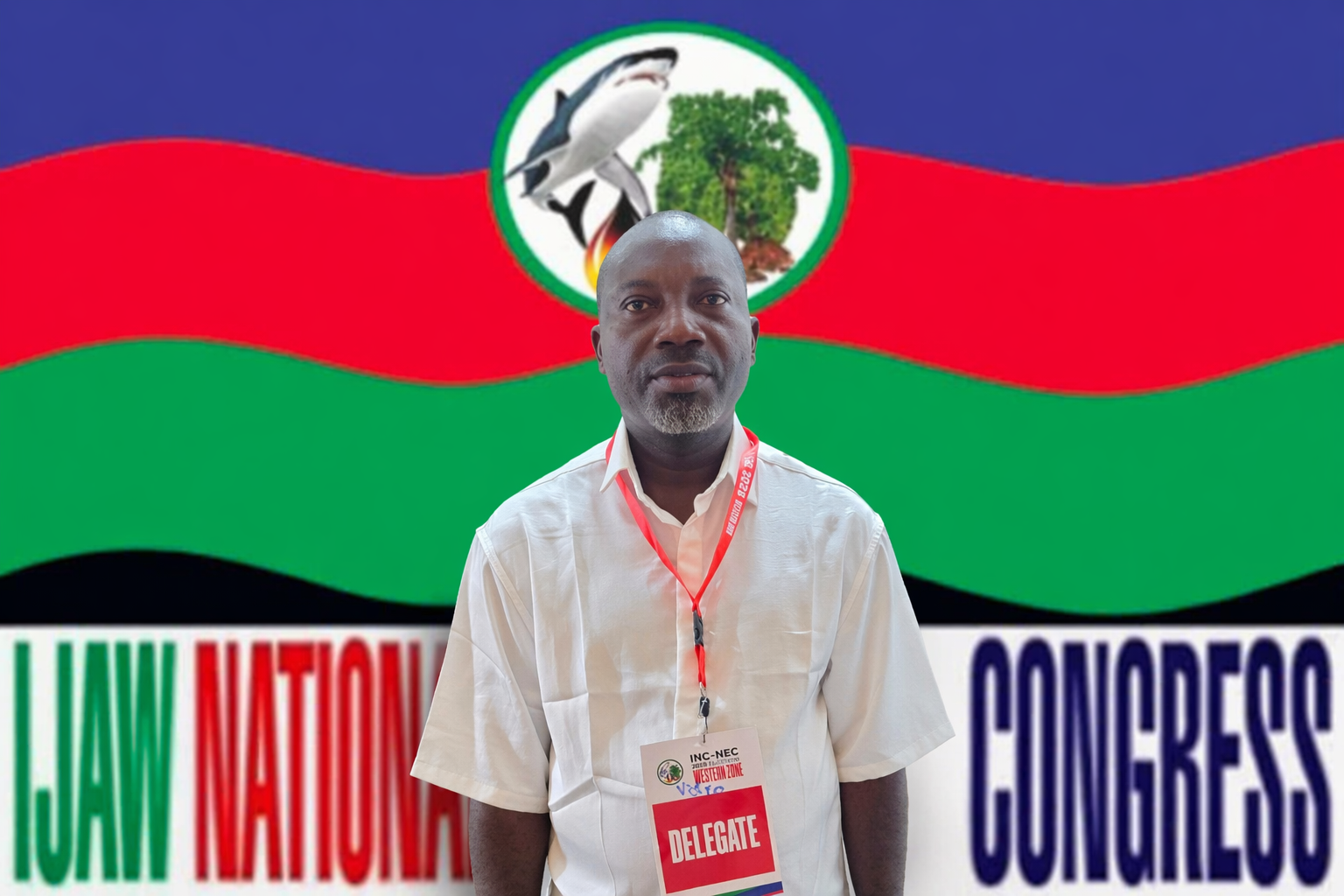
INC Election: Delegate Gbegha Commends Electronic Voting Process, Urges INEC to Adopt Model
By Favour Bibaikefie
WARRI — A voting delegate and former Chairman of Odimodi Community, Comrade Solomon Gbegha, has commended the National Electoral Committee of the Ijaw National Congress (INC) and the Prof. Benjamin Okaba-led executive for the successful conduct of the Congress’ national elections, describing the process as orderly, transparent, and technologically driven.
Gbegha, who participated in the exercise, praised the deployment of electronic voting, noting that it ensured credibility and efficiency throughout the election. He described the process as seamless and largely free of irregularities, stressing that it reflects the capacity of indigenous institutions to deliver credible electoral outcomes when properly managed.
According to him, the election demonstrated a high level of coordination and innovation, with real-time transmission of results enhancing transparency and trust among participants.
He further urged Nigeria’s electoral body, the Independent National Electoral Commission (INEC), to draw lessons from the INC model, particularly in the use of technology to strengthen the integrity of elections.
Gbegha maintained that adopting electronic voting and real-time result transmission could significantly improve the credibility of elections in the country, ensuring that every vote cast is accurately recorded and reflected in the final outcome.
The INC election, held on April 13, 2026, followed an earlier postponement from March 7, 2026, due to disputes among some candidates, which led to legal actions that temporarily halted the process.
Despite the initial setbacks, the Congress successfully conducted the rescheduled election during its 2026 National Elective Convention, with Hon. Chief (Barr.) McDonald Igbadiwei emerging victorious.
Observers have since described the exercise as a major milestone for the INC, highlighting its potential as a model for electoral reforms within and beyond the Niger Delta region.
IduwiniVoice Social
WHEN PAIN COMES FULL CIRCLE: A CAUTIONARY TALE ON MARRIAGE, SURVIVAL, AND MORAL COMPLEXITY
IduwiniVoice Social
In today’s increasingly complex social and economic climate, stories of broken homes and shifting moral boundaries are no longer rare—they are becoming reflections of a broader societal struggle.
A growing pattern has emerged among separated couples, particularly where infidelity played a role in the dissolution of marriage. In one such illustrative scenario, a woman, deeply hurt by her husband’s repeated acts of cheating, chose to leave her marriage with her children in pursuit of dignity, independence, and emotional peace.
Initially, her decision appeared justified. Like many single parents, she embraced the burden of providing for her children alone, working tirelessly to meet rising economic demands. However, despite her efforts, financial pressure mounted. School fees, daily expenses, and the weight of single parenthood began to take their toll.
In search of stability, she entered into a relationship with a wealthy married man—prioritizing survival over sentiment. What began as a means to an end soon placed her in a position she once despised: that of a “side partner” in another woman’s marriage.
Over time, a psychological shift occurred. The same behavior that once caused her deep pain began to appear more complex, even understandable. She found herself reflecting on her former husband’s actions, questioning whether the women involved in his infidelity might have been driven by circumstances similar to hers—economic hardship, responsibility, and survival.
Yet, this rationalization did not eliminate the emotional toll. The reality of her situation became clearer when the married man she depended on began to distance himself within the boundaries of his own home, prioritizing his wife and demanding discretion. The imbalance of power and emotional neglect resurfaced—this time from a different angle.
In a twist of fate, she reconnected with her former husband, who had since remarried. Occasional visits, financial support, and moments of nostalgia blurred boundaries, leading to renewed intimacy. The situation grew more complicated as she found herself entangled with two married men—one who had once betrayed her, and another who continued to do so with her involvement.
This narrative highlights a painful irony: a decision made in pursuit of dignity and justice can, under pressure, lead to circumstances that mirror the very pain one sought to escape.
Social analysts note that such situations are not isolated incidents but are indicative of broader systemic issues—economic instability, societal pressure, and the evolving definitions of morality and survival.
While the emotional impulse to leave a painful relationship is understandable, experts emphasize the importance of careful consideration, support systems, and long-term planning before making life-altering decisions. The consequences of such decisions often extend beyond immediate relief, shaping future realities in unexpected ways.
Ultimately, this story serves as a sobering reminder that life’s complexities rarely offer clear-cut answers. Choices made in moments of pain can echo far into the future, sometimes bringing individuals face-to-face with the very realities they once rejected.
As the saying goes, “it rains everywhere.” Challenges are universal, and no situation is entirely free from hardship. Yet, within these storms lies an opportunity for reflection, growth, and wiser decision-making.
Indeed, love remains a beautiful ideal—but navigating it requires not only emotion, but clarity, resilience, and foresight.

By Favour Bibaikefie
The Burutu Local Government Council in Delta State has announced the passing of Mrs. Alice Ayiba-Etare Takeme, mother of the Executive Chairman of the council, Hon. Chief Julius Takeme, PhD, JP.
The council disclosed the development in an official press statement issued on Wednesday and signed by the Secretary of Burutu Local Government Council, Barr. Roland Ombe., expressing deep grief over the loss.
In the announcement titled “BURUTU LOCAL GOVERNMENT COUNCIL – OFFICIAL ANNOUNCEMENT,” the council stated:
“The Burutu Local Government Council hereby announces, with deep sorrow and a profound sense of loss, the passing of Mrs. Alice Ayiba-Etare Takeme, beloved mother of the Executive Chairman of Burutu Local Government, Hon. Chief Julius Takeme, PhD, JP.”
According to the statement, Mama Takeme passed away on Tuesday, March 3, 2026, after a brief illness.
The council described the deceased as a woman of admirable virtues whose life reflected dedication to family and community.
“Mama Takeme died on Tuesday, March 3, 2026, after a brief illness. Until her death, She was a devoted mother and grandmother, whose life was marked by humility, strength and character.”
The statement further noted that her passing represents a significant loss not only to her immediate family but also to the wider Burutu community where she was highly respected.
“Her passing is not only a painful loss to the family of the Takemes but also to the entire Burutu Local Government Area where she was widely respected and admired.”
On behalf of the people and leadership of the council, the Burutu Local Government extended condolences to the chairman and the entire Takeme family.
“On behalf of the Government and people of Burutu Local Government Area, the Leadership and entire Council extend heartfelt condolences to the Executive Chairman, Hon. Chief Julius Takeme, Ph.D., JP, the Takeme family, and all the bereaved. We pray that the Almighty God grants the family the fortitude to bear this irreparable loss and also grants the departed eternal rest.”
The council added that details of the burial arrangements would be made public at a later date.
“Further details regarding the funeral arrangements will be communicated in due course.” the statement concluded.