
Breaking
Warri Ijaw Leaders Defend INEC Ward Delineation, Commend INEC for a Thorough Job.

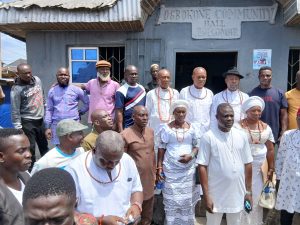
Says Ogbe-Ijoh-Warri deserved more than three wards in Warri-South Local Government Area.
By Favour Bibaikefie
Leaders of the Ogbe-Ijoh (Ijaw) community have addressed recent protests by Itsekiri groups over the Independent National Electoral Commission’s (INEC) fresh delineation of electoral wards in Warri South Local Government Area. In a press briefing held on April 11, 2025, Ogbe-Ijoh representatives reaffirmed their historical and legal presence in Warri South, citing court rulings and decades-old electoral structures. They condemned claims excluding them from the area and urged INEC to ignore such objections. Calling for at least five homogenous wards, they emphasized the need for fair representation and the creation of a dedicated Ijaw state constituency.
Read full Press Statement:
“PRESS BRIEFING BY THE OGBE-IJOH PEOPLE ON THE PROPOSED FRESH DELINEATION OF ELECTORAL WARDS/POLLING UNITS IN WARRI SOUTH LOCAL GOVERNMENT AREA OF DELTA STATE BY THE INDEPENDENT NATIONAL ELECTORAL COMMISSION (INEC) IN COMPLIANCE WITH THE SUPREME COURT JUDGMENT ON FRESH DELINEATION AND MATTERS THERETO
“Since the Independent National Electoral Commission (INEC) on the 4th of April, 2025 released the report of its Fieldwork on the proposed delineation of electoral wards and polling units in the Warri Federal Constituency of Delta State, the Ogbe-Ijoh (Ijaw) people have noticed with keen interest series of protests by the Itseikiri and their allies in both print and electronic media including arguing that, the Ogbe-Ijoh (Ijaw) people are not part of Warri South Local Government. This press briefing is to clear this ignorance and set the records straight.
It is important to note with specific reference to the Supreme Court ordered delineation that, the issue of whether the Ogbe-Ijoh (Ijaw) people are part of Warri South Local Government Area or not was raised at the INEC stakeholders meeting by the Itsekiris, reflected in the minutes of stakeholders meetings and it was dealt with by the stakeholders in the said meetings by resolving that from available intelligence reports, legal documents, physical communities on ground and existing electoral polling units, the Ogbe-Ijoh (Ijaw) people are integral part of Warri South Local Government, but denied electoral representation by not having homogenous electoral wards of their own, but balkanised into different polling units in different wards in Warri South LGA. The Itsekiris too admitted this fact.
It was on this basis that, at the stakeholders meeting of Ijaw, Itsekiri and Urhobo held on 8th of July, 2024 at Government House Annex, Warri preparatory to starting the Fieldwork in Warri South LGA, a team of INEC Field Officers were assigned to the Ijaw areas in Warri South LGA, just as INEC Field Officers were assigned to the Itsekiri and Urhobo areas. Furthermore, the INEC field officers assigned to the Ijaw areas were the only ones who covered the Ijaw areas covered by the proposed Ewein, Bulouama, Ogbe-Ijoh Warri Urban and part of GRA wards of Warri South LGA. The INEC field officers assigned to Itsekiri and Urhobo areas did not and could not have covered these areas because they are indigenous Ijaw communities, where the Ijaws resides to the knowledge of all persons and authorities. These facts are known to the Itsekiri leaders and especially those who participated in the INEC fieldwork, but are not telling the public.
“For historical purposes and to educate younger Itsekiri people who do not know the founding history of Warri, Ogbe-Ijoh is recorded as the first settlement in the present Warri Urban along the Ogbe-Ijoh-Warri River (otherwise known as the Warri anchorage) in Warri South Local Government Area of Delta State. Indeed, the present Warri started from Ogbe-Ijoh. In 1955, when the first local administrative structure was established and electoral delineation done in Warri Urban, the Ogbe-Ijoh (Ijaw) people were included in the Warri Urban District Council together with a section of Urhobo and Itsekiri as defined by Western Region Laws of Nigeria No 177 of 1955. The said law created four autonomous electoral wards for the Ijaw people of Ogbe-Ijoh, which were– Alders town B3, Ogbe-Ijoh Ward C1, Ogbe-Ijoh Ward C2 and Government Area F1. This structure with elected Ogbe-Ijoh Councillors remained operational till sometime in 1976, when the Olusegun Obasanjo’s Military Government introduced local Government reforms giving birth to the present local Government structure. The defunct Warri Urban District Council is today known as the Warri South Local Government Council.
“It is important to note that, before the introduction of Local Government administration, there were Seven (7) District Councils in the Warri area, including the Warri Urban District Council, which was only the Warri main City. But the Ode-Itsekiri District Council which was not part of the Warri Urban District Council was included to make up the present Warri South LGA.
“The introduction of Local Government Administration and the subsequent delineation of electoral wards in the area concerned led to the balkanization of the hitherto homogenous Ijaw fours in Warri South LGA into mere polling units in different wards mainly as minorities. The electoral wards that, the Ogbe-Ijoh people were balkanized into before the Supreme Court Ordered delineation of electoral wards were Pessu, GRA, Bowen and Okere wards. The Ogbe-Ijoh areas were balkanized into these electoral wards and thereby making them minorities and politically weak. Since the 1976 balkanization of our homogenous four electoral wards, we have always protested and made known to successive electoral bodies of the need to balance the lopsided electoral wards in Warri South Local Government without much success before a group of patriotic Ijaw men sought legal redress leading to the celebrated Supreme Court judgement in December 2nd, 2022.
“It is these Ijaw areas previously delineated in 1955 as Alder’s town B2, Ogbe-Ijoh C1, Ogbe-Ijoh C2 and Government area F1, that the INEC Field Officers assigned to the Ijaw areas visited and delineated as Bulou-Ama Ward 02, Ewein Ward 07 and Ogbe-Ijoh Warri Urban Ward 12 and the part of Ogbe-Ijoh areas in the GRA Ward 08. Hence, the delineation of electoral wards and polling units to cover the Ijaw areas in Warri Urban is not a new development, but has been in existence for decades even before those protesting were born. The recent exercise only seeks to correct an obvious injustice where the Ijaws in Warri South LGA are delineated into different polling units and denied representation in the Warri South LGA administration.
“We wish to state further that, contrary to the false impression been created by the Itsekiris, the Ijaw areas have always been separated from the Itsekiri areas in Warri Urban. It is for this reason that, the Chiefs Law of 1957, CAP 19, provides that, the authority of the Itsekiri monarch, the Olu of Warri excludes Ogbe-Ijoh Areas. The 1979 Bendel State Traditional Rulers and Chiefs Edict, B.S.L.N 44, described the Amaokosu of Ogbe-Ijoh as the prescribed authority of Ogbe-Ijoh lands and people in Warri metropolis. This meant that, all the lands of the Ijaw of Ogbe-Ijoh are excluded from claims by the Itsekiri people.
“Furthermore, the Delta State Traditional Rulers, Chiefs and Council Law, Vol. 3, now cap T3 Laws of Delta State, 2006 recognizes four Clans in Warri Metropolis: Itsekiri Kingdom, where the Olu is the prescribed authority, Okere-Urhobo Kingdom where the Orosuen of Okere-Urhobo is the prescribed authority, Agbassa Kingdom where the Ovie of Agbarha is the prescribed authority and the Ogbe-Ijoh Kingdom where the Amaokosu of Ogbe-Ijoh is the prescribed authority of Ogbe-Ijoh Kingdom in Warri metropolis.
The purpose of the above laws is to the effect that, the Ogbe-Ijoh Kingdom and their lands in Warri metropolis in Warri South Local Government Area are excluded from the claim of the Itsekiri people. This position has been confirmed by the Court of Appeal in Appeal No CA/AS/441/2016 in a judgement delivered on the 5th of June, 2023.
“In conclusion, we commend the Independent National Electoral Commission (INEC) for being able to commence the delineation process despite series of litigation against the Commission by the Itseikiri. We also commend the Commission in Warri South Local Government for being fair to all the ethnic nationalities and stakeholders. However, the Ogbe-Ijoh people state that, their areas should have been delineated into atleast five homogenous electoral wards. If the Ogbe-Ijoh people had four electoral wards as far back as 1955, it is only fair for the number to be increased decades after. We therefore call for the creation of more electoral wards for Ijaws in Warri Urban and also urge the Independent National Electoral Commission to disregard frivolous protests against the delineation exercise in Warri South LGA by the Itsekiris.
“We wish to call on the INEC for creation of additional wards and state Constituency for the Ijaws of Warri South. This is predicated on the ground that the Itsekiris and Urhobos already have their own Constituencies in the Warri South.”
Sign for Ogbe-Ijoh Kingdom:
Hon. Denbo-Denbofa Oweikpodor,
(Ijaw Focal Person)
Chief M. Keme,
Comrade Moses Fiyebor.






Breaking
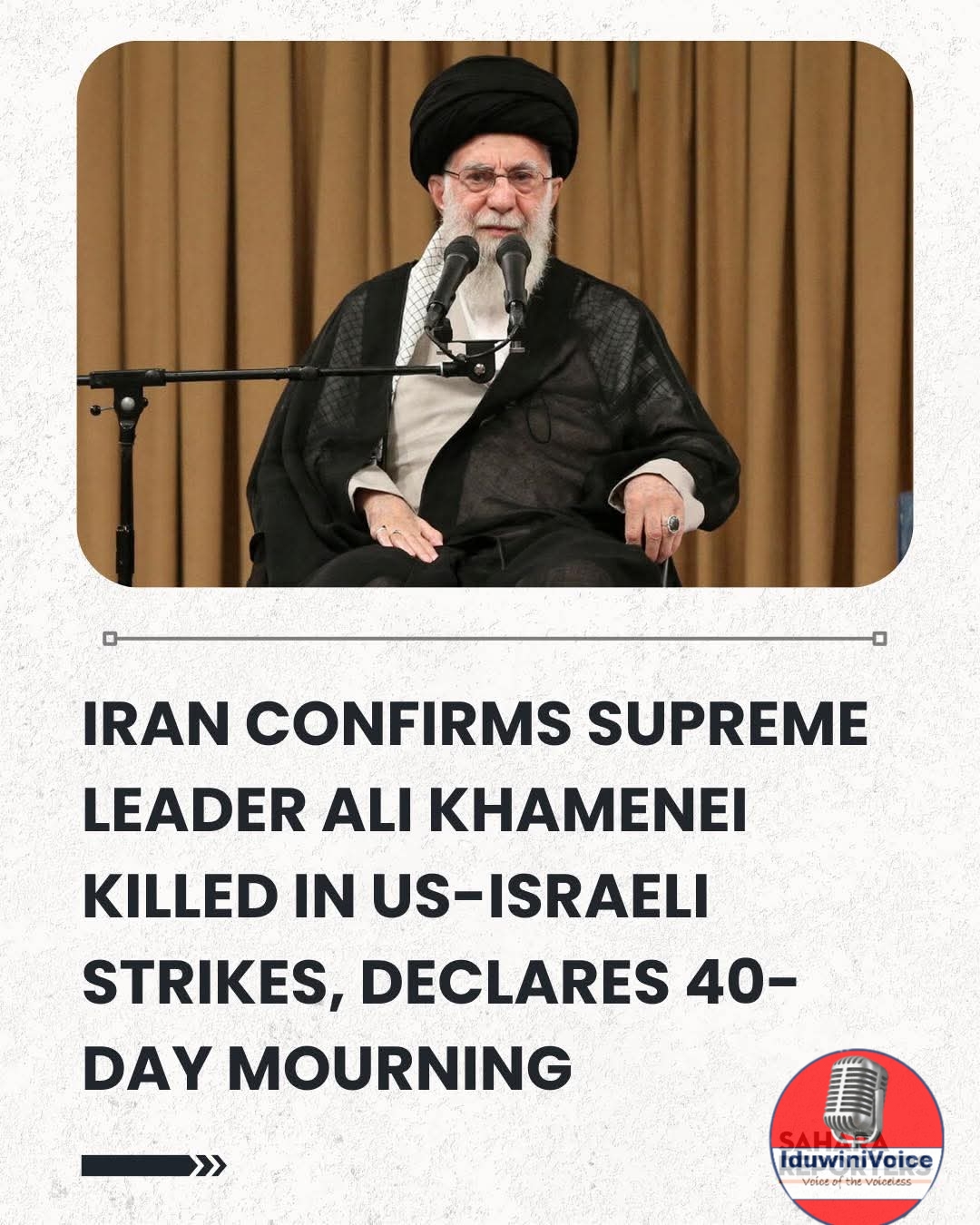
International: Iran Confirms Death of Supreme Leader Ayatollah Ali Khamenei After US-Israeli Strikes — 40-Day National Mourning Declared
By Favour Bibaikefie, International Affairs Correspondent
Tehran — In an unprecedented escalation of Middle East tensions, Iran’s state media has confirmed that Supreme Leader Ali Khamenei has been killed following coordinated military strikes by the United States and Israel, the government announced late Saturday.
In a statement broadcast on state television, Iranian authorities declared a 40-day period of mourning and seven days of public holiday across the Islamic Republic in memory of the 86-year-old cleric, who had led Iran since 1989.
The announcement confirmed reports from earlier in the day by U.S. and Israeli officials that Khamenei had been killed during a major offensive dubbed “Operation Epic Fury” — a series of air and missile strikes targeting regime leadership and strategic sites across Iran.
President Donald Trump, in a social media post, hailed Khamenei’s death as a significant blow to the Iranian regime, describing him as one of “the most evil people in history.” Israeli Prime Minister Benjamin Netanyahu also said there were strong indications that the cleric was “no longer alive” after his compound in Tehran was hit during the attack.
Iranian state media further reported that several members of Khamenei’s immediate family, including a daughter, son-in-law and a grandchild, were killed in the same strike. Tehran’s Supreme National Security Council labelled the attack an “act of aggression” and vowed to hold the United States and Israel accountable.
The death of Iran’s supreme leader — who wielded ultimate authority over the country’s military, judiciary and all branches of government — has triggered widespread uncertainty about the future leadership of the Islamic Republic and heightened fears of broader regional conflict.
The strikes have already prompted retaliatory actions from Iranian forces, with explosions reported across several Middle East countries. International capitals are watching developments closely as responses from neighbouring states and global powers continue to unfold.
By Favour Bibaikefie
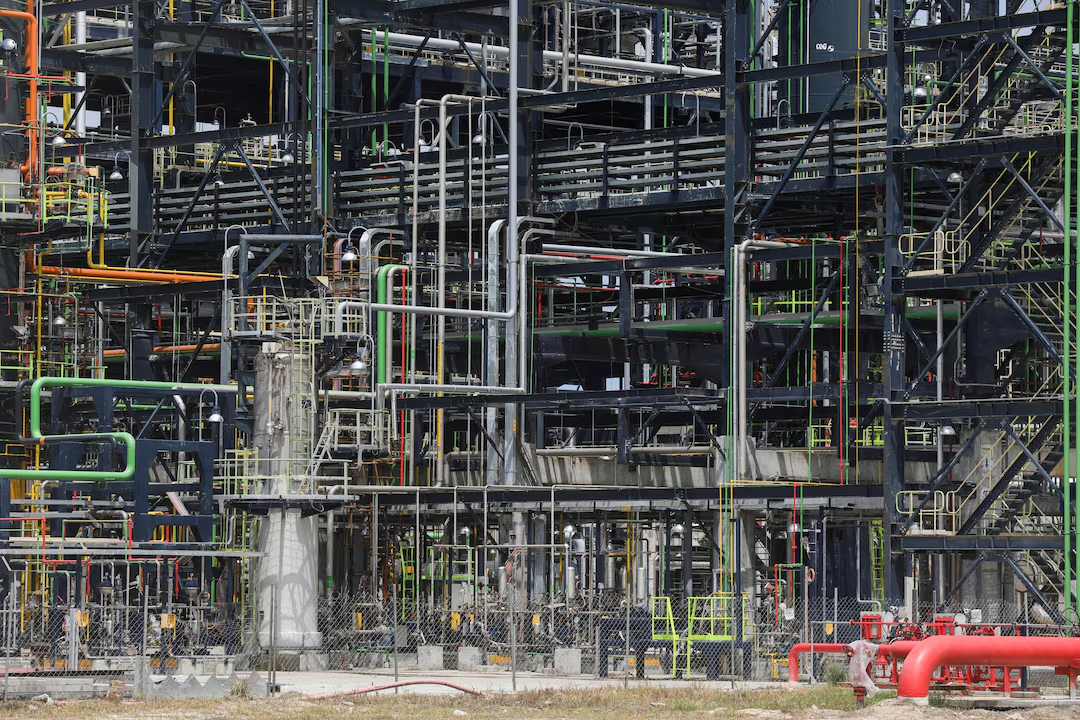
LAGOS — Nigeria’s Dangote Group has signed a $400 million equipment agreement with China’s Xuzhou Construction Machinery Group (XCMG) to accelerate the expansion of its oil refinery, reinforcing efforts to boost domestic refining capacity and industrial development.
The company disclosed on Tuesday that the newly acquired equipment will support ongoing projects across its refining, petrochemical, agricultural, and infrastructure operations. The strategic investment is part of Dangote Group’s broader plan to scale up the refinery’s output toward a projected capacity of 1.4 million barrels per day.
Industry analysts say the expansion represents a significant milestone in Nigeria’s drive to reduce dependence on imported petroleum products while strengthening local production and economic growth.
The Dangote Refinery, regarded as one of Africa’s largest industrial projects, is expected to enhance fuel availability, stimulate job creation, and position Nigeria as a key exporter of refined petroleum products in the global energy market.
Breaking
Agbor Makes List as PDP Appoints Caretaker Committees for Osun, Enugu, Imo, Rivers and Delta States

By: Divine Perezide
The National Working Committee (NWC) of the Peoples Democratic Party (PDP) has approved new caretaker committees to oversee the affairs of the party in five states, pending the inauguration of fresh executive structures.
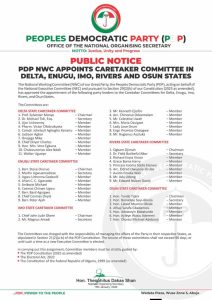
In a public notice dated January 15, 2026, and signed by the National Organising Secretary, Hon. Theophilus Dakas Shan, the NWC said the decision was taken on behalf of the National Executive Committee (NEC) and in line with constitutional provisions. According to the statement, the appointments were made “pursuant to Section 29(2)(b) of our Constitution (2025 as amended).”
State Committees Announced
For Delta State, the committee is headed by Prof. Sylvester Monye as Chairman, with Dr. Michael Tidi, Esq. serving as Secretary. They will be supported by 16 other members including Ujor Ucheonny, Pharm. Victor Ofobrukuta, Comdr. Johnbull Aghogho Kenairu, Chief Ekiyor Charles, and Hon. Mrs. Vero Egbuna, among others.
In Enugu State, Barr. Steve Oruruo was appointed Chairman, while Martin Ugwuamaideze was named Secretary. The committee includes seven additional members such as Ugwu Uchenna Godswill, Lilian C.E. Ugwuoke, and Chief Cosmas Onyia.
The Imo State Caretaker Committee is comparatively lean, with Chief John Jude Okere as Chairman and Mr. Magnus Amadi as Secretary.
For Rivers State, Ogbam Ojimah was named Chairman, with Dr. Field Baribeful Nkor appointed as Secretary. Other members include Richard Enyia Victor, Grace Boma Harry, Princess Isoma Stella Elenwa, and Austin Emeka Wali.
In Osun State, Hon. Tunde Tijani leads the committee, with Hon. Bamidele Seyi-Abiola serving as Secretary. Five additional members were listed, including Hon. Lateef Mumini Obidel and Alhaji Sarafa Gbadeamosi.
Mandate and Tenure
The PDP clarified that the committees are mandated to “manage the affairs of the Party in their respective States, as stipulated in Section 21(2)(a-b) of the PDP Constitution.” The party further noted that the duration of the committees “shall not exceed 90 days, or until such a time as a new Executive Committee is elected.”
Members were also advised to conduct their activities in compliance with the PDP Constitution (2025 as amended), the Electoral Act 2022, and the Nigerian Constitution (1999 as amended).
Meanwhile, the notice closed with the party’s slogan, “PDP, Power to the People,” indicating continuity of its internal restructuring ahead of future political engagements.