
News
PAP Distributes Laptops to Students as Otuaro Reaffirms Commitment to Education-Driven Empowerment in Niger Delta


By: Divine Perezide
The Education for Empowerment (E4E) campaign of the Presidential Amnesty Programme (PAP), under the leadership of its Administrator, Chief Dr. Dennis Brutu Otuaro, has continued its support for students with the distribution of laptops to beneficiaries of the PAP Scholarship Scheme at the Nigerian Maritime University, Okerenkoko.
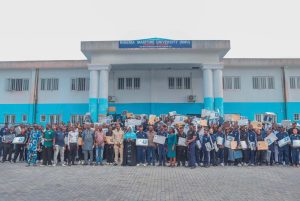
The laptop distribution exercise was carried out on January 30, 2026, at the institution’s Okerenkoko campus, as part of the E4E Mandate Campaign aimed at strengthening academic performance and boosting digital learning among students in the Niger Delta region.

Speaking during the visit, the PAP delegation led by Engr. Victor Ebikonde Sokoto explained that the initiative is in line with the agency’s core responsibility of empowering young people through education, adding that access to learning tools remains critical to improving productivity and academic excellence. The team also reaffirmed that the current administration under Dr. Otuaro remains firmly committed to positively impacting the lives of youths across the region.

The delegation further disclosed that more tertiary institutions would be visited in the coming days, as the E4E Mandate Campaign continues to promote education and skills development as key drivers of growth and prosperity. According to the team, the programme has continued to enjoy the support of stakeholders who have commended Dr. Otuaro’s dedication to youth empowerment.

Meanwhile, students of the Nigerian Maritime University, Okerenkoko, who benefited from the exercise, expressed appreciation to the PAP leadership, describing the intervention as timely and impactful. They praised Dr. Otuaro for prioritising education as a tool for development and empowerment, and assured that the laptops provided would be put to effective academic use.











News
CBN WINS GLOBAL CENTRAL BANK OF THE YEAR 2026 AWARD;BOLD REFORMS AND POLICY RESET RESTORE GLOBAL INVESTOR TRUST
By Favour Bibaikefie
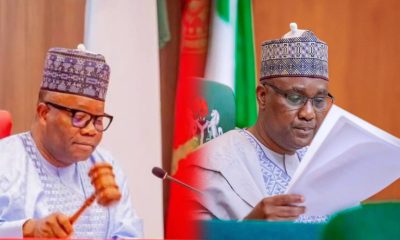
The Central Bank of Nigeria has achieved a historic milestone on the global stage, being named the “Central Bank of the Year 2026” by the prestigious Central Banking Awards Committee in London.
The award, announced during the 13th annual Central Banking Awards, recognizes the apex bank’s “remarkable turnaround” of the Nigerian economy. According to the committee, the honour is a testament to the bold and often difficult reforms implemented under the leadership of Governor Olayemi Cardoso. The publication noted that the CBN successfully pulled the nation’s economy back from the brink of a major crisis through a disciplined return to orthodox monetary policy and institutional transparency.
The committee specifically highlighted the CBN’s success in tackling the “crippling” foreign exchange challenges inherited in late 2023.
A major pillar of the award was the total overhaul of the FX market, which saw the bank transition to a “willing-buyer, willing-seller” model and clear a $7 billion backlog of unpaid obligations. These moves have dramatically stabilized the Naira, with the gap between official and parallel market rates shrinking to less than 2%, down from over 60% two years ago. Furthermore, the bank’s aggressive stance on inflation saw headline figures drop from a peak of 34.8% in late 2024 to 15.1% by early 2026.
Beyond monetary policy, the award also recognizes significant improvements in governance and international compliance.
The CBN’s efforts were instrumental in Nigeria’s removal from the Financial Action Task Force (FATF) grey list in 2025, a move that has significantly lowered the cost of international transactions for Nigerian banks. In a statement following the announcement, Governor Cardoso dedicated the award to the “resilience of the Nigerian people,” reaffirming the bank’s commitment to achieving a 1-trillion-dollar economy through price stability and a robust financial system.
By Ezinne
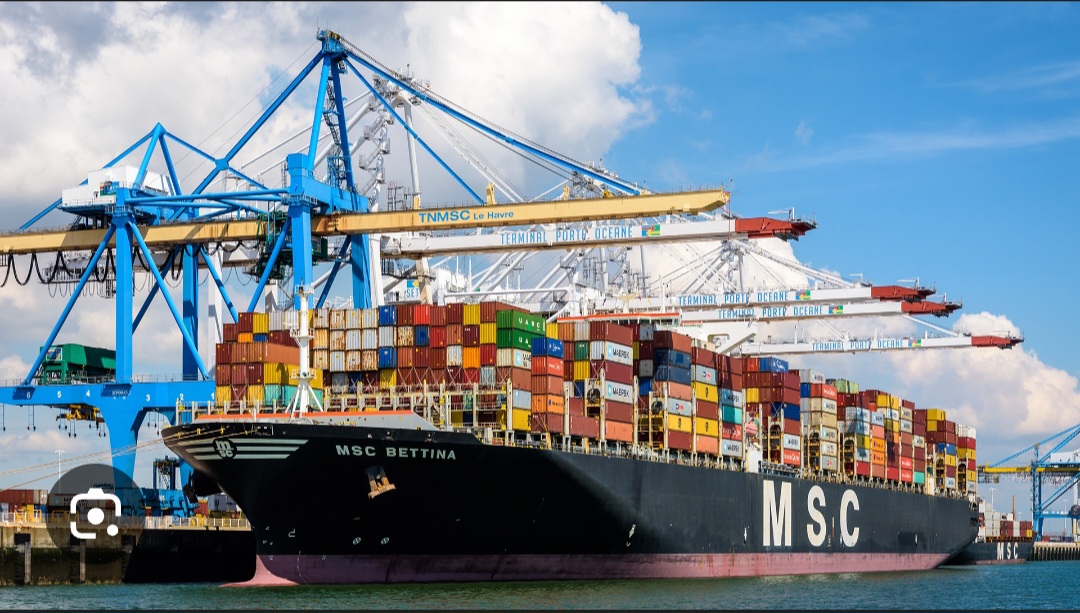
Operations at the Lagos ports were disrupted on Friday as tensions escalated between freight forwarders and the Mediterranean Shipping Company (MSC) over a controversial increase in local shipping charges.
Hundreds of clearing agents and freight forwarders staged a massive protest at the company’s Lagos office, demanding an immediate reversal of what they described as “arbitrary and astronomical” tariff hikes. The protesters decried the rising cost of clearing goods, warning that the new charges would further strain businesses and worsen inflationary pressures across the country.
The protest, spearheaded by five major freight forwarding associations, accused MSC of implementing unilateral price adjustments without obtaining the required regulatory approval from the the Nigerian Shippers’ Council.
In swift response, the Executive Secretary of the Council, Barrister Akutah Pius Ukeyima, intervened, calling for calm and urging all parties to embrace dialogue.
While acknowledging the concerns raised by the freight forwarders, Ukeyima warned that the disruption of port operations could have far-reaching consequences, including port congestion, delays in cargo clearance, and potential international trade penalties.
“The shutting down of shipping operations is a drastic measure that could negatively impact the entire maritime supply chain,” he stated.
The Council has consequently summoned both MSC management and representatives of the protesting associations to an emergency Conflict Resolution Meeting scheduled for early next week, aimed at resolving the impasse through established regulatory frameworks.
Freight forwarders insist that the new tariff structure—affecting container handling and administrative fees—will significantly increase the cost of doing business at Nigerian ports. They have vowed to sustain the protest until MSC suspends the charges and agrees to a transparent review process.
Industry stakeholders have expressed concern over the timing of the dispute, noting that global shipping costs are already under pressure due to geopolitical tensions in the Middle East. Experts warn that prolonged local conflicts within the maritime sector could deter foreign investment and further destabilize Nigeria’s trade environment.
Reaffirming its statutory mandate, the Nigerian Shippers’ Council emphasized that no shipping line is permitted to increase charges without adhering to the Notification and Negotiation Protocol, assuring stakeholders of a “fair and firm” resolution process.
By Ezinne
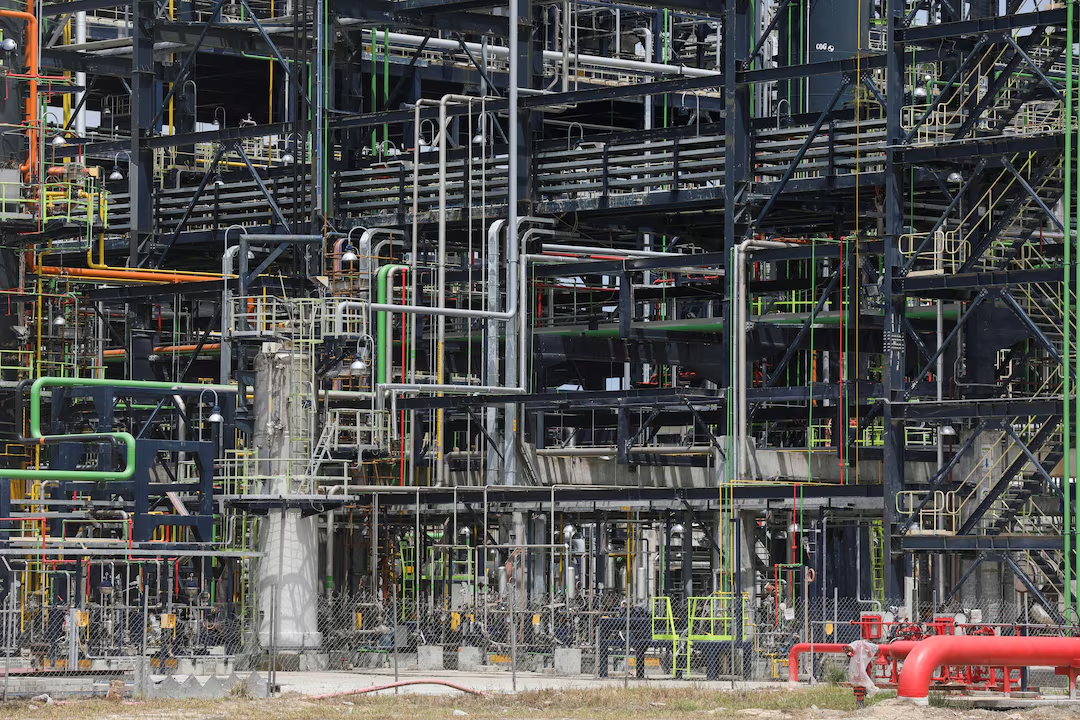
The ripple effects of the escalating conflict in the Middle East have begun to impact Nigeria’s downstream petroleum sector, as the Dangote Petroleum Refinery announced a fresh increase in the price of Premium Motor Spirit (PMS), commonly known as petrol.
As of Saturday, March 21, the 650,000-barrel-per-day facility raised its ex-gantry price to ₦1,245 per litre, up from the previous ₦1,175, representing an increase of nearly six percent.
Management of the refinery attributed the adjustment to the “unprecedented surge” in global crude oil prices, largely driven by ongoing geopolitical tensions in the Middle East involving . Industry data indicates that has consistently traded above $114 per barrel, significantly raising the cost of sourcing crude feedstock.
In a statement, refinery officials noted that while the facility remains committed to serving as a “local shield” for African energy security, it cannot remain insulated from global market realities, particularly the rising war-risk premiums affecting international oil supply chains.
Analysts warn that the development is likely to trigger a fresh round of fuel price increases across Nigeria, as marketers adjust pump prices to reflect transportation, distribution, and logistics costs. Projections suggest that petrol prices in several states could soon exceed ₦1,350 per litre.
Despite the increase, the Dangote Refinery continues to be regarded as the most dependable source of refined petroleum products in the region, especially as traditional import routes through the Red Sea remain disrupted by ongoing hostilities.
The latest price adjustment underscores Nigeria’s continued vulnerability to global oil market fluctuations, even as efforts to boost local refining capacity gain momentum.