
News
Delta @ 34: “Prioritize Riverine Development, Avoid Extravagant Festivities – Mulade to Gov. Oborevwori


* Uges Oborevwori to emulate former Gov James Onanefe Ibori.
By: Favour Bibaikefie
As Delta state prepares to celebrate its 34th anniversary, renowned peace builder and environmental rights activist, Chief, Comrade, (Dr.) Sheriff Mulade (PhD.), has urged the administration of Governor Sheriff Oborevwori to place greater emphasis on addressing the infrastructural gaps in the state’s riverine communities. He lamented that despite the enormous revenues generated from the petroleum industry and the blue economy, these areas remain “deprived and neglected.”
Mulade made the call while offering his congratulations to Governor Oborevwori and Deltans ahead of the remarkable occasion of the State’s 34th anniversary on August 27, 2025.
In the congratulatory message, Mulade felicitates with governor Oborevwori on the giant strides his administration is making in the State and also applauded Deltans for the relative peace, unity as well as the progress that has been achieved since its creation in 1991.
He said, “Permit me to specially felicitate with Your Excellency, Rt. Hon. Sheriff Oborevwori, the Executive Governor of Delta State on this momentous occasion of Delta State at 34, and the giant strides of your governance of our dear Delta State.
“It is exactly 34 years today that Delta State was created, and I celebrate not just our 34th Anniversary and togetherness as a people, but the relative peace, unity and progress we have witnessed and enjoyed in the past 34 years. We celebrate our founding fathers and the grace of God that has kept us together as one indivisible state, in spite of our cultural, linguistic, and environmental diversity,” he noted.
However, the Ibe-Serimowei of ancient Gbaramatu Kingdom lamented the deliberate neglect and marginalisation of the riverine population through infrastructural deficit, and appealed to governor Oborevwori to follow in the steps of its former predecessor, governor James Onanefe Ibori, to change the narrative by embarking on major roads and bridges so as to write his name in gold.
“It is quite unfortunate that the riverine communities mainly dominated by the Ijaw and Itsekiri ethnic nationalities are totally deprived and neglected in spite of their huge resource contribution through oil and gas as well as blue economy which is the main stay of the State’s economy,” Mulade lamented.
Continuing, he added, “I therefore urge Gov Sheriff Oborevwori to emulate His Excellency, Chief James Onanafe Ibori, who is the only governor that gave sense of belonging to the Ijaws and Itsekiri’s by constructing the Bomadi and Omadino bridges that linked the hinterland to the upland at the peak of the Niger Delta crisis with dwindling economy.
“Governor Sheriff Oborevwori should commence the construction of Ayakoromo bridge and Omadino road connecting Okerenkoko, Pepe-ama, Ekpemu, Akpata, Ogidadinor, Edeuba and Kokodiagbene communities in Burutu and Warri South-West LGA’s respectively in Delta State to write and print his name in the heart of Deltans, particularly the Ijaws and Itsekiris.
“Speaking further, just as the governor did in education in the upland, he should convert the former Delta State School of Marine Technology in Burutu which was politically upgraded to a moribound polytechnic in 2023, to a university or campus of the Delta State University, Abraka, Southern Delta University, Ozoro, or the Delta State University of Education, Agbor with a special focus on maritime to harness the blue economy, because state polytechnics are no longer a standard basis of education in the country,” he asserted.
Mulade also advise the governor not to be tempted to lavish the State’s resources on unnecessary jamboree in the name of the 34th anniversary of the State’s creation, but to instead, channel such funds into flagging-off meaningful projects towards industrialisation of the State that will create employment opportunities for our teeming youths.
“I wish to strongly advise Governor Sheriff Oborevwori, to change the narrative of celebrating the state creation with taxpayers’ money in political funfair, which is a waste of resources, but His Excellency should rather use Delta State at 34 to flag-off construction of economically viable projects such as the Ayakoromo bridge and the Omadino-Okerenkoko-Kokodiagbene road, among others alongside the recent approved flyovers at Agbor and Ughelli.
“In this respect, i wish to place on a particular note, that the effort of your Excellency on the towering human capital and infrastructural revolution in some parts of the State, is evidential. However, the riverine communities need to experience significant and economically valuable infrastructural projects that will be commemorate with her revenue contributions.
In his commendation to Deltans, he said, “Let me cease this medium to salute Deltans, past and present leaders for their commitment to statehood, the development strides, and the strengthening of our democracy. And to Deltans, we appreciate your spirit of resilience and commitment to building a state of our dream and sustaining the vision of our founding fathers,” he added.










By Favour Bibaikefie
LAGOS — Operatives of the Nigeria Security and Civil Defence Corps have uncovered a suspected baby factory in Badagry area of Lagos State, rescuing 28 persons during a late-night raid.
Authorities said those rescued included 18 adults and 10 children. Among the adults were 17 pregnant women, while one case involving a suspected miscarriage was also recorded. Two persons were arrested in connection with the operation.
The Lagos State Commandant of the NSCDC, Adedotun Keshinro, disclosed that the raid followed weeks of intelligence gathering and surveillance.
According to him, the facility, located in Okuju-Ilado, Badagry, was made up of several apartments and had been monitored for about three weeks before security operatives moved in around midnight on Wednesday.
Keshinro alleged that the operators targeted vulnerable pregnant women by offering them financial inducements. He further claimed that the women were made to sign agreements and were subsequently restricted from leaving the premises freely.
Investigators also suspect that the syndicate used a fake social media profile to attract unsuspecting victims before moving discussions to private channels.
However, one of the arrested suspects denied wrongdoing, insisting that the women came willingly and that no unlawful activity took place.
A woman rescued from the premises reportedly told officials that she entered the facility voluntarily after being abandoned by the man responsible for her pregnancy.
Some community leaders in the area said residents had observed unusual movements around the compound but did not know the true nature of activities there until the security operation was carried out.
The NSCDC said both suspects and rescued victims would be transferred to the appropriate anti-human trafficking agency for further investigation and necessary action.

By Tama Peretengboro
ABUJA — President Bola Ahmed Tinubu has stirred public discussion after making a remark in which he said he “took over leadership from myself” and described the late Muhammadu Buhari as being inseparable from his own political identity.
The statement, made during a public appearance captured in a viral video, quickly generated widespread reactions across political and social circles, with many Nigerians debating the meaning and context of the President’s comments.
Observers said the remarks appeared to underscore Tinubu’s close political association with Buhari and the continuity of governance between both administrations. Others interpreted the comments as an attempt to highlight the shared vision and alliance that existed between the two leaders during Buhari’s tenure.
Since assuming office in May 2023, Tinubu has repeatedly acknowledged Buhari’s role in the formation and electoral success of the All Progressives Congress, as well as the political transition that brought the ruling party to power.
The resurfaced clip has since fueled fresh commentary online, with supporters defending the statement as symbolic and critics questioning its phrasing.
As of the time of filing this report, the Presidency had not issued any formal clarification regarding the viral video.
See video: https://www.instagram.com/reel/DXOOaYSCG23/?igsh=MTF6MzJlOWptanJlYQ==
By Divine Perezide
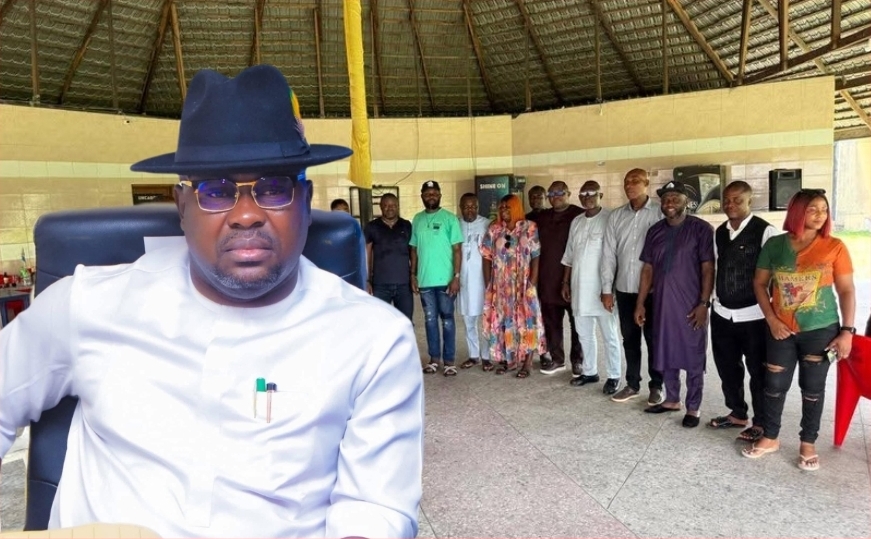
BURUTU — The member representing Burutu State Constituency I in the Delta State House of Assembly, Hon. Alapala Anthony Ebitonmo, has officially announced his intention to seek re-election in the 2027 polls.
Hon. Alapala made the declaration while addressing executives of the All Progressives Congress in Burutu Local Government Area, shortly after the release of the Independent National Electoral Commission timetable and the party’s schedule for the May 16 State Houses of Assembly primaries.
During the meeting, the lawmaker expressed gratitude to party leaders and members for their support during the 2023 general elections, particularly commending members in Burutu LGA for their steadfastness throughout the legal disputes that followed the polls.
He recalled that after his initial victory was overturned by the Court of Appeal, party loyalists remained committed until he eventually emerged victorious in the rerun election.
Speaking on his stewardship, Alapala said his administration had recorded notable progress despite the challenges that marked the early period of his tenure. He noted that the political developments in Delta State, including the alignment of major political blocs and the emergence of Rt. Hon. Sheriff Oborevwori as leader of the APC in the state, had created a more favourable atmosphere for governance.
The legislator stated that several constituency projects are ongoing across the six wards of Burutu North, stressing that grassroots development remains central to his agenda.
On human capital development, he disclosed that more than 50 constituents are currently serving in various appointments under his office, with beneficiaries drawn from all six wards to promote fairness and inclusion.
He further revealed that over 20 students from the constituency have benefited from scholarship opportunities facilitated through his office, while more than 790 students are receiving regular stipends under the Alapala Ebitonmo Students’ Support Scheme.
According to him, the initiative was introduced to reduce financial hardship among students and encourage academic success.
Hon. Alapala also said he had assisted several indigenes of Burutu North in securing empowerment opportunities as well as pensionable employment.
Reaffirming his commitment to public service, the lawmaker assured party stakeholders that if re-elected, he would build on the achievements already recorded and deliver greater democratic dividends to the people.
He also pledged continued loyalty to the APC and its guiding principles.