
News
DELINEATION: “EXERCISE IS CONSTITUTIONAL AND MORAL; NO MORE SUPREMACY, BUT BROTHERLY COEXISTENCE” – IJAW GROUP TUTORS ITSEKIRIS


Warri, Nigeria – July 16, 2025: The Ijaw Stakeholders of Warri Federal Constituency have issued a bold and historic statement declaring full support for the ongoing delineation process by the Independent National Electoral Commission (INEC), describing it as a long-awaited correction to decades of historical distortion, political marginalization, and territorial misrepresentation.
In a strong worded release,the stakeholders challenged the legitimacy of Itsekiri land claims and monarch authority, asserting that the truth of Warri’s founding peoples and rightful landowners can no longer be buried beneath colonial narratives and elite manipulation. Read full release:
“PRESS RELEASE
“Issued by: Ijaw Stakeholders of Warri Federal Constituency
“Date: 16 July 2025
“HEADLINE:
“THE LIE IS DEAD, THE LAND SPEAKS: DELINEATION IS HERE TO STAY, AND SO IS THE TRUTH
“TO WHOM MUCH LAND IS GIVEN, MUCH LIES HAVE BEEN TOLD
“For decades, a small ethnic group has wrapped itself in borrowed robes and built castles of influence upon swamps of fiction. The Itsekiris, by a mix of colonial favoritism, media mischief and oil-backed lobbying, have projected themselves as landlords over a territory they neither founded nor truly occupied in majority. They have distorted maps, fabricated history and declared themselves monarchs over a land that was already thriving with Ijaw and Urhobo civilizations before Ginuwa ever arrived at Ijala, an Ijaw town, not an Itsekiri creation.
“But history does not remain silent forever. The ground speaks. The creeks cry out. The people rise. And the truth long suppressed under the boots of colonial policies and oil politics has finally found its voice through facts, maps, judgments, census data and the awakening of ancestral memory.
“Today, we declare without any iota of doubt that the delineation of Warri Federal Constituency is not only constitutional, it is a moral correction, a historical rebalancing and a political rebirth.
“THE TRUTH HAS BEEN UNSEALED: KEY EXPOSÉS
“No Land, No Numbers, No Legitimacy
“Let it be told loud and clear, the Itsekiris have no ancestral claim over the majority of Warri land. From Gbaramatu to Ogbe-Ijoh, Okerenkoko to Isaba, these lands were never under the control of the Olu of Warri. In fact, Colonial Officer M.C. Smart (1933) stated explicitly:
“There is no historical evidence that the Olu or his agents exercised political control over Gbaramatu or the Forcados River areas.” (Intelligence Report, NAI CSO 26/2 27036)
“Census data also exposes the demographic fraud. While the Ijaws and Urhobos number in the hundreds of thousands, Itsekiris barely make up 5% of the population in Warri Federal Constituency. Their loud voice is not from the people, it is from privileged positioning and outside funding.
“The Manufactured Monarchy and the Fake Crown
“Until 1952, the title was simply “Olu of Itsekiri” a modest title rightly confined to a small ethnic domain. But in a colonial act of deception, the name was changed to “Olu of Warri”, creating the illusion of sovereignty over a land never owned.
“The Itsekiris were not the first settlers of Warri Division. Their claims to exclusive ownership are historically baseless.” — Prof. E.J. Alagoa, Niger Delta Oral Traditions and History
“That title change was resisted by Urhobo and Ijaw leaders of the time. Today, we renew that resistance and we demand the immediate reversal of the title back to its truthful form.
“The Ward Delineation: A Verdict of Justice
“The Independent National Electoral Commission (INEC), after due consideration of population density, indigenous habitation, and administrative justice, has undertaken the constitutional exercise of delineation. The Itsekiris, sensing the exposure of their long-standing fraud, now resort to blackmail, media lobbying and legal stalling.
“But the game is up.
“We affirm that the delineation result must be announced. It is not just a democratic exercise, it is historical reparation.
“It was once said:
“In the past, the man has been first; in the future, the system must be first.” — Frederick W. Taylor
“Falsehood may run for years, but truth walks in one day and takes over the house.” — Ijaw Proverb
“The greatest injustice in the Niger Delta is not oil theft — it is land theft.” — Late Chief Harold Dappa-Biriye
“Let justice roll down like waters, and righteousness like an ever-flowing stream.” — Amos 5:24 (Holy Scripture)
“OUR FINAL ADVICE TO THE ITSEKIRIS
“Enough of the media manipulations. Enough of the legal distractions. Enough of clinging to a throne built on quicksand. You cannot hold the majority hostage forever.
“We advise you: accept the truth and let justice reign. Coexistence is possible but not at the cost of false supremacy. You are not landlords. You are not founders. You are, by all historical accounts, tenants who must now learn to live in truth or be remembered for lies.
“CALL TO ACTION
“We call on:
“INEC: Proceed without fear or favour. The delineation must be concluded and gazetted.
“The Presidency and National Assembly: Stand firm for constitutional equity.
The International Community: Monitor the manipulation tactics and support indigenous land rights.
“The Nigerian People: Reject false narratives. Support the voice of history.”
Sign:
Chief Tiemopere Joshua (President)
Chief Ebikeke T. Goodstime (Secretary)
Ijaw Stakeholders
IJAW STAKEHOLDERS OF WARRI FEDERAL CONSTITUENCY
As the struggle for the truth and equity intensifies, the Ijaw Stakeholders have urged INEC to act boldly and without fear, while calling on the federal government, international observers, and Nigerian public to support a rebalancing rooted in constitutional fairness nd historical facts. With the tides of history turning, the statement concludes with a passionate appeal: coexistence remains possible-but only on the foundations of truth,not illusion.

By Favour Bibaikefie
LAGOS — Operatives of the Nigeria Security and Civil Defence Corps have uncovered a suspected baby factory in Badagry area of Lagos State, rescuing 28 persons during a late-night raid.
Authorities said those rescued included 18 adults and 10 children. Among the adults were 17 pregnant women, while one case involving a suspected miscarriage was also recorded. Two persons were arrested in connection with the operation.
The Lagos State Commandant of the NSCDC, Adedotun Keshinro, disclosed that the raid followed weeks of intelligence gathering and surveillance.
According to him, the facility, located in Okuju-Ilado, Badagry, was made up of several apartments and had been monitored for about three weeks before security operatives moved in around midnight on Wednesday.
Keshinro alleged that the operators targeted vulnerable pregnant women by offering them financial inducements. He further claimed that the women were made to sign agreements and were subsequently restricted from leaving the premises freely.
Investigators also suspect that the syndicate used a fake social media profile to attract unsuspecting victims before moving discussions to private channels.
However, one of the arrested suspects denied wrongdoing, insisting that the women came willingly and that no unlawful activity took place.
A woman rescued from the premises reportedly told officials that she entered the facility voluntarily after being abandoned by the man responsible for her pregnancy.
Some community leaders in the area said residents had observed unusual movements around the compound but did not know the true nature of activities there until the security operation was carried out.
The NSCDC said both suspects and rescued victims would be transferred to the appropriate anti-human trafficking agency for further investigation and necessary action.

By Tama Peretengboro
ABUJA — President Bola Ahmed Tinubu has stirred public discussion after making a remark in which he said he “took over leadership from myself” and described the late Muhammadu Buhari as being inseparable from his own political identity.
The statement, made during a public appearance captured in a viral video, quickly generated widespread reactions across political and social circles, with many Nigerians debating the meaning and context of the President’s comments.
Observers said the remarks appeared to underscore Tinubu’s close political association with Buhari and the continuity of governance between both administrations. Others interpreted the comments as an attempt to highlight the shared vision and alliance that existed between the two leaders during Buhari’s tenure.
Since assuming office in May 2023, Tinubu has repeatedly acknowledged Buhari’s role in the formation and electoral success of the All Progressives Congress, as well as the political transition that brought the ruling party to power.
The resurfaced clip has since fueled fresh commentary online, with supporters defending the statement as symbolic and critics questioning its phrasing.
As of the time of filing this report, the Presidency had not issued any formal clarification regarding the viral video.
See video: https://www.instagram.com/reel/DXOOaYSCG23/?igsh=MTF6MzJlOWptanJlYQ==
By Divine Perezide
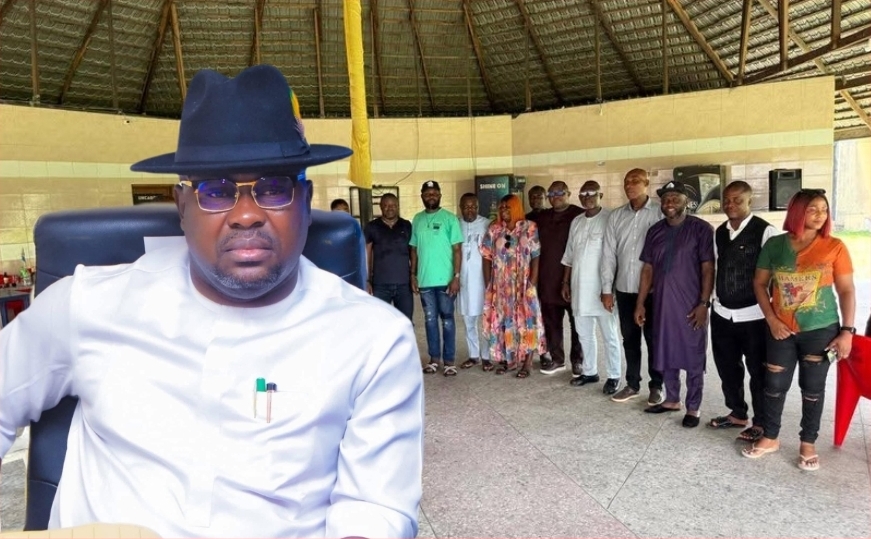
BURUTU — The member representing Burutu State Constituency I in the Delta State House of Assembly, Hon. Alapala Anthony Ebitonmo, has officially announced his intention to seek re-election in the 2027 polls.
Hon. Alapala made the declaration while addressing executives of the All Progressives Congress in Burutu Local Government Area, shortly after the release of the Independent National Electoral Commission timetable and the party’s schedule for the May 16 State Houses of Assembly primaries.
During the meeting, the lawmaker expressed gratitude to party leaders and members for their support during the 2023 general elections, particularly commending members in Burutu LGA for their steadfastness throughout the legal disputes that followed the polls.
He recalled that after his initial victory was overturned by the Court of Appeal, party loyalists remained committed until he eventually emerged victorious in the rerun election.
Speaking on his stewardship, Alapala said his administration had recorded notable progress despite the challenges that marked the early period of his tenure. He noted that the political developments in Delta State, including the alignment of major political blocs and the emergence of Rt. Hon. Sheriff Oborevwori as leader of the APC in the state, had created a more favourable atmosphere for governance.
The legislator stated that several constituency projects are ongoing across the six wards of Burutu North, stressing that grassroots development remains central to his agenda.
On human capital development, he disclosed that more than 50 constituents are currently serving in various appointments under his office, with beneficiaries drawn from all six wards to promote fairness and inclusion.
He further revealed that over 20 students from the constituency have benefited from scholarship opportunities facilitated through his office, while more than 790 students are receiving regular stipends under the Alapala Ebitonmo Students’ Support Scheme.
According to him, the initiative was introduced to reduce financial hardship among students and encourage academic success.
Hon. Alapala also said he had assisted several indigenes of Burutu North in securing empowerment opportunities as well as pensionable employment.
Reaffirming his commitment to public service, the lawmaker assured party stakeholders that if re-elected, he would build on the achievements already recorded and deliver greater democratic dividends to the people.
He also pledged continued loyalty to the APC and its guiding principles.