
News
Chief Berry Negerese Honoured for Advancing Peacebuilding Across Africa

By Divine Perezide
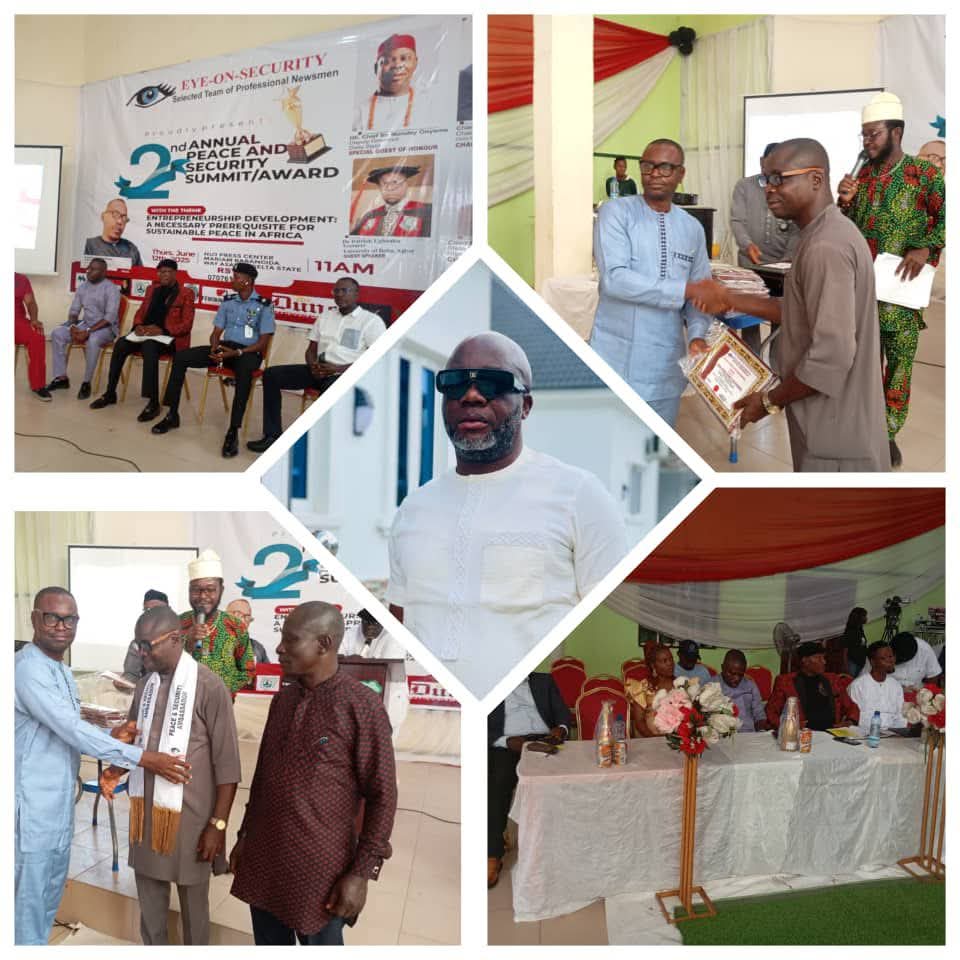
In a significant move to celebrate good leadership and impact, Hon. Chief Berry Negerese, Principal of the Wind of Progress Forum, was on Thursday, June 12, 2025, honoured with the Award for Immense Contributions to Genuine Peacebuilding in Africa. The recognition, conferred by EYE-ON-SECURITY, a distinguished consortium of seasoned journalists, formed part of the highly anticipated 2nd Annual Peace and Security Summit/Awards held at the NUJ Press Centre in Asaba, Delta State.
Represented by top official of the Forum, Chief Negerese was praised for his visionary grassroots empowerment programmes and enduring efforts to promote sustainable peace and development across the Niger Delta, Nigeria, and the African continent at large.
This was made public in a statement signed by Negerese’s Media Aide, Yeine Lucky Dennis, which reads thus in full:
𝗘𝗬𝗘- 𝗢𝗡- 𝗦𝗘𝗖𝗨𝗥𝗜𝗧𝗬
𝐒𝐞𝐥𝐞𝐜𝐭𝐞𝐝 𝐓𝐞𝐚𝐦 𝐨𝐟 𝐏𝐫𝐨𝐟𝐞𝐬𝐬𝐢𝐨𝐧𝐚𝐥 𝐍𝐞𝐰𝐬𝐦𝐞𝐧~ 2𝑛𝑑 𝐴𝑛𝑛𝑢𝑎𝑙 𝑃𝑒𝑎𝑐𝑒 𝑎𝑛𝑑 𝑆𝑒𝑐𝑢𝑟𝑖𝑡𝑦 𝑆𝑢𝑏𝑚𝑖𝑡/𝐴𝑤𝑎𝑟𝑑
“𝐇𝐨𝐧. 𝐂𝐡𝐢𝐞𝐟 𝐁𝐞𝐫𝐫𝐲 𝐍𝐞𝐠𝐞𝐫𝐞𝐬𝐞 𝐑𝐞𝐜𝐨𝐠𝐧𝐢𝐬𝐞𝐝 𝐟𝐨𝐫 𝐇𝐢𝐬 𝐈𝐦𝐦𝐞𝐫𝐬𝐞 𝐂𝐨𝐧𝐭𝐫𝐢𝐛𝐮𝐭𝐢𝐨𝐧𝐬 𝐭𝐨 𝐆𝐞𝐧𝐮𝐢𝐧𝐞 𝐏𝐞𝐚𝐜𝐞 𝐁𝐮𝐢𝐥𝐝𝐢𝐧𝐠 𝐏𝐫𝐨𝐜𝐞𝐬𝐬 𝐢𝐧 𝐀𝐟𝐫𝐢𝐜𝐚
“𝙏𝙝𝙪𝙧𝙨. 𝙅𝙪𝙣𝙚 12𝙩𝙝, 2025
“𝗛𝗼𝗻. 𝗖𝗵𝗶𝗲𝗳 𝗕𝗲𝗿𝗿𝘆 𝗡𝗲𝗴𝗲𝗿𝗲𝘀𝗲, leader and founder of the Wind of Progress Forum, Earlier today was honoured with the prestigious Award for Immense Contributions to Genuine Peacebuilding in Africa. The award, presented by 𝑬𝒀𝑬- 𝑶𝑵- 𝑺𝑬𝑪𝑼𝑹𝑰𝑻𝒀—a select team of seasoned journalists—was part of the second edition of the Peace and Security Summit/Awards held at the NUJ Press Centre, Mariam Babangida Way, Asaba, Delta State. Representing Hon. Chief Berry Negerese at the ceremony were Barr. Japan Udoji, Director General of the Wind of Progress Forum; Hon. Victor Ebiyekon, Secretary of the forum; and Mr. Ekpama P. Doubra, Media Personnel for the forum.
“During his remarks at the event, Barr. Udoji Japan emphasized that the summit’s theme—”Entrepreneurship Development: A Necessary Prerequisite for Sustainable Peace in Africa”—resonates deeply with the founding vision of Chief Negerese. He highlighted the impact of the Wind of Progress Annual Women Skill Acquisition Programme, which has empowered women across all Local Government Areas in Bayelsa State with training in vital skills such as catering, fashion design, makeup artistry, event decoration, and hairdressing. Barr. Udoji praised the organizers for recognizing the transformative initiatives led by Chief Negerese, which continue to foster peace and economic resilience across the Niger Delta region and beyond.
“The well-attended summit brought together an array of esteemed dignitaries and stakeholders in peace and security. Notable guests included H.E. Chief Sir Monday Onyeme, Deputy Governor of Delta State; Obi Chief Nwanze Odua, the Odogwu of Asaba; H.R.M. Obi Collins Alioma Ezenweali Ozoji Igwe I, the Obi of Otolokpo Kingdom; Chief Peter Onye Ejiniwe, the Ojah of Onicha Uku Kingdom; Dr. (Mrs.) Alice Atuwo, Executive Secretary of Bayelsa State Education Development Trust Fund; Chief Barr. David Ogbodo (AIG rtd), Chairman of Delta State Public Procurement Council; and Dr. Patrick Ugboaku of the University of Delta, Agbor, who served as guest speaker. Security officials and government representatives also graced the occasion, including CP Abaniwonda S. Olufemi, Delta State Commissioner of Police; SP Bright Edafe, the PPRO for Delta State; Hon. Obi Kelvin Ezenyili, PhD, Executive Chairman of Oshimili South LGA; and Hon. Friday Voke, Executive Chairman of Isoko South LGA, among others.”
𝒀𝒆𝒏𝒏𝒆 𝑳𝒖𝒄𝒌𝒚 𝑫𝒆𝒏𝒏𝒊𝒔
𝑫𝒊𝒓𝒆𝒄𝒕𝒐𝒓
𝑴𝒆𝒅𝒊𝒂/𝑷𝒖𝒃𝒍𝒊𝒄𝒊𝒕𝒚
𝑾𝒊𝒏𝒅 𝒐𝒇 𝑷𝒓𝒐𝒈𝒓𝒆𝒔𝒔 𝑭𝒐𝒓𝒖𝒎













By Favour Bibaikefie
LAGOS — Operatives of the Nigeria Security and Civil Defence Corps have uncovered a suspected baby factory in Badagry area of Lagos State, rescuing 28 persons during a late-night raid.
Authorities said those rescued included 18 adults and 10 children. Among the adults were 17 pregnant women, while one case involving a suspected miscarriage was also recorded. Two persons were arrested in connection with the operation.
The Lagos State Commandant of the NSCDC, Adedotun Keshinro, disclosed that the raid followed weeks of intelligence gathering and surveillance.
According to him, the facility, located in Okuju-Ilado, Badagry, was made up of several apartments and had been monitored for about three weeks before security operatives moved in around midnight on Wednesday.
Keshinro alleged that the operators targeted vulnerable pregnant women by offering them financial inducements. He further claimed that the women were made to sign agreements and were subsequently restricted from leaving the premises freely.
Investigators also suspect that the syndicate used a fake social media profile to attract unsuspecting victims before moving discussions to private channels.
However, one of the arrested suspects denied wrongdoing, insisting that the women came willingly and that no unlawful activity took place.
A woman rescued from the premises reportedly told officials that she entered the facility voluntarily after being abandoned by the man responsible for her pregnancy.
Some community leaders in the area said residents had observed unusual movements around the compound but did not know the true nature of activities there until the security operation was carried out.
The NSCDC said both suspects and rescued victims would be transferred to the appropriate anti-human trafficking agency for further investigation and necessary action.

By Tama Peretengboro
ABUJA — President Bola Ahmed Tinubu has stirred public discussion after making a remark in which he said he “took over leadership from myself” and described the late Muhammadu Buhari as being inseparable from his own political identity.
The statement, made during a public appearance captured in a viral video, quickly generated widespread reactions across political and social circles, with many Nigerians debating the meaning and context of the President’s comments.
Observers said the remarks appeared to underscore Tinubu’s close political association with Buhari and the continuity of governance between both administrations. Others interpreted the comments as an attempt to highlight the shared vision and alliance that existed between the two leaders during Buhari’s tenure.
Since assuming office in May 2023, Tinubu has repeatedly acknowledged Buhari’s role in the formation and electoral success of the All Progressives Congress, as well as the political transition that brought the ruling party to power.
The resurfaced clip has since fueled fresh commentary online, with supporters defending the statement as symbolic and critics questioning its phrasing.
As of the time of filing this report, the Presidency had not issued any formal clarification regarding the viral video.
See video: https://www.instagram.com/reel/DXOOaYSCG23/?igsh=MTF6MzJlOWptanJlYQ==

By Divine Perezide
BURUTU — The member representing Burutu State Constituency I in the Delta State House of Assembly, Hon. Alapala Anthony Ebitonmo, has officially announced his intention to seek re-election in the 2027 polls.
Hon. Alapala made the declaration while addressing executives of the All Progressives Congress in Burutu Local Government Area, shortly after the release of the Independent National Electoral Commission timetable and the party’s schedule for the May 16 State Houses of Assembly primaries.
During the meeting, the lawmaker expressed gratitude to party leaders and members for their support during the 2023 general elections, particularly commending members in Burutu LGA for their steadfastness throughout the legal disputes that followed the polls.
He recalled that after his initial victory was overturned by the Court of Appeal, party loyalists remained committed until he eventually emerged victorious in the rerun election.
Speaking on his stewardship, Alapala said his administration had recorded notable progress despite the challenges that marked the early period of his tenure. He noted that the political developments in Delta State, including the alignment of major political blocs and the emergence of Rt. Hon. Sheriff Oborevwori as leader of the APC in the state, had created a more favourable atmosphere for governance.
The legislator stated that several constituency projects are ongoing across the six wards of Burutu North, stressing that grassroots development remains central to his agenda.
On human capital development, he disclosed that more than 50 constituents are currently serving in various appointments under his office, with beneficiaries drawn from all six wards to promote fairness and inclusion.
He further revealed that over 20 students from the constituency have benefited from scholarship opportunities facilitated through his office, while more than 790 students are receiving regular stipends under the Alapala Ebitonmo Students’ Support Scheme.
According to him, the initiative was introduced to reduce financial hardship among students and encourage academic success.
Hon. Alapala also said he had assisted several indigenes of Burutu North in securing empowerment opportunities as well as pensionable employment.
Reaffirming his commitment to public service, the lawmaker assured party stakeholders that if re-elected, he would build on the achievements already recorded and deliver greater democratic dividends to the people.
He also pledged continued loyalty to the APC and its guiding principles.