
Breaking
PRESENTATION BY HIS EXCELLENCY, PRESIDENT BOLA AHMED TINUBU, GCFR OF THE 2025 BUDGET OF RESTORATION: SECURING PEACE, REBUILDING PROSPERITY* *TO* *A JOINT SESSION OF THE NATIONAL ASSEMBLY ON WEDNESDAY 18TH DECEMBER, 2024

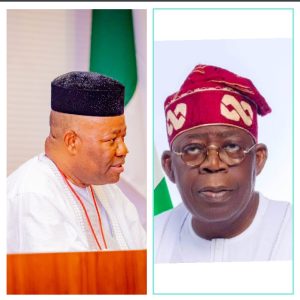
PROTOCOLS:
— The Vice President, Senator Kashim Shettima
— Senate President, Distinguished Senator Godswill Akpabio
— Right Honourable Speaker, Tajudeen Abbas
— National Chairman of our great party, Excellency, Abdullahi Umar Ganduje
— State Governors here present
— Distinguished Leaders and Members of the National Assembly
— Senior Government Officials here present
— Gentlemen of the press,
My Fellow Nigerians,
1. In fulfilment of one of my constitutional duties and with unyielding commitment to rebuilding Nigeria towards ensuring that we remain steadfast on the journey to a prosperous future, I hereby present the 2025 Budget to the Joint Session of the 10th National Assembly.
2. On this day, before this hallowed chamber, I present to you the 2025 Budget at a time when our country is at a crucial point in its development trajectory.
3. The 2025 Budget Proposal again reinforces our administration’s roadmap to secure peace, prosperity, and hope for a greater future for our beloved nation. This budget christened, “Budget of Restoration: Securing Peace, Rebuilding Prosperity,” strikes at the very core of our Renewed Hope Agenda and demonstrates our commitment to stabilizing the economy, improving lives, and repositioning our country for greater performance.
4. The journey of economic renewal and institutional development, which we began 18 months ago as a nation, is very much underway. It is not a journey of our choosing but one we had to embark on for Nigeria to have a real chance at greatness. I thank every Nigerian for embarking on this journey of REFORMS and TRANSFORMATION with us.
5. The road of reforms is now clearly upon us, and as the President of this blessed nation, I know this less-travelled road has not been easy. That there have been difficulties and sacrifices. They will not be in vain. And we must keep faith with the process to arrive at our collectively desired destination.
6. We must build on the progress we have made in the past eighteen months in restructuring our economy and ensuring it is strong enough to withstand the headwinds of any future shocks of the global downturn.
7. The 2025 budget that I present today is one of restoration. It seeks to consolidate the key policies we have instituted to restructure our economy, boost human capital development, increase the volume of trade and investments, bolster oil and gas production, get our manufacturing sector humming again and ultimately increase the competitiveness of our economy.
8. We do not intend to depart from this critical path to strengthen the Nigerian economy. Just as I believe in the resilience of our economy to withstand the current challenges, I also strongly believe in the resilience of the Nigerian people. Again, I summon the unstoppable Nigerian spirit to lead us on as we work to rebuild the fabric of our economy and existence.
9. The improvements we witnessed in the 2024 budget have led us into the 2025 budget. The goals of advancing national security, creating economic opportunities, investing in our youthful population, infrastructure development, and national re-orientation form the core of the 2025 budget. But more than that, this will lay a solid foundation for Nigeria’s future growth trajectory.
CURRENT ECONOMIC REALITIES AND PROGRESS
10. Distinguished Senate President, Right Honourable Speaker of the House of Representatives, leaders and members of both Chambers of the National Assembly, I report today that our economy is responding positively to stimulus. Our objective is to further stimulate the economy through the implementation of targeted fiscal stimulus packages through public expenditures and specific non-inflationary spending.
11. The reforms we have instituted are beginning to yield results. Nigerians will soon experience a better and more functional economy.
12. Global economic growth for the outgoing year 2024 was projected at 3.2 percent, and against predictions, our country made significant progress.
o Our economy grew by 3.46 percent in the third quarter of 2024, up from 2.54 percent in the third quarter of 2023.
o Our Foreign Reserves now stand at nearly 42 billion US dollars, providing a robust buffer against external shocks.
o Our rising exports are reflected in the current trade surplus, which now stands at 5.8 trillion naira, according to the National Bureau of Statistics.
13. These clear results of gradual recovery, among others, reflect the resilience of our economy and the impact of deliberate policy choices we made from the outset.
2024 BUDGET PERFORMANCE
14. I am happy to inform this National Assembly that our administration attained remarkable milestones in implementing the 2024 Budget. In 2024, we achieved:
o 14.55 trillion naira in revenue, meeting 75 percent of our target as of the third quarter.
o 21.60 trillion naira in expenditure, representing 85 percent of our target, also in the third quarter.
15. While challenges persist, we improved revenue collection and fulfilled key obligations. The transformational effects of this on our economy are gradually being felt.
PHILOSOPHY OF THE 2025 BUDGET
16. The 2025 Budget seeks to:
o Restore macroeconomic stability.
o Enhance the business environment.
o Foster inclusive growth, employment, and poverty reduction.
o Promote equitable income distribution and human capital development.
17. Our budgetary allocations reflect the administration’s strategic priorities, especially in the implementation of the Renewed Hope Agenda and its developmental objectives.
2025 BUDGET OVERVIEW
18. The numbers for our 2025 budget proposal tell a bold and exciting story of the direction we are taking to retool and revamp the socio-economic fabric of our society.
o In 2025, we are targeting 34.82 trillion naira in revenue to fund the budget.
o Government expenditure in the same year is projected to be 47.90 trillion naira, including 15.81 trillion naira for debt servicing.
o A total of 13.08 trillion naira, or 3.89 percent of GDP, will make up the budget deficit.
19. This is an ambitious but necessary budget to secure our future.
20. The Budget projects inflation will decline from the current rate of 34.6 percent to 15 percent next year, while the exchange rate will improve from approximately 1,700 naira per US dollar to 1,500 naira, and a base crude oil production assumption of 2.06 million barrels per day (mbpd).
21. These projections are based on the following observations:
o Reduced importation of petroleum products alongside increased export of finished petroleum products.
o Bumper harvests, driven by enhanced security, reducing reliance on food imports.
o Increased foreign exchange inflows through Foreign Portfolio Investments.
o Higher crude oil output and exports, coupled with a substantial reduction in upstream oil and gas production costs.
KEY PRIORITIES: REBUILDING NIGERIA
22. Our budgetary allocations underscore this administration’s strategic priorities, particularly in advancing the Renewed Hope Agenda and achieving its developmental objectives.
23. Highlights of the 2025 Budget Allocations:
• Defence and Security: N4.91 trillion
• Infrastructure: N4.06 trillion
• Health: N2.48 trillion
• Education: N3.52 trillion
24. As we embark on implementing the 2025 Budget, our steps are deliberate, our decisions resolute, and our priorities are clear. This budget reflects a renewed commitment to strengthening the foundation of a robust economy, while addressing critical sectors essential for the growth and development we envision.
Securing Our Nation:
25. Security is the foundation of all progress. We have significantly increased funding for the military, paramilitary, and police forces to secure the nation, protect our borders, and consolidate government control over every inch of our national territory. The government will continue to provide our security forces with the modern tools and technology they need to keep us safe. Boosting the morale of our men and women in the armed forces will remain our government’s top priority.
26. The officers, men, and women of our Armed Forces and the Nigerian Police Force are the shields and protectors of our nation. Our administration will continue to empower them to defeat insurgency, banditry, and all threats to our sovereignty. Our people should never live in fear—whether on their farmlands, highways or cities. By restoring peace, we restore productivity, revive businesses, and rebuild our communities.
Infrastructure Development:
27. When we launched the Renewed Hope Infrastructure Development Fund, it was with the conviction that infrastructure remains the backbone of every thriving economy. Under this programme, we are accelerating investments in energy, transport, and public works. By leveraging private capital, we hope to complete key projects that drive growth and create jobs. We have already embarked on key legacy projects: Lagos-Calabar Coastal Highway and Sokoto-Badagry Highway, which will have a huge impact on the lives of our people and accelerate economic output.
Human Capital Development:
28. Our people are our greatest resource. That is why we are making record investments in education, healthcare, and social services:
o Our administration has so far disbursed 34 billion naira to over 300,000 students via the Nigeria Education Loan Fund (NELFUND). In the 2025 Budget, we have made provision for 826.90 billion naira for infrastructure development in the educational sector. This provision also includes those for the Universal Basic Education (UBEC) and the nine new higher educational institutions.
o We are convinced that Universal Health Coverage initiatives will strengthen primary healthcare systems across Nigeria. In this way, we have allocated 402 billion naira for infrastructure investments in the health sector in the 2025 Budget and another 282.65 billion naira for the Basic Health Care Fund. Our hospitals will be revitalised with medication and better resources, ensuring quality care for all Nigerians. This is consistent with the Federal Government’s planned procurement of essential drugs for distribution to public healthcare facilities nationwide, improving healthcare access and reducing medical import dependency.
Revitalizing Agriculture:
29. Increasing agricultural production is central to our food security agenda, but insecurity has crippled this vital sector. We are supporting our farmers with funding and inputs to reignite productivity. Food security is non-negotiable. In this regard, we are taking bold steps to ensure that every Nigerian can feed conveniently, and none of our citizens will have to go to bed hungry.
30. Distinguished Senate President, Right Honourable Speaker of the House of Representatives, leaders and members of both Chambers of the National Assembly and fellow Nigerians, our 2025 budget proposal is not just another statement on projected government revenue and expenditures. It is one that calls for action.
31. Our nation faces existential threats from corruption and insecurity and suffers from many past poor choices. These challenges are surmountable when we work collaboratively to overcome them. We must rewrite the narrative of this nation together, with every leader, institution, and citizen playing their part.
32. The time for lamentation is over. This is a time to act. A time to support and promote greater investment in the private sector. A time for our civil servants to faithfully execute our policies and programmes. It is a time for every Nigerian to look hopefully towards a brighter future because a new day has dawned for us as a nation.
33. As your President, I remain committed and resolute to continue to lead the charge.
34. This 2025 budget proposal lays the foundation for peace, prosperity, and much needed hope. It is the plan through which a Nigeria where every citizen can dream, work, and thrive in safety can be achieved.
35. It is with great pleasure, therefore, that I lay before this distinguished Joint Session of the National Assembly the 2025 Budget of the Federal Government of Nigeria titled “The Restoration Budget: Securing Peace, Rebuilding Prosperity.
36. May God bless our Armed Forces and keep them safe. May God bless the Federal Republic of Nigeria.
Thank you.
*Bola Ahmed Tinubu, GCFR*
President, Commander-in-Chief of The Armed Forces,
Federal Republic of Nigeria





Breaking
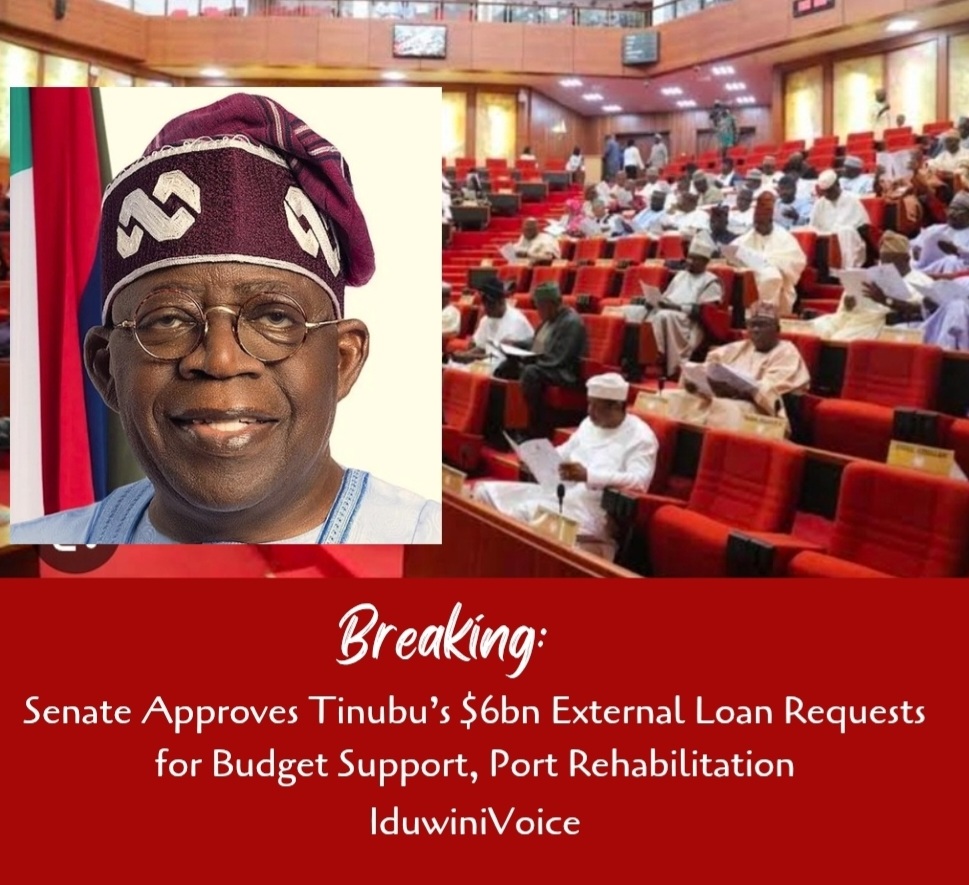
Senate Approves Tinubu’s $6bn External Loan Requests for Budget Support, Port Rehabilitation
By Favour Bibaikefie
The Nigerian Senate has approved President ’s request for two external loan facilities totaling $6 billion, aimed at supporting the 2026 budget and upgrading key maritime infrastructure across the country.
The approval followed the consideration of two executive communications earlier transmitted to the upper chamber and read during plenary by Senate President on Tuesday, March 31, 2026.
Breakdown of the facilities shows that the Federal Government secured a $5 billion loan from Abu Dhabi Bank to provide critical budgetary support. The fund is expected to help bridge fiscal gaps and enable the government meet pressing financial obligations.
The second facility, valued at $1 billion, is from Citi Bank, London, and is specifically designated for the rehabilitation and technical upgrade of Nigeria’s major seaports, including the Lagos Port Complex and Tin Can Island Port.
According to the presidency, the port modernisation initiative is designed to tackle longstanding operational inefficiencies, strengthen security, and boost non-oil exports. The government also aims to reposition Nigeria as a leading trade hub within the West African sub-region through improved port infrastructure.
Following deliberations, lawmakers gave their nod to the loan requests after reviewing the report of the Senate Committee on Local and Foreign Debts, chaired by Senator Aliyu Wammakko, which had earlier been mandated to examine the proposals.
Senate sources indicated that the approval was granted after assurances on the viability of the projects, expected economic returns, and the capacity of the government to manage the country’s debt profile responsibly.
The development marks a significant step in the Federal Government’s efforts to stabilise public finances and accelerate infrastructure renewal, particularly in the maritime sector, which remains a critical gateway for international trade and revenue generation.

As Iran strikes Kuwaiti vessel Al-Salmi
By Ezinne
Tensions in the Persian Gulf have reached a boiling point after a giant Kuwaiti crude oil tanker, the Al-Salmi, was hit by an Iranian drone strike while anchored off the coast of Dubai early Tuesday, March 31, 2026. The attack follows a fresh ultimatum from US President Donald Trump, who warned that the United States would “obliterate” Iran’s energy grid and oil infrastructure if the Strait of Hormuz is not immediately reopened.
The Al-Salmi, which was fully laden with approximately 2 million barrels of crude oil, was struck on its starboard side shortly after midnight, sparking a major fire. Dubai maritime authorities confirmed that firefighting teams successfully extinguished the blaze after an hours-long operation. While all 24 crew members were reported safe and no oil spill has yet been confirmed, the Kuwait Petroleum Corporation (KPC) condemned the incident as a “direct, heinous attack.”
This escalation comes as President Trump utilized social media on Monday to threaten the destruction of Iran’s Kharg Island oil hub, power plants, and desalination facilities if a ceasefire deal is not reached “shortly.” The conflict, which began in late February, has already pushed global oil prices above $100 a barrel and gasoline prices in the US past $4 a gallon. As the US and Israel continue missile strikes on military and nuclear infrastructure within Iran, Tehran has retaliated by targeting commercial shipping and regional energy plants, raising fears of a total collapse in global energy security.
By Favour Bibaikefie
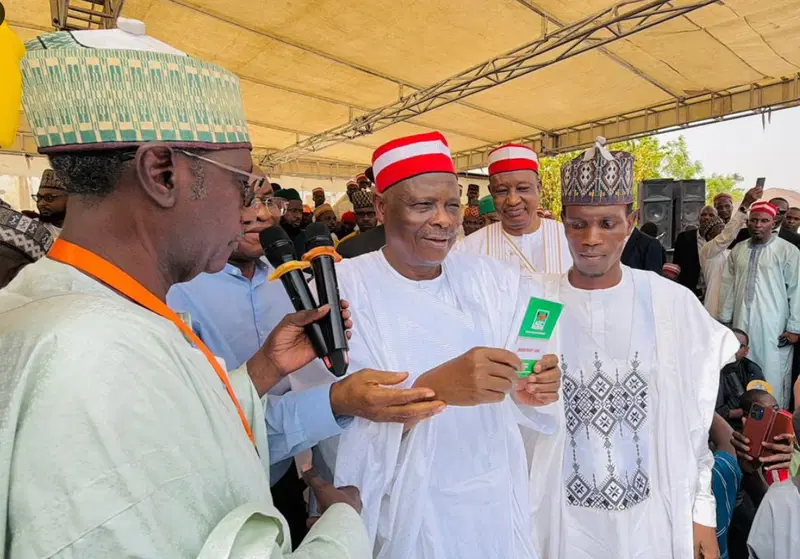
Nigeria’s political landscape witnessed a significant shift on Monday as formally defected to the African Democratic Congress (ADC), a move widely seen as a strategic recalibration ahead of the 2027 general elections.
Kwankwaso, a former governor of Kano State and presidential candidate of the New Nigeria Peoples Party (NNPP) in the 2023 elections, officially registered with the ADC in Kano, marking the end of his association with the NNPP and signalling a new phase in Nigeria’s opposition politics.
The high-profile defection event attracted key political figures across party lines, underscoring growing momentum toward a broad-based coalition aimed at challenging the ruling party in 2027. Among those reportedly present or aligned with the unfolding political realignment are prominent opposition figures believed to be exploring a unified front.
Strategic Realignment Ahead of 2027
Political analysts say Kwankwaso’s entry into the ADC represents more than a routine party switch; it reflects an emerging convergence of opposition forces seeking to avoid the fragmentation that defined the 2023 presidential election.
In that election cycle, the opposition vote was split among multiple candidates, including Atiku Abubakar of the Peoples Democratic Party (PDP), Peter Obi of the Labour Party, and Kwankwaso himself under the NNPP platform—an outcome that ultimately benefited the ruling All Progressives Congress.
With less than two years to the next electoral cycle, Monday’s development suggests a deliberate effort to consolidate political strength, particularly in northern Nigeria where Kwankwaso commands a formidable grassroots following through his Kwankwasiyya movement.
ADC Emerges as Coalition Platform
The ADC, hitherto considered a minor political platform, is increasingly positioning itself as a potential coalition vehicle for opposition leaders seeking a neutral ground free from entrenched internal rivalries associated with older parties.
Observers note that Kwankwaso’s defection may trigger a domino effect, encouraging other political heavyweights to reconsider their affiliations as consultations intensify across the opposition spectrum.
There are also indications that talks are ongoing among leading political actors on the possibility of presenting a consensus presidential candidate in 2027—a strategy aimed at mounting a more formidable challenge to the incumbent administration.
Implications for the Ruling Party
For the APC, Kwankwaso’s move introduces a fresh layer of complexity to the evolving political equation. While the ruling party maintains a strong national structure and incumbency advantage, a united opposition could significantly alter electoral dynamics, particularly in battleground states across the North-Central and North-West regions.
Political commentators argue that the success of the emerging coalition will depend largely on its ability to manage internal ambitions, agree on power-sharing arrangements, and present a coherent policy alternative to Nigerians.
Looking Ahead
As political activities gradually build toward 2027, Kwankwaso’s defection to the ADC may well be remembered as a defining moment in the early stages of coalition politics in Nigeria’s Fourth Republic.
Whether this realignment translates into a viable electoral force remains to be seen, but one point is clear: the race to 2027 has begun in earnest, and the battle lines are already being redrawn.