
IduwiniVoice Social
5 Ways to Manage Wealth After Retirement in Nigeria


5 Ways to Manage Wealth After Retirement in Nigeria
By Lawrence Agbo
Are you a retiree in Nigeria and you end up not living the life you so desire for yourself after retirement? You discover that your carefully planned retirement programme could not sustain you a few years later and you wonder what you did wrong.
The answer to that question is that you lack proper management of your wealth after retirement. However, this article will enlighten you on how to manage your wealth after retirement by using deliberate planned strategies.
Here are 5 ways to manage your wealth after retirement.
Consider working part-time
Retirement is supposed to be a period of refraining from active duty and engaging in a part-time or remote job, but not to stop working entirely. The mistake most retirees make is that they fall back on their pension or savings and continue spending like they are used to while on active service.
That is the wrong way to manage wealth as a retiree and will only make you broke.
By engaging in a part-time job, you will be able to manage what you have saved durin your 35 years of active service, stay more informed and keep your brain active.
Doing a part-time job will also fetch you additional income that can cover some expenses. It also allows you to choose flexible hours and preferred times of work.
You can choose to teach or retail whichever is convenient for you and ensure you create a network. By doing this, you will come in contact with those who will need your services or expertise.
Look for passive income opportunities
Passive income is simply the earnings you receive from investments or business ventures that require no serious effort to maintain from the investor or retirer as this case may be.
While you are still on active service, ensure that you have a business that brings in passive income and if you don’t, endeavour to have an investment that brings in return.
In our society today, many retirees rely on this means and it seems very resourceful. You will see a 70-year-old man living flamboyantly and living a healthy life because he is sure of getting returns either weekly, monthly or even yearly. This is why retired landlords in Lagos State don’t lack.
They depend on the money for rent from tenants. Some even go as far as using a scheme that enables them to make a huge sum of money at once if the need arises by giving a tenant notice to quit to get a new one or increasing the house rent yearly.
This will enable you to reduce reliance on the money saved during your active days at work and it allows for more leisure time or the ability to pursue other interests.
Managing your expenses in retirement
The way you spend during retirement goes a long way to determining how will you manage it. This is the time for you to be honest with yourself as much as possible by avoiding unnecessary spending or a flamboyant lifestyle if you really want to manage your wealth.
To achieve this, create a comprehensive budget that will identify all your sources of income including your pension, passive income and part-time work and categorise how much you spend monthly on expenses.
You should focus more on your needs than wants at this stage and ensure you stay free from debt.
Use the 4% rule
This is one of the smartest rules to manage wealth after retirement by providing a specific guideline for withdrawal from savings annually.
This rule is designed to ensure that the savings last at least 30 years. This rule is also good for managing how you spend, especially when you know that you can’t get more than 4% of your savings annually
Move to a smaller property
After retirement, there is a need to move to a smaller property to cut expenses. If you have a property you put up for rent, you should move to one that is easy to maintain and put the expensive one up for rent.
The cost of maintaining a flamboyant lifestyle can be very expensive. So you need to watch out for that.
This is not the right time to move to a flamboyant house if you are a tenant. Rather, you should move to a cheaper apartment where you will pay less and still live comfortably.
Culled: Vanguard News
IduwiniVoice Social
Warri Set for Grand Wedding Reception as Tarelaemi Gbesine, Ware-Ebi Guwor Tie the Knot Today

By Favour Bibaikefie
WARRI — The city of Warri is expected to witness a colourful social gathering today as families, friends, dignitaries and well-wishers converge for the marriage reception of Tarelaemi Benjamin Gbesine and Ware-Ebi Mark Guwor.
The reception, billed for today Saturday, April 18, 2026, follows a Traditional Marriage Ceremony which took place at the residence of Mr. Benjamin Gbesine, located at New Layout, Ekpan, in Warri.
According to the family announcement, the wedding ceremony is being hosted by the families of Mr. Benjamin Gbesine of Odimodi and Ogulagha towns in Burutu Local Government Area, alongside the family of Hon. Mark Guwor of Ogulagha Town, Burutu LGA, as well as Oporoza, Okerenkoko and Igoba communities in Warri South-West Local Government Area, all in Delta State.
The solemnisation scheduled hold at the Kratos Event Centre, Refinery Road, Delta State 12 noon today is expected to attract prominent personalities from across Delta State and beyond, reflecting the strong family and community ties of both households.
The families announced the official colours of the day as cream and champagne gold, setting the tone for what is anticipated to be a classy and memorable occasion.
Sources close to the families and residents of Warri and neighbouring communities have described the ceremony as one of the notable social events of the season, with excitement already building around the city.
The marriage of Tarelaemi and Ware-Ebi is being celebrated as not only the coming together of two respected families with deep roots across Burutu and Warri South-West councils of Delta State, but the union of three notable ancient kingdoms of Ijaw nation (Iduwini, Ogulagha, and Gbaramatu).
The couple has continued to receive goodwill messages and prayers for a successful ceremony and a blissful married life since the announcement was made public.
Make the above the leading story (showing full story) using the uploaded photo of the couple
IduwiniVoice Social
INC Election: Delegate Gbegha Commends Electronic Voting Process, Urges INEC to Adopt Model
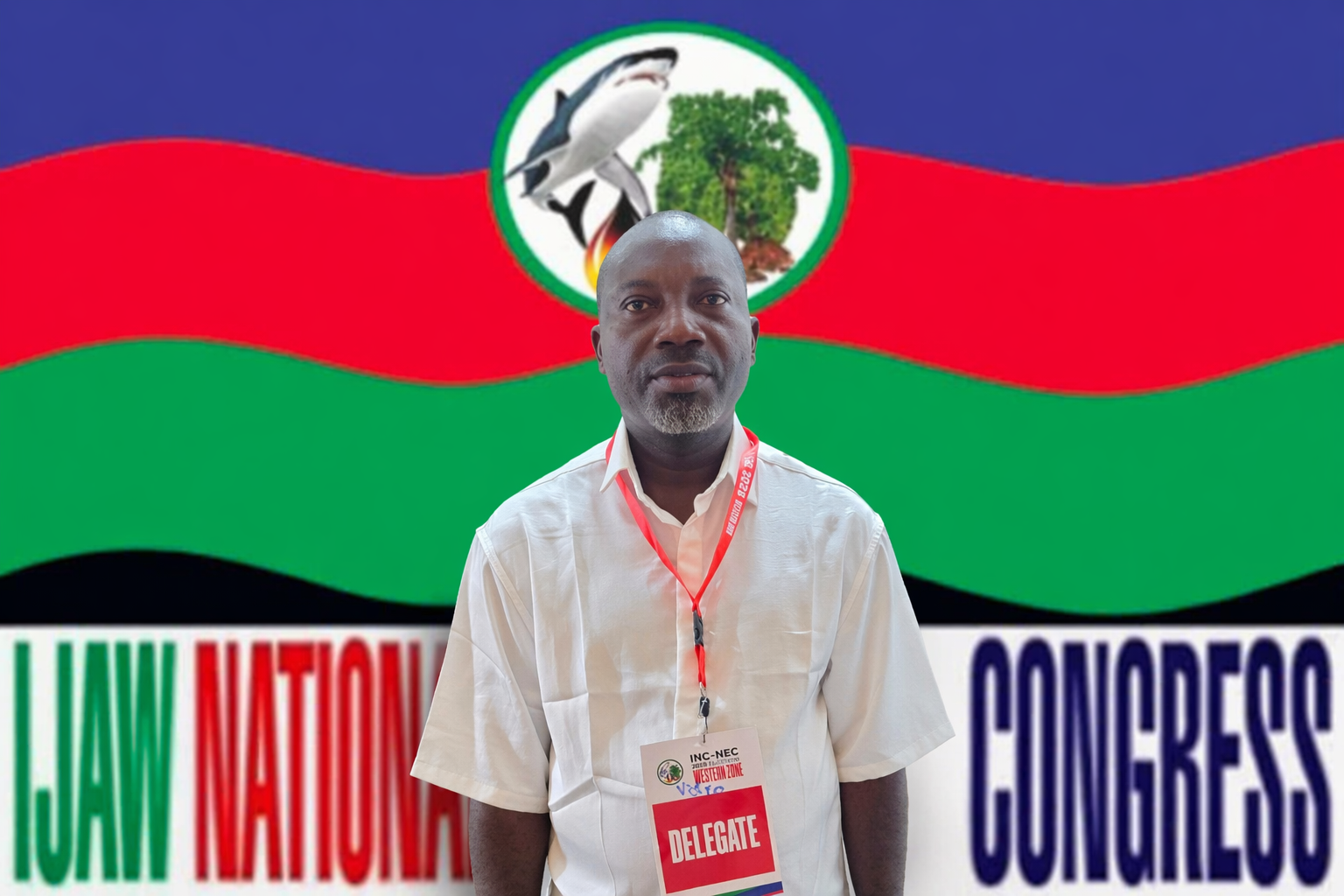
INC Election: Delegate Gbegha Commends Electronic Voting Process, Urges INEC to Adopt Model
By Favour Bibaikefie
WARRI — A voting delegate and former Chairman of Odimodi Community, Comrade Solomon Gbegha, has commended the National Electoral Committee of the Ijaw National Congress (INC) and the Prof. Benjamin Okaba-led executive for the successful conduct of the Congress’ national elections, describing the process as orderly, transparent, and technologically driven.
Gbegha, who participated in the exercise, praised the deployment of electronic voting, noting that it ensured credibility and efficiency throughout the election. He described the process as seamless and largely free of irregularities, stressing that it reflects the capacity of indigenous institutions to deliver credible electoral outcomes when properly managed.
According to him, the election demonstrated a high level of coordination and innovation, with real-time transmission of results enhancing transparency and trust among participants.
He further urged Nigeria’s electoral body, the Independent National Electoral Commission (INEC), to draw lessons from the INC model, particularly in the use of technology to strengthen the integrity of elections.
Gbegha maintained that adopting electronic voting and real-time result transmission could significantly improve the credibility of elections in the country, ensuring that every vote cast is accurately recorded and reflected in the final outcome.
The INC election, held on April 13, 2026, followed an earlier postponement from March 7, 2026, due to disputes among some candidates, which led to legal actions that temporarily halted the process.
Despite the initial setbacks, the Congress successfully conducted the rescheduled election during its 2026 National Elective Convention, with Hon. Chief (Barr.) McDonald Igbadiwei emerging victorious.
Observers have since described the exercise as a major milestone for the INC, highlighting its potential as a model for electoral reforms within and beyond the Niger Delta region.
IduwiniVoice Social
WHEN PAIN COMES FULL CIRCLE: A CAUTIONARY TALE ON MARRIAGE, SURVIVAL, AND MORAL COMPLEXITY
IduwiniVoice Social
In today’s increasingly complex social and economic climate, stories of broken homes and shifting moral boundaries are no longer rare—they are becoming reflections of a broader societal struggle.
A growing pattern has emerged among separated couples, particularly where infidelity played a role in the dissolution of marriage. In one such illustrative scenario, a woman, deeply hurt by her husband’s repeated acts of cheating, chose to leave her marriage with her children in pursuit of dignity, independence, and emotional peace.
Initially, her decision appeared justified. Like many single parents, she embraced the burden of providing for her children alone, working tirelessly to meet rising economic demands. However, despite her efforts, financial pressure mounted. School fees, daily expenses, and the weight of single parenthood began to take their toll.
In search of stability, she entered into a relationship with a wealthy married man—prioritizing survival over sentiment. What began as a means to an end soon placed her in a position she once despised: that of a “side partner” in another woman’s marriage.
Over time, a psychological shift occurred. The same behavior that once caused her deep pain began to appear more complex, even understandable. She found herself reflecting on her former husband’s actions, questioning whether the women involved in his infidelity might have been driven by circumstances similar to hers—economic hardship, responsibility, and survival.
Yet, this rationalization did not eliminate the emotional toll. The reality of her situation became clearer when the married man she depended on began to distance himself within the boundaries of his own home, prioritizing his wife and demanding discretion. The imbalance of power and emotional neglect resurfaced—this time from a different angle.
In a twist of fate, she reconnected with her former husband, who had since remarried. Occasional visits, financial support, and moments of nostalgia blurred boundaries, leading to renewed intimacy. The situation grew more complicated as she found herself entangled with two married men—one who had once betrayed her, and another who continued to do so with her involvement.
This narrative highlights a painful irony: a decision made in pursuit of dignity and justice can, under pressure, lead to circumstances that mirror the very pain one sought to escape.
Social analysts note that such situations are not isolated incidents but are indicative of broader systemic issues—economic instability, societal pressure, and the evolving definitions of morality and survival.
While the emotional impulse to leave a painful relationship is understandable, experts emphasize the importance of careful consideration, support systems, and long-term planning before making life-altering decisions. The consequences of such decisions often extend beyond immediate relief, shaping future realities in unexpected ways.
Ultimately, this story serves as a sobering reminder that life’s complexities rarely offer clear-cut answers. Choices made in moments of pain can echo far into the future, sometimes bringing individuals face-to-face with the very realities they once rejected.
As the saying goes, “it rains everywhere.” Challenges are universal, and no situation is entirely free from hardship. Yet, within these storms lies an opportunity for reflection, growth, and wiser decision-making.
Indeed, love remains a beautiful ideal—but navigating it requires not only emotion, but clarity, resilience, and foresight.