
News
Why I went public with bribe offer to write against Dangote refinery — Hundeyin

IduwiniVoice
Why I went public with bribe offer to write against Dangote refinery — Hundeyin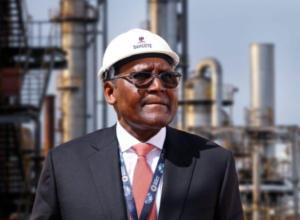
By Prisca Sam-Duru
When investigative Journalist David Hundeyin, broke the news on his X, about how he triumphed over the temptation to craft an article to smear the Dangote refinery and be rewarded ‘handsomely’, not many people believed him.
Hundeyin had last weekend in a series of posts on X, written about how he struggled first with the idea of going public with serious allegations against an international NGO, known as Dialogue Earth, accusing them of attempting to commission a smear campaign targeting the Dangote Refinery while pretending to be addressing environmental concerns.
According to him, the foreign NGO, which was known previously as China Dialogue Trust, offered him N800,000 which is about $500 to write an article to be focused on environmental issues surrounding the Dangote refinery.
“I debated long and hard whether to do this publicly, but I think a message needs to be sent to a group of external interests working in tandem with the internal interests described in the quoted tweet to counteract the interests of half a billion West Africans. A message that at whatever level we exist, we take our destiny seriously and we are not to be trifled with.
“Last week, I received an N800,000 offer from an international NGO called Dialogue Earth (formerly known as China Dialogue Trust) to write an article essentially saying that Dangote Refinery is terrible for the environment because something something “Environmental Concerns,” something something “Climate Change,” something something “Energy Transition Policy,” something something “COP 28.”
“The (unstated but clearly implied) thrust of the brief was for a prominent local voice to put their name on an article that is an argument or a premise for the the Nigerian government to kill the refinery based on its “energy transition commitments” and “environmental policy.” This conclusion wasn’t immediately apparent when they reached out to me, but I suspected where it was heading, and I quickly accepted the offer so that I could see the brief and obtain hard evidence. I’ve attached screenshots from the brief below…” Hundeyin stated.
Some netizens however, believed him, praised him for having the will power to make such important exposure in the interest of the Nigeria people. They also advised him to stay safe.
For people doubting whether the post and claim were facts, Hundeyin spoke on the same issue on Arise Television during the week. There, he explained what went down.
According to him, there are foreign actors who exploit Africa’s energy challenges which manifested recently in a narrative war against Dangote Refinery aimed at maintaining energy poverty in Nigeria.
He stated clearly that he went public with the issue so that people will know that ‘there are external interests invested in the energy poverty that Nigeria and West Africa have historically faced’.
Hundeyin who emphasised the importance of public exposure as a powerful tool against hidden agendas, maintained his earlier claim on X, that he was offered N800,000 by an international NGO, known as Dialogue Earth, to defame the Dangote refinery. N800,000? That’s what it would have taken him to do a stinker against the Dangote refinery? The bribe amount sounds quite ridiculous to many who also see it as a huge insult on the journalism profession.
His words, “People need to know that there are external interests invested in the energy poverty that Nigeria and West Africa have historically faced. I don’t believe that my going public with it is going to change the world, however, I think that the power of public exposure is one of the last few powers that regular people in this part of the world still have.
“A lot of the powers that these foreign actors wield can be wielded because it is done in secret because people don’t even know they exist.”
Just as he wrote on his X, the investigative journalist disclosed that for long, many foreign actors have been benefiting from Africa’s persistent energy challenges, adding that if he didn’t go public on this encounter, it would have been labeled conspiracy theory as usual.
“Prior to this incident, if you were to come out and tell people that there are players in the global development space or in the NGO space who would very much like the status quo to be preserved in terms of Africa being poor and Nigeria suffering from energy poverty, despite being one of the world’s largest energy exporters, it would sound like a conspiracy theory.
“There is a narrative war being fought by foreign entities, using African faces to lead this attack,” he said.
In essence, the move by the NGO involved was ‘part of a broader strategy to preserve the status quo of energy poverty in Africa despite the continent’s vast resources.’
Asked whether he believed some other journalists may have been approached by not just the NGO he mentioned but by other foreign entities to scuttle major projects in the country, he said, “Absolutely, 100%! First of all, in this instance, I’m pretty sure that I wasn’t the only journalist that they would have reached out to though I can’t prove that yet. In the aftermath of going public, they mobilised a narrative response on a news platform. There’s already a pushback where what I did was termed sensationalist…essentially, that it’s not a big deal that I kind of misrepresented what was being done and that I’m basically an attention seeker. That I did it to chase clout.”
The said offer that would have worked against Dangote refinery was according to the journalist, not the first time he was approached for commissioned work but actually, the first time he got an offer to write against Nigeria’s interest.
“It is not the first time in terms of being commissioned, that I have been approached to write a story or an article. It is very common within the journalism space but this is the first time that someone has come to me with an offer to write about something that affects my country, and affects me potentially, basically telling me to write against my own interest.”
Hundeyin maintained he made the revelation in the interest of Nigerians while not expecting action from the government.
“I expect the government to do absolutely nothing as they always do. I didn’t do this to get a response from the government. It was to educate the public because I think it is only the public that can rescue this thing now, because clearly the government of the day at the very least, doesn’t seem to care if Dangote refinery takes off or not.”
© 2024 Vanguard Media Limited, Nigeria








By Favour Bibaikefie
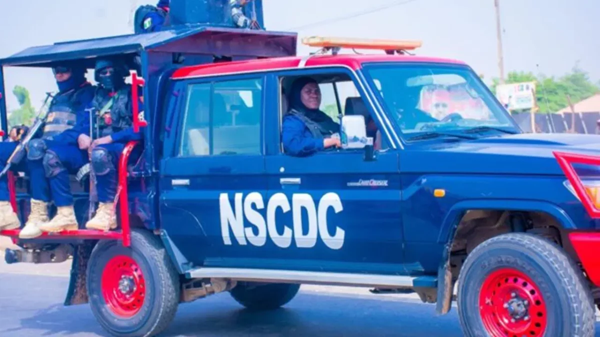
LAGOS — Operatives of the Nigeria Security and Civil Defence Corps have uncovered a suspected baby factory in Badagry area of Lagos State, rescuing 28 persons during a late-night raid.
Authorities said those rescued included 18 adults and 10 children. Among the adults were 17 pregnant women, while one case involving a suspected miscarriage was also recorded. Two persons were arrested in connection with the operation.
The Lagos State Commandant of the NSCDC, Adedotun Keshinro, disclosed that the raid followed weeks of intelligence gathering and surveillance.
According to him, the facility, located in Okuju-Ilado, Badagry, was made up of several apartments and had been monitored for about three weeks before security operatives moved in around midnight on Wednesday.
Keshinro alleged that the operators targeted vulnerable pregnant women by offering them financial inducements. He further claimed that the women were made to sign agreements and were subsequently restricted from leaving the premises freely.
Investigators also suspect that the syndicate used a fake social media profile to attract unsuspecting victims before moving discussions to private channels.
However, one of the arrested suspects denied wrongdoing, insisting that the women came willingly and that no unlawful activity took place.
A woman rescued from the premises reportedly told officials that she entered the facility voluntarily after being abandoned by the man responsible for her pregnancy.
Some community leaders in the area said residents had observed unusual movements around the compound but did not know the true nature of activities there until the security operation was carried out.
The NSCDC said both suspects and rescued victims would be transferred to the appropriate anti-human trafficking agency for further investigation and necessary action.
By Tama Peretengboro
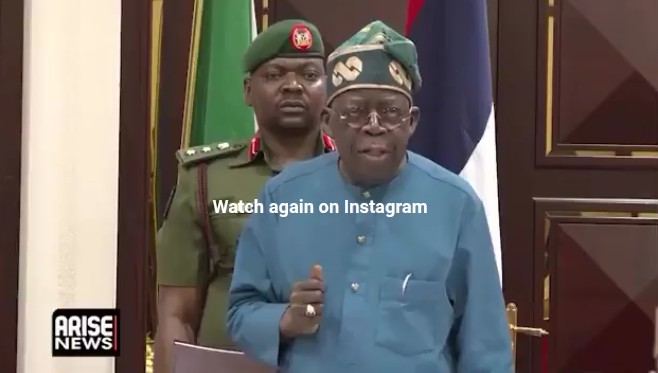
ABUJA — President Bola Ahmed Tinubu has stirred public discussion after making a remark in which he said he “took over leadership from myself” and described the late Muhammadu Buhari as being inseparable from his own political identity.
The statement, made during a public appearance captured in a viral video, quickly generated widespread reactions across political and social circles, with many Nigerians debating the meaning and context of the President’s comments.
Observers said the remarks appeared to underscore Tinubu’s close political association with Buhari and the continuity of governance between both administrations. Others interpreted the comments as an attempt to highlight the shared vision and alliance that existed between the two leaders during Buhari’s tenure.
Since assuming office in May 2023, Tinubu has repeatedly acknowledged Buhari’s role in the formation and electoral success of the All Progressives Congress, as well as the political transition that brought the ruling party to power.
The resurfaced clip has since fueled fresh commentary online, with supporters defending the statement as symbolic and critics questioning its phrasing.
As of the time of filing this report, the Presidency had not issued any formal clarification regarding the viral video.
See video: https://www.instagram.com/reel/DXOOaYSCG23/?igsh=MTF6MzJlOWptanJlYQ==
By Divine Perezide
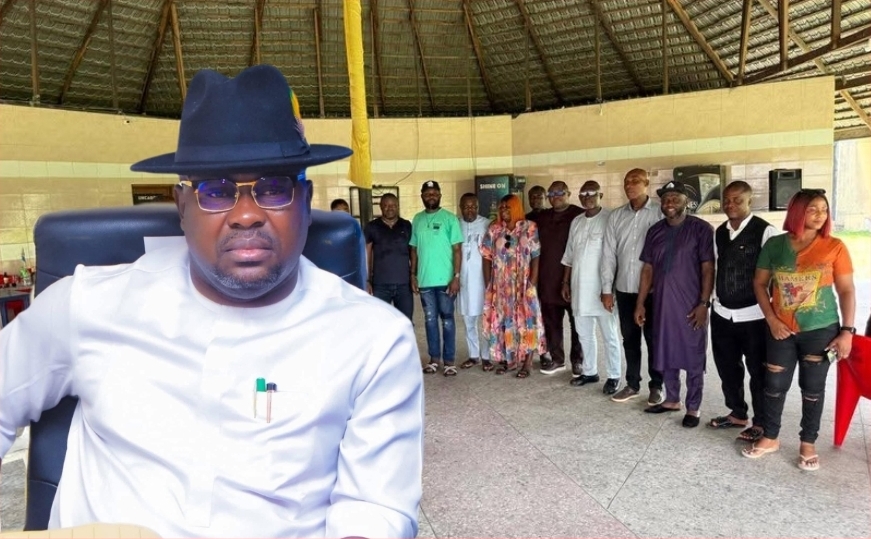
BURUTU — The member representing Burutu State Constituency I in the Delta State House of Assembly, Hon. Alapala Anthony Ebitonmo, has officially announced his intention to seek re-election in the 2027 polls.
Hon. Alapala made the declaration while addressing executives of the All Progressives Congress in Burutu Local Government Area, shortly after the release of the Independent National Electoral Commission timetable and the party’s schedule for the May 16 State Houses of Assembly primaries.
During the meeting, the lawmaker expressed gratitude to party leaders and members for their support during the 2023 general elections, particularly commending members in Burutu LGA for their steadfastness throughout the legal disputes that followed the polls.
He recalled that after his initial victory was overturned by the Court of Appeal, party loyalists remained committed until he eventually emerged victorious in the rerun election.
Speaking on his stewardship, Alapala said his administration had recorded notable progress despite the challenges that marked the early period of his tenure. He noted that the political developments in Delta State, including the alignment of major political blocs and the emergence of Rt. Hon. Sheriff Oborevwori as leader of the APC in the state, had created a more favourable atmosphere for governance.
The legislator stated that several constituency projects are ongoing across the six wards of Burutu North, stressing that grassroots development remains central to his agenda.
On human capital development, he disclosed that more than 50 constituents are currently serving in various appointments under his office, with beneficiaries drawn from all six wards to promote fairness and inclusion.
He further revealed that over 20 students from the constituency have benefited from scholarship opportunities facilitated through his office, while more than 790 students are receiving regular stipends under the Alapala Ebitonmo Students’ Support Scheme.
According to him, the initiative was introduced to reduce financial hardship among students and encourage academic success.
Hon. Alapala also said he had assisted several indigenes of Burutu North in securing empowerment opportunities as well as pensionable employment.
Reaffirming his commitment to public service, the lawmaker assured party stakeholders that if re-elected, he would build on the achievements already recorded and deliver greater democratic dividends to the people.
He also pledged continued loyalty to the APC and its guiding principles.