
News
Gbaramatu Chiefs Firmly Defend Nigerian Maritime University Against Renaming Petition.

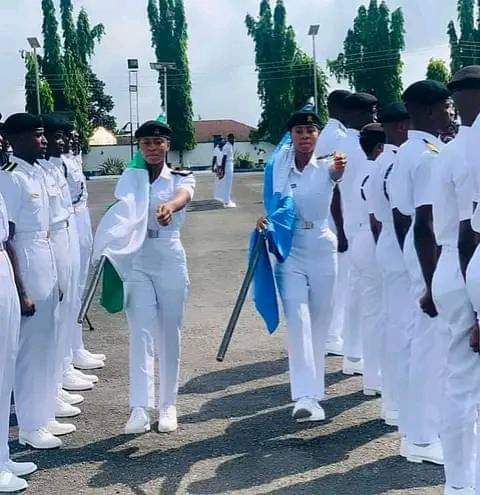
Gbaramatu Chiefs Firmly Defend Nigerian Maritime University Against Renaming Petition.
By Anthony Beauty.
In a resolute response to the recent petition submitted by the Itsekiri Omadino and their associates, Gbaramatu Chiefs Charles Torusin, Clement Sokoto, Victor Odu, and Ebi Bebenimibo have staunchly rejected calls for renaming and discontinuing funding for the Nigerian Maritime University, Okerenkoko.
Established during the administration of former President Goodluck Jonathan, the university, situated in Okerenkoko town in Gbaramatu kingdom of Warri South West LGA, has faced persistent opposition since President Muhammadu Buhari’s tenure, notably from Minister for Transportation, Rotimi Amaechi.
Amaechi, questioning the university’s necessity before the Senate committee on Marine Transport in 2016, referred to it as a “waste of resources,” citing existing institutes in Oron, Zaria, and elsewhere. Despite the opposition, the university has thrived, producing graduates who have actively participated in the National Youth Service Corp (NYSC) and recently celebrated its maiden convocation ceremony.
However, the recent petition from the Itsekiri Omadino alleges wrongful and illegal naming of the university, claiming ownership of the land based on court judgments. The petitioners further asserted fraudulent sales of Okerenkoko land and question the government’s support for the implicated party, accusing them of fanning the embers of hostility.
In response, Chiefs Torusin, Sokoto, Odu, and Bebenimibo challenge these claims, reaffirming the aboriginal identity of ‘Nigeria Maritime University, Okerenkoko’. They strongly oppose renaming the university, with emphasis on Okerenkoko’s historical significance over generations.
The Chiefs call upon the federal and state governments, as well as respected stakeholders, to address the petitioners and their sponsors. They advocate for a united front among Urhobo, Ijaw, and Itsekiri natives to prevent a recurrence of past ethnic conflicts in the Warri territory.
As the controversy unfolds, the Gbaramatu Chiefs remain steadfast in their commitment to preserving the identity and legacy of the Nigerian Maritime University, Okerenkoko.
Their rejection letter reads in full;
“AN OPEN LETTER TO PRESIDENT BOLA AHMED TINUBU GCFR, PRESIDENT AND COMMANDER–IN-CHIEF OF THE ARMED FORCES OF THE FEDERAL REPUBLIC OF NIGERIA.
“YOUR EXCELLENCY,
“RE: THE PROVOCATIVE AND MISLEADING PETITION BY THE ITSEKIRI OMADINO AND THEIR CRONIES THAT THE NIGERIA MARITIME UNIVERSITY, OKERENKOKO SHOULD BE RENAMED AND ITS FUNDING HALTED.
“Sir, the Nigeria Maritime University, Okerenkoko in Gbaramatu kingdom of Warri South West LGA was established amongst other Universities in the twilight of former president Goodluck Jonathan’s administration. Prof (Mrs.) Ongoebi Maureen Etebu and Mr. Anho Nathaniel Esoghene Lucky were appointed as Vice Chancellor and Registrar respectively through a letter referenced HME/FME/41/X/139, and signed by the then minister for Education, Malam Ibrahim Shekarau in May, 2015.
“No sooner than former president Mohammadu Buhari assumed office on 29th May, 2015, and Mr. Rotimi Amaechi sworn in as minister for Transportation on 11th November, 2015, was the start of the beginning of what one would term a whirlwind of conspiratorial gang-up headed by Mr. Rotimi Amaechi and his ilks using at some point the Itsekiri Omadino as canon fodder to close-down or halt the funding of the University.
It may be very relevant to quote Mr. Rotimi Amaechi statements in the above regard on the 19th January, 2016, when he appeared before the Senate committee on Marine transport, headed by Senator Ahmed Sani.
‘’We are not going ahead with the Nigeria Maritime University, Okerenkoko project proposed by the Nigeria Maritime Administration and Safety Agency (NIMASA) because we have an institute in Oron, we have Nigeria Institute of Transport Technology, Zaria and we have Nigeria College of Aviation in Zaria, which we could upgrade into a University status and MIMASA is proposing to build a new one’’.
“He further stated;
‘’Who will attend the university? How many parents will allow their children to go to such a place where it proposes to site the university? I don’t think we are proceeding with the University proposed by NIMASA because it is a waste of resources’’
“Interestingly, in spite of these vitriolic attacks and condemnations of the establishment of the university, the Nigeria Maritime University, Okerenkoko is developing by ‘’leaps and bounds’’. The granduants of the institution are already serving in the mandatory National Youth Service Corp (NYSC) and the University having had its maiden convocation ceremony.
“At this juncture, one ordinarily would have thought that the unwarranted calls to close down the University would have been abated, which is not the case as evidenced in the Itsekiri Omadino calling on the office of Mr. President to halt the funding of the university.
“According to the petitioner, the university is wrongfully and illegally named as Nigeria Maritime University Okerenkoko. That the lex situs of the University and the larger Okerenkoko lands belongs to the petitioner by virtue of court judgements.
“Furthermore, that they the petitioners have caused EFCC to investigate the dramatis personae (name withheld) for the fraudulent sales and overbloated price of Okerenkoko land and the said dramatis personae is not only moving freely but is also being contractually patronised by the government even as he threatens the Nigeria state and its military with his secessionist agenda.
The petitioners went further to state that the former Attorney General of the Federation had earlier sent his legal opinion to the National Assembly to rename the Nigeria Maritime University, Okerenkoko in accordance with the petitioners prayers to avert ethnic crisis. And that Mr. President should demonstrate the NADECO spirit in him to halt funding of the University.
“Without much ado, there is no- law that turns a man to become a woman vice versa. The aboriginal Okerenkoko peoples and their land have always been Okerenkoko from generations past and would always remain Okerenkoko and no foreign name can be foisted on Okerenkoko and her institutions. Okerenkoko Primary school founded in 1955, Okerenkoko Secondary School as well as the Nigeria Maritime University, Okerenkoko would continually go by the name Okerenkoko and no other.
“The purportedly obtained fraudulent judgements are pari materia with some other cases that are sub-judice for which the Supreme Court had frowned at judgements obtained against the weight of evidence. Furthermore, it suffices to say that there was complete compliance with the procurement Act and law in the acquisition of the twin land for the Nigeria Maritime University, Okerenkoko measuring 100.045 hectares and the land for the Ship Building and Ship Repairs measuring 50,280 hectares. These acquisitions have since been gazetted; Delta state of Nigeria Gazette No.38 Asaba -19th September, 2013 Vol 23 and No.39 Asaba – 26th September, 2013, Vol 23 respectively.
“It is important to state that the procurement/acquisition of the lands, the petitioners seek to rename was consummated over a decade ago and due compensations paid to the people of Okerenkoko for damages of farmlands, Shrines, Fish Ponds etc. One wonders where the petitioners were then.
Sir, we are not aware of any dramatis personae whose name(s) is withheld, that is associated with fraudulent sales of Okerenkoko land with overbloated price. For which the petitioners have caused EFCC to investigate the dramatis personae who according to the petitioners, is moving freely around and being contractually patronised by the government even as he threatens the Nigeria state and the military with his secessionist agenda.
“Furthermore, we consider it mischievous and strange for the petitioners to call on Mr. President to demonstrate the NADECO spirit in him, in a case that is clearly driven by reckless ethnic chauvinism.
“Conclusively, we respectfully call on the Federal and State governments and all critical stakeholders to call the petitioners and their known sponsors to order as the Urhobo, Ijaw and Itsekiri natives of Warri territory are an indivisible people.
“As we cannot afford history to repeat itself as in the unreasonable, wasteful and destructive Warri ethnic bloodbath of 1997 and 2003 respectively.”
Signed: Chief Charles Torusin
Chief Clement Sokoto
Chief Victor Odu
Chief Ebi Bebenimibo”
IduwiniVoice recall that the leaders of Omadina Itsekiri had petitioned President Bola Ahmed Tinubu, when he ascented to the Bill for an Act creating the Nigerian Maritime University, Okerenkoko, which had passed second reading on the floor of the Senate during President Buhari’s tenure, after it was re-presented for third reading and passage by Sen. Joel Onowakpor Thomas.

By Divine Perezide
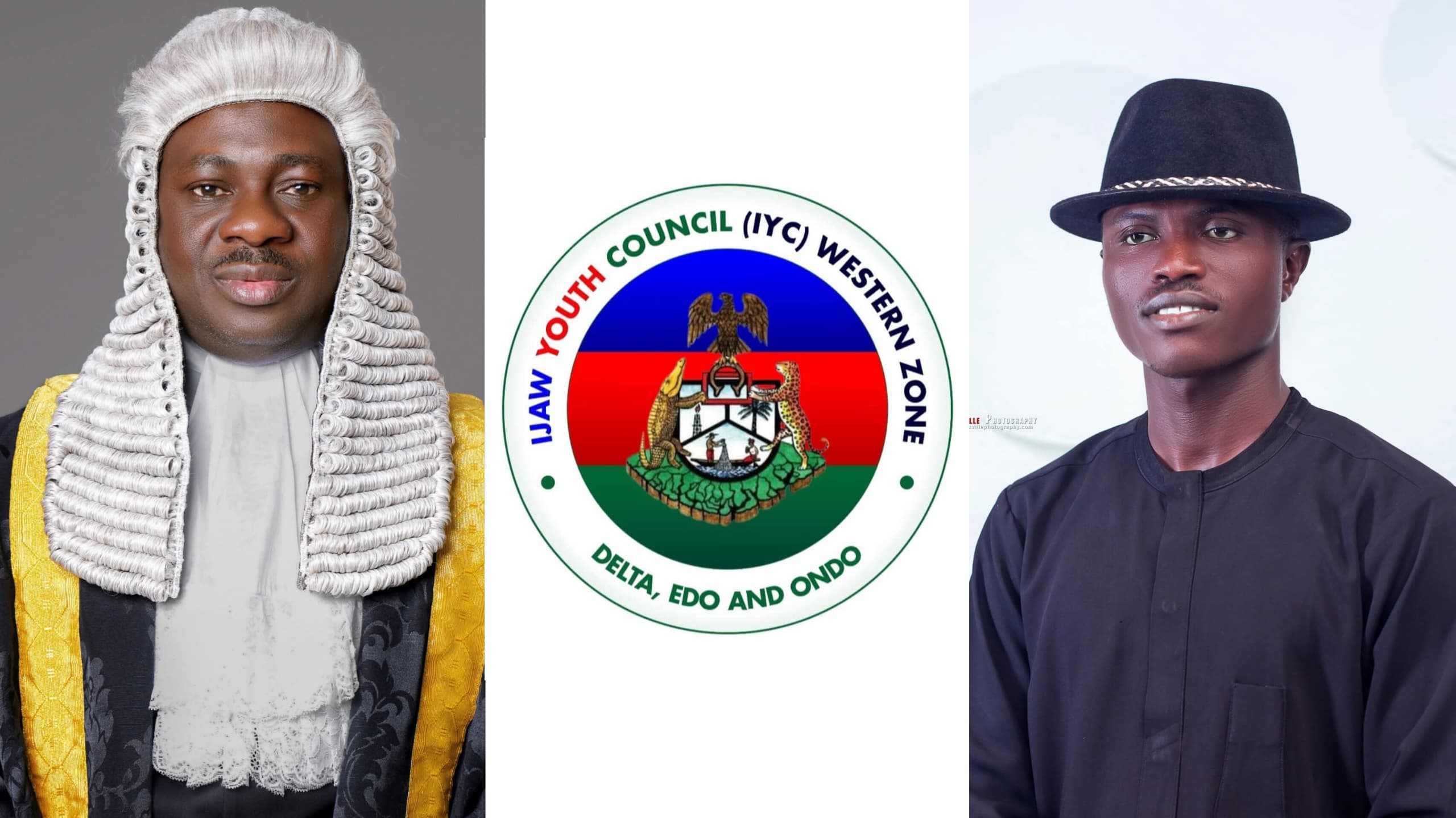
WARRI — The Ijaw Youth Council (IYC), Western Zone, has backed the Speaker of the Delta State House of Assembly, Rt. Hon. Emomotimi Dennis Guwor, over his recent assertion that Ijaws occupy six local government areas in Delta State, describing the claim as factual and widely acknowledged.
Guwor had made the statement during a gathering in Bomadi where Ijaw leaders hosted Delta State Governor, Sheriff Oborevwori. The event also featured the endorsement of President Bola Ahmed Tinubu and Governor Oborevwori as preferred candidates for the 2027 presidential and governorship elections by Ijaw stakeholders in the state.
The Speaker, while presiding over the adoption of a motion moved by Julius Pondi and seconded by Preyor Oboro, noted that the political stance reflected the position of Ijaws residing across six local government areas in Delta.
However, the comment has drawn criticism from sections of the Itsekiri ethnic nationality, who challenged the accuracy of the claim and described it as misleading.
Reacting to the controversy, the IYC Western Zone dismissed the criticisms, insisting that the Speaker’s statement aligns with demographic and political realities.
Speaking in Warri, the IYC Western Zone Information Officer, Tare Magbei, said the backlash was driven by political opposition and ethnic bias.
Magbei maintained that Ijaws have undisputed dominance in Burutu and Bomadi Local Government Areas, while constituting the majority population in Patani, Warri South-West, and Warri North, and maintaining a minority presence in Warri South.
He described attempts to discredit the Speaker as “deliberate efforts to misinform the public,” adding that the issue has been unnecessarily politicised due to the approaching election cycle.
According to him, “what the Speaker stated reflects the obvious realities known to residents of Delta State,” noting that stirring ethnic sentiments for political gain could undermine peaceful coexistence in the region.
The IYC spokesman further warned that disputing such claims could heighten tensions, emphasizing that the Ijaw people have historically demonstrated restraint and commitment to peaceful relations with neighbouring ethnic groups.
He urged political actors to prioritise issue-based engagement rather than what he termed campaigns of calumny targeted at public office holders, including the Speaker.
The development underscores growing political realignments ahead of the 2027 elections, as stakeholders across Delta State continue to position themselves within the broader dynamics of ethnic representation and electoral strategy.
By Favour Bibaikefie
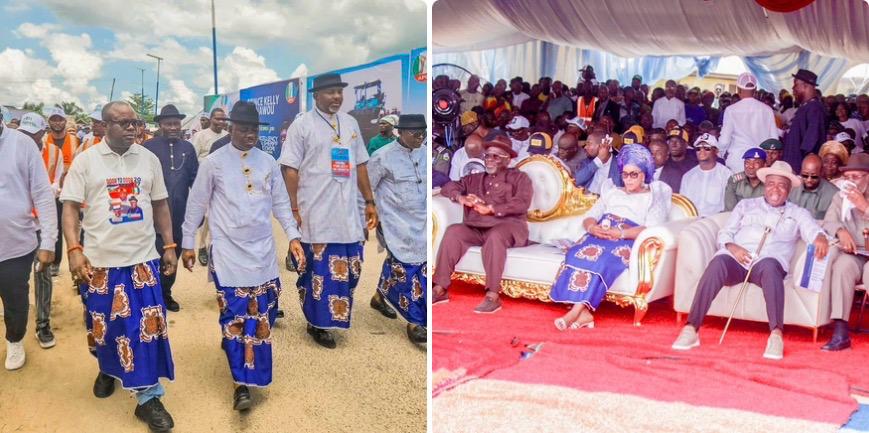
BOMADI, DELTA STATE — Prominent Ijaw leaders, traditional rulers and political stakeholders have thrown their weight behind President Bola Ahmed Tinubu and Delta State Governor Sheriff Oborevwori for second terms in office, ahead of the 2027 general elections.
The endorsement was announced at a large gathering held in Bomadi, headquarters of Bomadi Local Government Area, during a grand reception organised by Delta Ijaw political leaders in honour of the governor.
The event drew thousands of Ijaw indigenes and key figures from across the Niger Delta, including the Administrator of the Presidential Amnesty Programme, Dennis Brutu Otuaro, who led the mobilisation efforts alongside other stakeholders.
The motion for endorsement was formally moved by a member of the House of Representatives, Hon. Julius Pondi, and seconded by Delta State lawmaker Hon. Kenneth Oboro. It was subsequently ratified through a voice vote presided over by the Speaker of the Delta State House of Assembly, Emomotimi Dennis Guwor.
Also present was Bayelsa State Governor, Douye Diri, who commended the Delta State administration for its development-focused approach in Ijaw communities.
In recognition of his contributions, traditional rulers under the Delta Ijaw Traditional Rulers Forum conferred the chieftaincy title “Izonebimiewei”—meaning “the man who does good for the Ijaw people”—on Governor Oborevwori. The monarchs described the honour as a reflection of his infrastructural strides and commitment to the welfare of riverine communities.
Among the royal fathers in attendance were the Ebenana-owei of Ogulagha Kingdom, HRM Joseph Timiyan; Pere of Akugbene-Mein Kingdom, HRM Pere Kalanama VIII; and several other paramount rulers across Ijaw kingdoms in Delta State.
Addressing the gathering, Governor Oborevwori expressed appreciation for the honour and reaffirmed his administration’s commitment to inclusive development. He noted that significant investments—running into hundreds of billions of naira—had already been made in infrastructure and social development across Ijaw areas.
According to him, the continued support of the Ijaw people would be reciprocated through further projects and political inclusion.
Speaking at the event, Otuaro urged the people to sustain their support for the current administration at the federal level, citing ongoing development initiatives in the Niger Delta. He pointed to key interventions, including large-scale infrastructure projects and strengthened institutional support for regional agencies.
He emphasized that continuity in leadership would consolidate the gains recorded so far, urging members of the PBAT Door-to-Door Movement 2027 to intensify grassroots mobilisation efforts.
The Chairman of the Central Organising Committee, Hon. Funkekeme Solomon, explained that the reception was convened as a demonstration of appreciation for the governor’s developmental achievements in Ijaw communities.
The event also witnessed a strong turnout of supporters aligned with the pro-Tinubu campaign structure, further underscoring the growing political momentum ahead of the next electoral cycle.
The endorsement marks a significant political statement from the Ijaw bloc in Delta State, signalling early alignment and strategic positioning ahead of the 2027 elections.
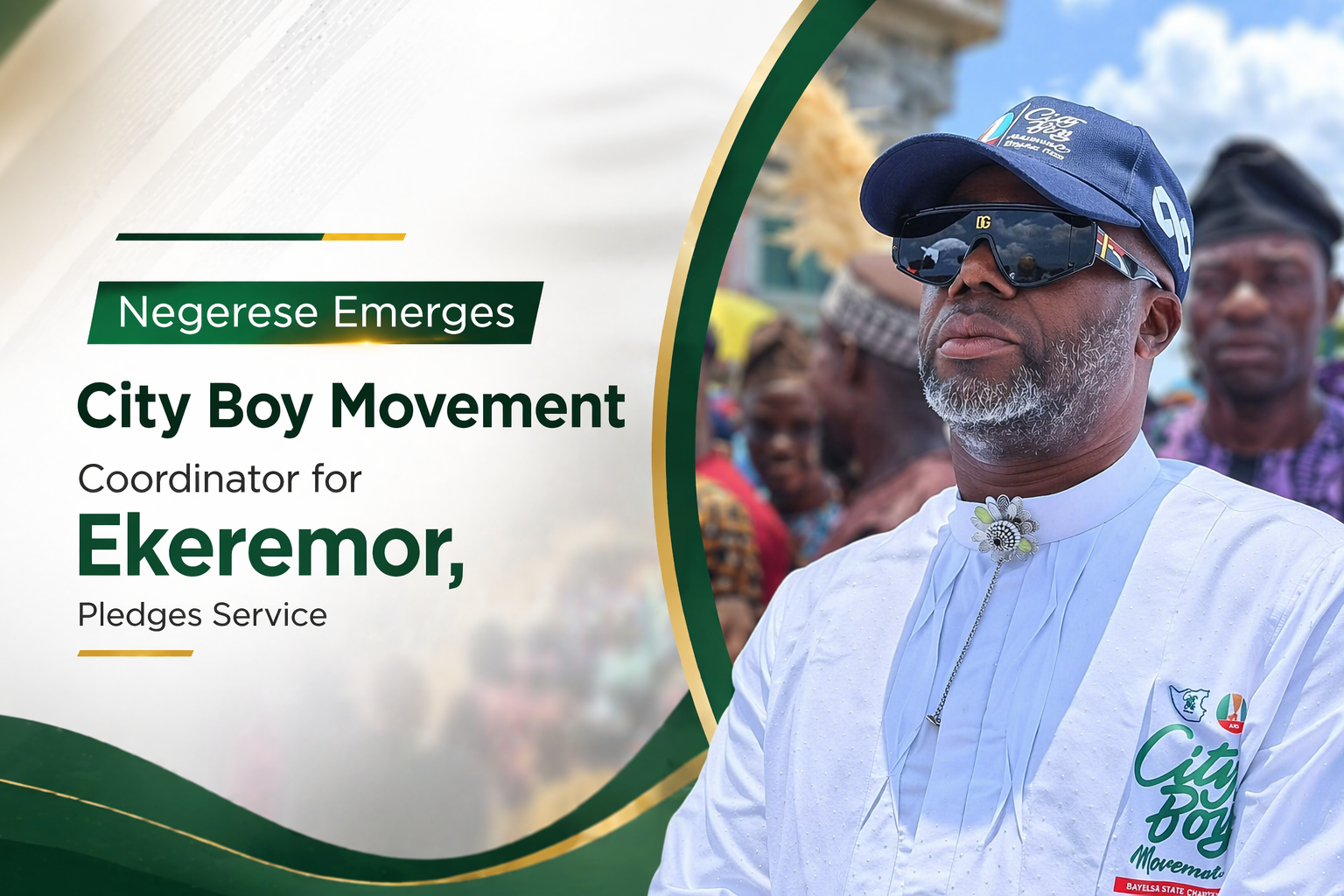
By Charity Ebi
Hon. has formally assumed office as the Coordinator of the City Boy Movement (CBM) in Ekeremor Local Government Area of Bayelsa State, pledging dedication to service and community development.
Speaking following his inauguration, Negerese described his new role as a call to responsibility and commitment rather than a mere title. He assured residents that his leadership would focus on delivering impact and fostering hope across the local government.
He expressed gratitude to God for what he described as divine grace and acknowledged the support of key political leaders and stakeholders, including the Governor of Bayelsa State, , and his deputy, . He also appreciated the Minister of State for Petroleum Resources, , for his encouragement and backing.
The newly inaugurated coordinator further thanked the leadership of the City Boy Movement, particularly the State Director-General, , as well as members of the organisation for entrusting him with the responsibility.
Negerese paid special tribute to the people of Ekeremor, including youths, women, and elders, for their support and participation in the process leading to his emergence.
He pledged to work collaboratively with stakeholders to promote development, empower residents, and strengthen unity within the area, expressing optimism about building a more vibrant and progressive Ekeremor under his coordination.