
2027
CHAOS AT APC NATIONAL CONVENTION

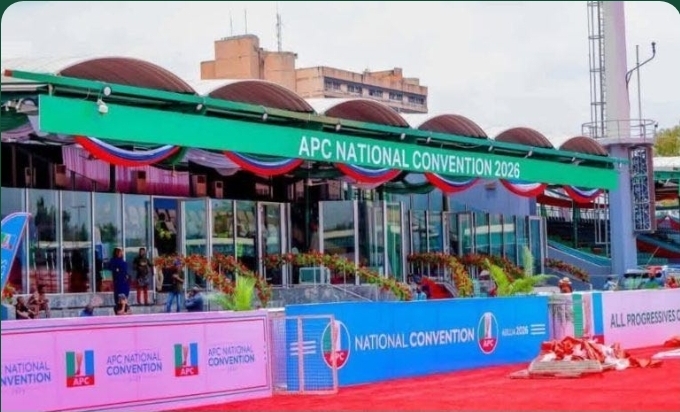
Delegates and press denied entry at Eagle Square
By Ezzine
The 4th Elective National Convention of the All Progressives Congress (APC) was marred by significant disorder at Eagle Square, Abuja, on Friday, March 27, 2026. Despite the high-profile nature of the event, hundreds of accredited delegates and journalists were reportedly locked out of the venue, leading to heated confrontations with security personnel.
The situation escalated early Friday morning as security forces, including the Department of State Services (DSS) and the Nigeria Police, implemented a total lockdown of the access gates leading to the main bowl. Many delegates, some of whom had traveled from far-flung states in the South-South and North-East, expressed frustration despite claims of prior accreditation, numerous attendees were unable to obtain the mandatory entry tags required for access, raising serious concerns about the planning and logistics of the high-profile event. Journalists from major national and international outlets also reported being physically barred from entering, despite possessing valid accreditation tags.One journalist, who identified herself as Seyi, recounted her ordeal, expressing disbelief at the disorganisation. She explained that repeated attempts to secure her accreditation through the Media and Publicity Committee yielded no results, leaving her and her colleagues locked out of a major national assignment.
The situation grew more tense as some frustrated delegates attempted to force their way through the metal detectors.
The confrontation reached a breaking point when security operatives deployed tear gas to push back surging crowds at the accreditation gates. One delegate, identified as Mallam Auwal Umar, recounted a harrowing scene where a colleague collapsed after inhaling the gas during the melee. Umar lamented the heavy-handed treatment, stating that such hostility was entirely unexpected at a national political event meant to foster party stakeholders’ unity.
A security officer on the scene, speaking on the condition of anonymity, defended the use of force. He maintained that security operatives were under “strict instructions” to admit only individuals with specific, verified identification tags. According to the officer, the deployment of tear gas became a “necessary measure” only after the crowd allegedly grew unruly and began to overwhelm the security perimeter.
The logistical failure has cast a long shadow over the convention’s core agenda. While the primary goal remains the formal ratification of the party’s leadership, the sight of disenfranchised delegates and the reported medical emergencies at the gate have raised serious questions about the overall execution of the event.
The APC National convention that was intended as a unified gathering of 8,453 delegates to ratify 30 members of the National Working Committee instead devolved into a scene of physical distress and administrative disarray.
Attention also remained on the anticipated arrival of Bola Ahmed Tinubu, who is expected to formally declare the convention open. However, the unfolding chaos has already cast a shadow over the exercise questioning the overall execution of the event.




New date, May 10 deadline for political parties
By Ezinne
The Independent National Electoral Commission (INEC) has officially extended the deadline for political parties to submit their electronic membership registers. In a statement released on Friday, March 27, 2026, the commission announced that the original closing date of April 21 has now been shifted to May 10, 2026, following intense pressure and concerns raised by party leaders.
The decision was reached after a high-level meeting between INEC officials and political party chairmen on Tuesday, March 24. Parties had expressed significant difficulties in meeting the initial timeline under the Revised Timetable for the 2027 General Elections, citing the technical demands of the new electronic registration system required by the Electoral Act 2026.
INEC National Commissioner and Chairman, Information and Voter Education Committee, Mohammed Kudu Haruna clarified that the adjustment is intended to align with Section 77(4) of the Act, which mandates that registers must be submitted at least 21 days before any primary election.
In addition to the register extension, INEC has also provided a wider window for the conduct of party primaries. Political parties are now permitted to hold their internal elections between April 23 and May 30, 2026. The commission emphasized that while the deadline has been moved to May 10, any party scheduling its primaries early in the window must ensure their register is submitted at least three weeks [21 days] prior to their specific date. This administrative shift is seen as a major relief for opposition parties that had previously protested the “tight” schedule, claiming it hindered their internal democratic processes. In view of this latest deadline, all political parties are expected to adhere to this timeline to ensure a smooth electoral process come 2027.
2027
OPEN LETTER TO INEC: EXPOSING FALSEHOODS, DEFENDING HISTORY AND DEMANDING IMMEDIATE PUBLICATION OF THE FINAL WARD DELINEATION RESULT
DATE: 19/3/2026
To the Chairman, Independent National Electoral Commission (INEC), Abuja, Nigeria.
We, the Concerned Elders of Warri Federal Constituency, write with anger that can no longer be restrained and with a sense of duty that cannot be compromised because what is unfolding before our eyes is not merely a delay but a dangerous erosion of constitutional order and a calculated suffocation of justice. Your continued refusal to publish the final ward delineation result, despite a clear and binding judgment of the Supreme Court of Nigeria, has moved beyond administrative hesitation into the realm of institutional defiance and it now stands as a direct threat to peace, stability and democratic legitimacy in Warri Federal Constituency. Let it be clearly stated without ambiguity or apology, this delay is not administrative, this delay is not accidental and this delay is injustice in motion.
We reject in totality the sustained attempts to distort the historical realities of Warri through selective narratives and deliberate misrepresentations. Documented records, colonial archives, scholarly works and judicial findings, have consistently established that Warri is a historically multi-community region whose identity cannot be monopolized by any single group. Accounts preserved in Benin archival traditions clearly indicate that Prince Ginuwa’s arrival into the coastal region was facilitated by already existing riverine populations and his prolonged stay in areas such as Amatu underscores the undeniable presence of organized communities long before the emergence of later political structures. In the authoritative work of Prof. Alan Ryder, Benin and the Europeans (1485–1897), the early presence of Niger Delta communities along the Benin River and Escravos axis is unmistakably acknowledged, while historical writings attributed to William Moore further concede that the territory was inhabited by Ijaw, Urhobo (Sobos) and Mahin peoples prior to the crystallization of Itsekiri identity. Judicial records, including Suit No. W/28/65 and other land-related litigations, equally demonstrate that ownership and occupation in Warri have always been layered, shared and contested, not absolute, not exclusive and certainly not subject to the narrow claims now being amplified. Traditional inter-marriages, lineage intersections and centuries of socio-cultural interaction across communities reinforce a simple but powerful truth. Warri’s history is one of coexistence, not monopoly. These are not emotional assertions, they are recorded facts, preserved in history, affirmed in scholarship and tested in law and no volume of propaganda can erase them.
Yet, while truth stands firmly documented, INEC has chosen silence. The Supreme Court of Nigeria has already spoken in clear, final and binding terms in the case of George Timinimi & Ors v. INEC (SC/CV/1033/2022), directing the proper delineation of wards in Warri Federal Constituency. That judgment is not open to negotiation, reinterpretation or delay. The Constitution of the Federal Republic of Nigeria, under Section 287(1), commands that the decisions of the Supreme Court shall be enforced by all authorities and persons across the Federation and INEC is not exempt from this command. The Commission has already conducted the delineation exercise, the fieldwork has been completed, communities have been engaged, data has been gathered and the process has been executed. What remains is the publication of the final result, yet this simple constitutional duty has been withheld, transforming what should have been a straightforward act of compliance into a troubling display of institutional reluctance. This is no longer a delay in process, it is a refusal to complete justice.
Let it be understood in the clearest possible terms that without the publication of the final delineation result, the electoral framework of Warri Federal Constituency remains fundamentally incomplete, structurally defective and legally questionable. Where the foundation is uncertain, the structure built upon it cannot stand and any voter registration exercise, electoral preparation or political activity conducted under such conditions raises serious concerns about legitimacy, legality and constitutional compliance. Democracy is not an abstract concept sustained by rhetoric, it is a system grounded in representation and representation itself begins with properly defined and publicly recognized electoral units. You cannot conduct credible elections on disputed boundaries, you cannot organize democratic processes on concealed outcomes and you cannot claim legitimacy where justice remains suspended.
Every passing day that INEC withholds this result deepens uncertainty, fuels suspicion and amplifies tension. Silence in a matter of this magnitude is not neutrality, it is complicity. Delay is not harmless, it is dangerous. Nigeria has paid dearly in the past for ignoring early warning signs in sensitive regions and Warri must not be allowed to drift into avoidable instability because a constitutional body refuses to act in accordance with the law. The consequences of inaction are already visible in the rising anxiety among communities, the spread of misinformation and the growing perception that forces opposed to transparency are influencing a process that should be guided solely by law and fairness.
We therefore call on the Federal Government of Nigeria to intervene with urgency and decisiveness. The Presidency must rise to its constitutional responsibility, the Attorney-General of the Federation must defend the authority of the Supreme Court and the National Assembly must not remain silent while the implementation of a lawful judgment is indefinitely delayed. A democracy where court orders are treated as optional is a democracy in decline and the rule of law must not be sacrificed on the altar of hesitation, pressure or convenience.
Our position is clear, firm and non-negotiable. We are not asking for favour, we are not negotiating for privilege and we are not pleading for consideration. We are demanding justice. We insist that INEC must immediately publish the final ward delineation result for Warri Federal Constituency in full compliance with the judgment of the Supreme Court of Nigeria. Anything short of this is unacceptable, indefensible and contrary to the principles upon which this nation stands.
INEC, the moment before you is a defining one. History will not remember explanations, it will remember actions. The courts have spoken, the process has been completed and the people are waiting. Warri cannot be held hostage by delay and justice cannot be postponed indefinitely without consequence. The Constitution must not be reduced to mere words and the authority of the Supreme Court must not be treated as symbolic.
Publish the final delineation result now. Not tomorrow. Not later. Now.
Signed:
Chief Tiemopere Joshua (President)
Chief Ebikeme T. Godstime (Secretary)
Concerned Elders of Warri Federal Constituency
Cc:
The President, Federal Republic of Nigeria
The National Assembly of Nigeria
The National Security Adviser (NSA)
The Attorney-General of the Federation
The Delta State Government
DATE: 18/3/2026
INEC’S DELAY ON WARRI FEDERAL CONSTITUENCY FINAL DELINEATION RESULT, A DELIBERATE INVITATION TO CRISIS
There comes a point in the life of a people when silence stops being patience and begins to look like surrender. We have reached that point.
The matter before the nation is simple, yet dangerously mishandled. The Supreme Court of Nigeria, in George Timinimi & Ors v. INEC (SC/CV/1033/2022), gave a clear and binding directive. INEC complied halfway, it conducted the delineation exercise. But at the very moment where truth ought to have been unveiled, it paused, withheld and retreated into a silence that now raises more questions than answers.
This is no longer delay in the ordinary sense. Delay suggests movement interrupted. What we are confronted with is something more troubling, a deliberate refusal to complete a lawful process. An institution created to protect democracy now stands at the edge of undermining it.
What makes this more disturbing is not just the silence but what that silence protects. Because behind it lies a familiar pattern, the bending of truth to suit power, the shrinking of a multi-ethnic reality into a convenient narrative and the quiet elevation of one claim above all others, not by evidence but by influence.
Warri, as history has always presented it, is not a single voice. It has never been. It is a convergence of peoples, of cultures, of histories that do not cancel one another but coexist. To attempt to compress that complexity into the authority of one throne is not only historically inaccurate, it is intellectually dishonest.
Even the law, which is expected to be neutral and dispassionate, recognizes this plurality. The Delta State Traditional Rulers Law does not construct a hierarchy of submission, it acknowledges a balance of authorities. Yet, in practice, what is being projected is something entirely different, a narrative where equality is quietly replaced with dominance and coexistence is rebranded as control.
One is then forced to ask, when did history become so negotiable?
We are reminded of 1952, when a colonial administrative decision altered a title and in doing so, attempted to stretch influence beyond its natural limits. That decision, made for convenience, not truth, has somehow survived into modern discourse as though it were an unquestionable foundation. But colonial adjustments cannot become eternal facts. If they could, then history itself would have no meaning beyond paperwork.
The danger lies not just in the distortion but in its persistence.
Because when falsehood is repeated long enough, it begins to wear the appearance of truth. And when institutions begin to act as though that appearance is sufficient, then justice is no longer guided by fact but by accommodation.
At the same time, there is an uncomfortable pattern that cannot be ignored. Warri has, over the years, been steadily weakened, not by accident but through a series of decisions and circumstances that all point in one direction. Economic relevance has been eroded. Institutions have shifted away. Opportunities have followed the same path.
Crisis, it seems, has become a silent instrument of relocation.
And now, the refusal to release a completed delineation result fits too neatly into that pattern to be dismissed as coincidence. It sustains uncertainty. It prolongs tension. It keeps representation in suspension. And in doing so, it preserves a structure where ambiguity becomes power.
But history, unlike institutions, does not forget.
Records from the colonial era, untouched by today’s political anxieties, speak plainly of Warri as a shared space, inhabited by Ijaw, Urhobo and Itsekiri. Judicial pronouncements, from the Privy Council to the Supreme Court, have repeatedly dismantled claims of overarching authority by one group over the others. These are not interpretations. They are conclusions reached after scrutiny, evidence and law.
Even earlier accounts, far removed from contemporary disputes, place the Ijaw people in the region long before the political structures now being elevated came into existence. These are not emotional claims. They are historical observations.
So the question becomes unavoidable, what exactly is being protected by this silence?
Because it cannot be the law, the law has already spoken.
It cannot be history, history has already recorded itself.
It cannot be justice, justice demands conclusion, not concealment.
What remains is something far less defensible.
The Constitution of Nigeria does not permit governance by hesitation. It does not endorse selective obedience. It does not recognize a democracy where participation is delayed until it becomes irrelevant. Sovereignty resides in the people, not in withheld documents. Representation is a right, not a privilege to be granted at convenience.
Time, in law, is not elastic. There is such a thing as reasonable time. And that time has passed.
What is left now is not a process in progress but a process in question.
It must be clearly understood that no democratic exercise can stand on an incomplete foundation. Electoral activities built on undefined or undisclosed structures are not merely flawed, they are illegitimate in principle. Legitimacy does not come from procedure alone, it comes from compliance with law and fairness.
And where those are absent, stability becomes fragile.
This is not an attempt to inflame. It is an attempt to prevent what history has shown us repeatedly, that unresolved injustice does not disappear. It accumulates. It deepens. And eventually, it expresses itself in ways that no institution can easily control.
Patience, often praised as a virtue, has limits. Beyond those limits, it begins to lose meaning.
We therefore speak, not in anger alone but in clarity.
The delineation has been done. It must be released.
The judgment has been given. It must be obeyed.
The people have waited. They must not be ignored.
Anything short of this is not neutrality. It is complicity.
Warri does not belong to a single narrative. It does not answer to a single authority. It cannot be reduced to a convenient version of itself.
It remains what it has always been, a meeting point of peoples whose rights are equal, whose histories are valid, and whose voices cannot be selectively amplified or silenced.
The responsibility now lies with those entrusted with authority.
To act.
To conclude.
To restore confidence before it erodes completely.
Because in the end, institutions are remembered not for what they began but for what they failed to finish.
Signed:
Chief Tiemopere Joshua ~ President
Chief Ebikeme T. Goodstime ~ Secretary
Stakeholders of Warri Federal Constituency for Truth and Justice
Cc:
The President of the Senate, National Assembly
The Speaker, House of Representatives
The National Security Adviser NSA
The Chief Justice of Nigeria
The Attorney-General of the Federation and Minister of Justice
Media Houses
International Observers