
News
Rivers Assembly Moves to Screen Nine Commissioner Nominees Submitted by Fubara

By Divine Perezide
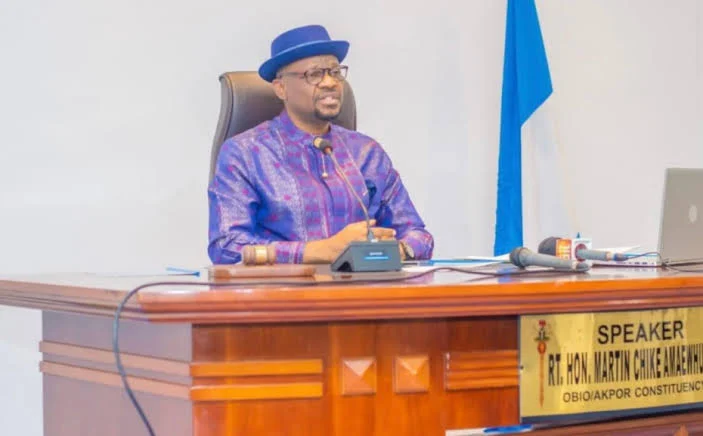
The Rivers State House of Assembly has commenced processes to screen nine individuals nominated by Governor Siminalayi Fubara for appointment as commissioners and members of the State Executive Council.
The nominees were invited by the Assembly following the formal submission of their names by the governor as part of efforts to reconstitute his cabinet after recent political developments in the state.
In a special announcement issued by the Clerk of the House, Dr. Emeka Amadi, the nominees were directed to submit detailed documentation, including multiple copies of their curriculum vitae, academic credentials and proof of tax compliance, ahead of the screening exercise.
The list of nominees forwarded to the legislature includes Professor Datonye Alasia, Mr. Tonye Bellgam, Professor Temple Nwofor, Dr. Peters Nwagor, Mrs. Charity Deemua, Tamuno Williams, Mr. Lekue Kenneth, Otonye Amachree, and Amairigha Edward Hart.
Although the Assembly confirmed receipt of the list, the exact date for the screening exercise had not been officially announced at the time of the invitation.
Political observers note that the nominations come after Governor Fubara recently reshuffled his administration, which included the dismissal of some commissioners and advisers as part of broader political adjustments within the state government.
The development also follows a period of political tension in Rivers State that prompted intervention by President Bola Tinubu, which helped calm disputes between Governor Fubara and his predecessor, Nyesom Wike, now Minister of the Federal Capital Territory.
With the screening process set to begin, the nominees are expected to appear before lawmakers to defend their credentials and policy visions before any confirmation that would enable them to assume office as members of the Rivers State Executive Council.
Analysts believe the exercise will mark another step in stabilising governance in the oil-rich state as the Fubara administration works to rebuild its cabinet and consolidate its political footing.
By Davison Tanyare
Warri — A legal dispute involving the leadership of the Ijaw National Congress (INC) has intensified following the commencement of contempt proceedings against some top officials of the organisation at the Bomadi High Court in Delta State.
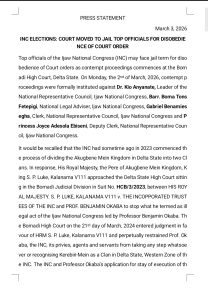
According to a press statement dated March 3, 2026, committal proceedings were formally instituted on Monday, March 2, against the Leader of the INC National Representative Council, Dr. Kio Anyanate, the National Legal Adviser, Barr. Boma Tons Fetepigi, the Clerk of the National Representative Council, Gabriel Benamiesiegha, and the Deputy Clerk, Princess Joyce Adesola Ebiseni.
The legal action is reportedly connected to an earlier judgment of the Delta State High Court sitting in Bomadi in Suit No. HCB/3/2023, filed by the Pere of Akugbene Mein Kingdom, His Royal Majesty King S. P. Luke (Kalanama VIII), against the Incorporated Trustees of the INC and the President of the organisation, Prof. Benjamin Okaba.
The monarch had approached the court to challenge a process allegedly initiated by the INC in 2023 to divide the Akugbene Mein Kingdom into two clans. In its judgment delivered on March 21, 2024, the Bomadi High Court ruled in favour of the monarch and restrained the INC, its leadership, and representatives from recognising Kerebiri-Mein as a clan within the Western Zone of the organisation.
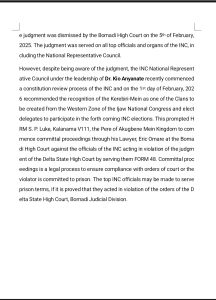
The court also dismissed an application filed by the INC seeking a stay of execution of the judgment on February 5, 2025. The ruling was subsequently served on relevant officials and organs of the organisation, including the National Representative Council.
However, the controversy resurfaced recently when the National Representative Council of the INC, during its constitution review deliberations on February 1, 2026, reportedly recommended the recognition of Kerebiri-Mein as a clan and proposed the election of delegates from the area to participate in the forthcoming INC elections.
The development prompted the Pere of Akugbene Mein Kingdom to initiate committal proceedings through his counsel, Mr. Eric Omare, who filed processes seeking to hold the officials accountable for allegedly violating the court’s order. The officials were said to have been served Form 48, which signals possible contempt proceedings that could lead to imprisonment if the court finds them guilty.
Read the Press Release issued by the monarch:
But the leadership of the Ijaw National Congress has strongly rejected the allegations, describing them as misleading and politically motivated attempts to tarnish the image of the organisation ahead of its forthcoming elections.
A senior aide to the INC President, Prof. Benjamin Okaba, who spoke to journalists in Warri, insisted that the organisation remains a law-abiding body that respects the authority of the courts.
According to him, the interpretation being given to the council’s constitutional review recommendations is inaccurate and does not amount to disobedience of any court order.
“The INC under the leadership of Professor Benjamin Okaba is a responsible and law-abiding organisation that holds the rule of law in the highest regard. At no time did the President direct any official to violate a valid court order,” the aide said.
He explained that the constitutional review exercise undertaken by the National Representative Council was part of the organisation’s routine internal administrative process and should not be misconstrued as a deliberate attempt to undermine the judiciary.
“The INC is a broad socio-cultural body representing millions of Ijaw people across Nigeria. Discussions around administrative structures or constitutional amendments are internal democratic processes and should not be misrepresented as contempt of court,” he added.
The aide further maintained that Prof. Okaba has always advocated peace, unity, and lawful engagement within the Ijaw nation, stressing that the current leadership remains committed to resolving all disputes through dialogue and legal channels.
He also expressed confidence that the courts would ultimately clarify the issues in dispute.
“We are confident that once the facts are properly presented before the court, it will become clear that there was no intention whatsoever to disrespect the judiciary. The INC leadership respects traditional institutions, respects the courts, and remains committed to the unity and progress of the Ijaw nation,” he said.
Observers within the Niger Delta say the unfolding legal dispute could influence political alignments within the INC as preparations intensify for the organisation’s forthcoming elections.
However, stakeholders are calling for restraint and dialogue to prevent internal disagreements from deepening divisions within the apex socio-cultural body of the Ijaw people.
News
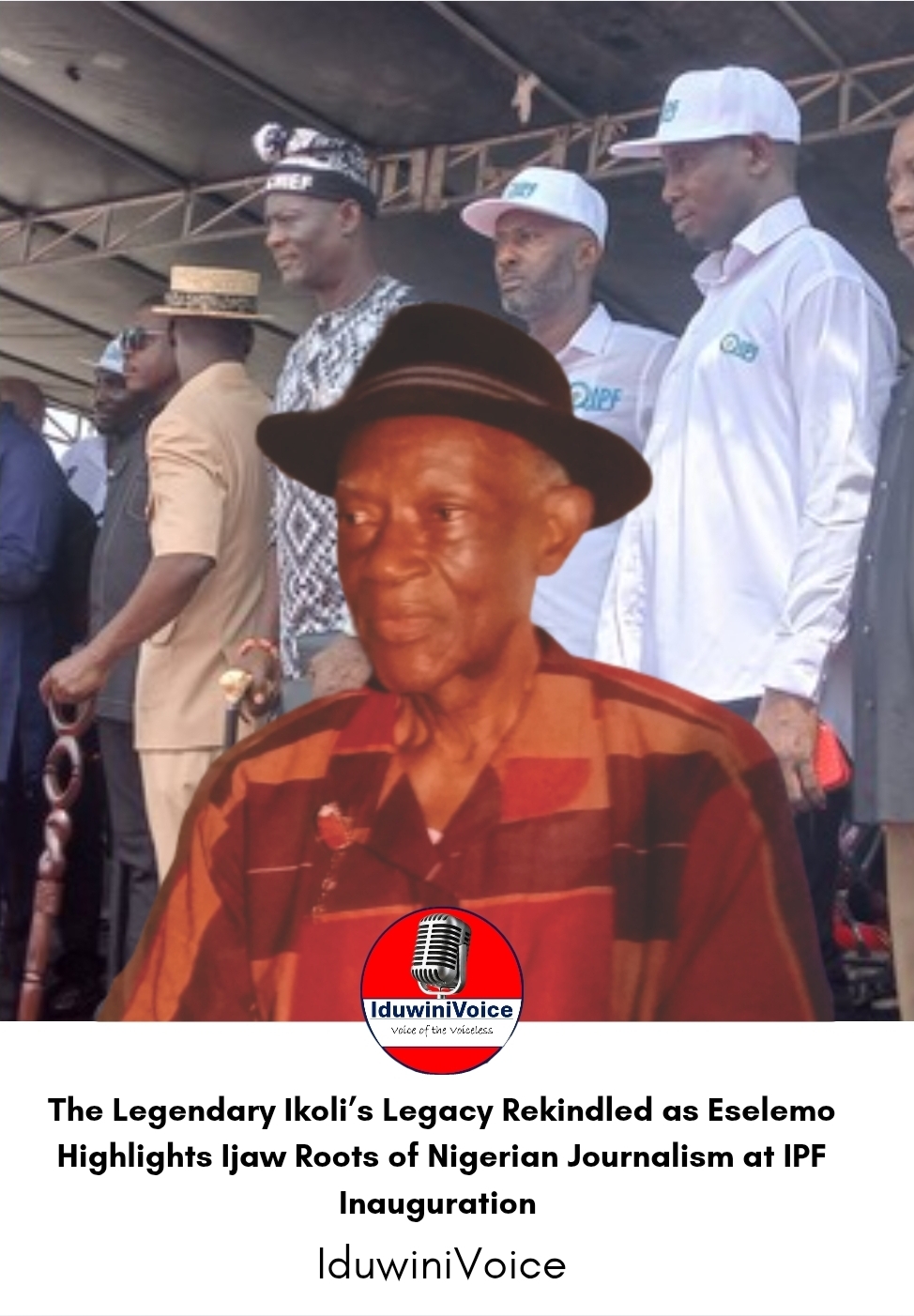
The Legendary Ikoli’s Legacy Rekindled as Eselemo Highlights Ijaw Roots of Nigerian Journalism at IPF Inauguration
By Favour Bibaikefie
WARRI — The enduring legacy of Ernest Sisei Ikoli took centre stage last Thursday in Warri as prominent Ijaw leader, Prince Collins Eselemo, a politician, foremost Ijaw nationalist and an advocate for Resource Control, declared that Nigerian journalism was built on foundations laid by Ijaw pioneers.
Speaking at the inauguration of the new National Executive Council of the Ijaw Publishers’ Forum (IPF), Eselemo asserted that the history of journalism in Nigeria cannot be told without acknowledging Ikoli’s towering contributions.
Ikoli, born in 1893 in Twon-Brass, present-day Bayelsa State, is widely recognised as one of the founding figures of modern Nigerian journalism. He became the first editor of the Daily Times of Nigeria in 1926, shaping public discourse during the colonial era through bold editorials and nationalist advocacy.
At the IPF second inauguration ceremony held last week at Ogbe-Ijoh, Warri, Eselemo maintained that Ikoli’s role in the nationalist struggle and media development underscores what he described as the intellectual heritage of the Ijaw people. He noted that Ikoli’s early association with John Payne Jacksonat the Lagos Weekly Record helped sharpen a nationalist press culture that later influenced a generation of political leaders.
Historical records show that Ikoli founded The African Messenger in 1921 before later editing The Daily Service, the mouthpiece of the Nigerian Youth Movement (NYM), which he co-founded alongside Hezekiah Oladipo Davies and J.C. Vaughan. The NYM later attracted nationalist figures including including Nnamdi Azikiwe and Obafemi Awolowo.
As president of the NYM, Ikoli was elected into the Legislative Council in 1942 and 1946, where he advocated educational reforms and greater Nigerian representation in governance. His philosophy of “one Nigeria, one Africa, one destiny” reflected a pan-African outlook that transcended ethnic lines.
Eselemo’s remarks at the IPF ceremony come amid renewed conversations about the contributions of minority ethnic groups to Nigeria’s political and media history. He urged contemporary publishers to emulate Ikoli’s courage, professionalism and commitment to truth.
Ikoli was awarded the Officer of the Order of the British Empire (OBE) in 1954 and lived to witness Nigeria’s independence on October 1, 1960, before passing away weeks later on October 21.
Today, his memory is preserved through scholarly works, the Bayelsa State “Earnest Ikoli Press Centre, and the Ernest Sisei Ikoli Foundation in Lagos, reinforcing Eselemor’s argument advanced in Ogbe-Ijoh, Warri — that the story of Nigerian journalism remains incomplete without acknowledging its Ijaw pioneers.
News
Ajapa Field MOU: Ogulagha Stakeholders Call for Review, Transparency and Alignment with Current Realities
By Charity Ebi
OGULAGHA, DELTA STATE — Nearly two decades after a Memorandum of Understanding (MOU) was signed between Britannia-U Nigeria Limited and Ogulagha Kingdom in Burutu Local Government Area, stakeholders in the oil-bearing community are calling for a comprehensive review of the agreement to reflect present-day economic and industry realities.
The 2007 MOU, tied to operations at the Ajapa Marginal Field, was introduced as a framework for peace, development and mutual benefit. However, community representatives say that while the agreement may have appeared workable at inception, its fixed financial structure has been overtaken by inflation, rising oil revenues and evolving governance standards within Nigeria’s petroleum sector.
Addressing journalists on behalf of stakeholders, Mr. Jude Iyelagha stressed that the concerns being raised should not be misconstrued as an attack on the integrity of Ogulagha’s traditional or political leadership.
“This is not an attempt to indict or insult the credibility of our revered leaders,” Iyelagha clarified. “Rather, it is an encouragement for leaders to revisit the well-documented terms, review them in line with current realities, and ensure they are fully implemented for the benefit of our people.”
Modest Provisions, Expanding Industry
Under the MOU, provisions reportedly included annual allocations for community drugs, scholarships for secondary and tertiary students, training slots at the Petroleum Training Institute (PTI), allowances for trainees, incentives for science teachers and sitting allowances for kingdom committee meetings.
While these figures may have been considered reasonable in 2007, stakeholders argue that their real value has significantly diminished over time due to inflation. Crucially, the sums were fixed and not indexed to oil prices, production output or inflationary trends.
Using conservative production estimates common to marginal fields in the Niger Delta, observers note that annual gross revenues from such operations could run into tens of billions of naira. When juxtaposed with community allocations that reportedly totalled only a few million naira annually at inception, the proportional disparity becomes a central point of concern.
For residents, the issue is less about confrontation and more about fairness.
Development Expectations in a Resource-Rich Area
Ogulagha Kingdom remains one of the oil-producing hubs in Delta State. Yet stakeholders point to ongoing challenges including limited healthcare facilities, youth unemployment, fragile road networks, environmental vulnerability and constrained access to higher education funding.
Community leaders argue that development in oil-bearing areas should translate into tangible infrastructure such as modern health centres, shoreline protection projects, potable water systems, vocational training hubs and structured employment pipelines.
“The frustration is not hostility towards investment,” a stakeholder noted. “It is about proportionality and visible impact.”
Shareholding Claims and Transparency Concerns
Beyond the MOU, a more complex issue has emerged. Leaders within the kingdom assert that Ogulagha may not only be a host community but also a registered shareholder in the Ajapa Marginal Field structure, allegedly documented with the Corporate Affairs Commission.
If such shareholding exists, corporate law provides for certain rights, including access to audited financial statements, notice of Annual General Meetings and entitlement to dividends where declared.
Stakeholders claim that consistent access to production data, audited accounts and dividend clarity has not been fully established, raising questions about governance participation.
Again, Iyelagha emphasised that the intention is not to cast aspersions.
“We believe in dialogue and institutional engagement. What we are asking for is clarity, transparency and alignment with statutory expectations where applicable,” he said.
Petroleum Industry Act and Changing Standards
Analysts observe that the Petroleum Industry Act (PIA) has introduced more structured host community frameworks and governance mechanisms. Agreements executed before the reform era, they argue, may require review to align with contemporary standards of transparency and proportionality.
Stakeholders maintain that revisiting the 2007 framework would not only protect the long-term interests of the kingdom but also strengthen investor-community relations.
Company Response Awaited
Efforts to obtain official comments from Britannia-U Nigeria Limited were unsuccessful at the time of filing this report. The company’s response, when received, will be reflected in subsequent updates.
For now, the central appeal from Ogulagha stakeholders is measured and deliberate: a call for leaders to examine documented agreements, align them with present realities, and ensure that promises made translate into visible, sustainable benefits for the kingdom.
As one community voice put it, “Oil is finite, but our people and our future must endure.”