
News
DSC Roundabout Flyover Nears Completion as Delta Govt Conducts Pre-Handover Inspection


By Charity Ebi
The Delta State Government has conducted a pre-handover inspection of the DSC Roundabout Flyover in Effurun, describing the exercise as a major step toward the completion of one of the state’s flagship urban infrastructure projects.
The inspection, held on Monday, was led by the Commissioner for Works (Highways and Urban Roads), Comrade Reuben Izeze, alongside a high-powered and multidisciplinary delegation that included the Commissioner for Agriculture and Natural Resources, Barr. Val Arenyeka; the Executive Assistant to the Governor on Project Monitoring, Mr. Tuoyo Abigor; the Functioning Permanent Secretary in the Ministry of Works, Engr. Solomon Aghagba; the Technical Assistant to the Governor, Engr. Bob Nakpodia; senior engineers from the Ministry of Works, as well as representatives of the contractor, Julius Berger Nigeria Plc.
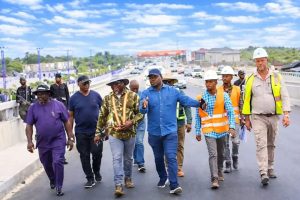
Addressing journalists during the inspection, Izeze said the exercise was carried out to assess the quality and level of work already executed before the final handover of the project.
“This visit is to enable us carry out a pre-handover inspection of the DSC Roundabout Flyover and see the level of work that has been done so far. The flyover aspect of the project is about 98 per cent completed,” he said.
He explained that the inspection followed an invitation by the contractor in order to identify and correct any outstanding issues ahead of final takeover by the state government.
“We were invited by the contractor to make our observations now, so that any issues identified can be addressed ahead of the final inspection and formal handover,” Izeze stated.
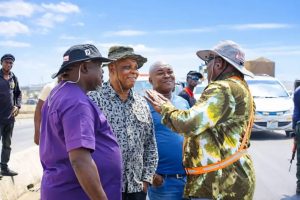
According to him, the inspection team moved from the Agbarho end of the flyover through to the Effurun axis, closely examining the structure and associated works.
Expressing satisfaction with the outcome of the exercise, the commissioner added, “From what we have seen, we are satisfied with the level of work done so far. We expect that by the time we return, based on the contractor’s invitation, the project would have attained 100 per cent completion.”
Although the project does not fall directly under his ministry, the Commissioner for Agriculture and Natural Resources, Barr. Val Arenyeka, highlighted the strategic importance of the flyover to the state’s agricultural value chain.
“Delta State is a major producer of food, and infrastructure like this flyover and the connecting roads are critical. Areas such as Ughelli, Abraka and other hinterland communities are key food-producing zones,” he said.
Arenyeka noted that the project would improve logistics for agricultural produce, stressing that “this bridge will significantly ease traffic and enhance the transportation of agricultural produce to the city, ultimately supporting food availability and affordability.”
He further disclosed that the state government was expanding food production through public-private partnerships, revealing that the state currently has “over 2,000 hectares of vegetable farms in Orerokpe, about 3,800 hectares dedicated to cassava cultivation in another axis with attached processing facilities, and more than 132 hectares of rice under dry-season farming in Aviara, Isoko South Local Government Area, a first in the state with plans to expand further.”
On his part, the Executive Assistant to the Governor on Project Monitoring, Mr. Tuoyo Abigor, confirmed that only minor finishing works were left on the project.
“As you can see, the road is almost 100 per cent complete. What remains are minor additional works, such as street lighting, which is a separate project,” Abigor said.
He added that “the flyover is already open for public use, and the quality of work here is of the highest standard. The project is progressing strictly in line with the plan.”
The DSC Roundabout Flyover, when fully completed and handed over, is expected to significantly decongest traffic in Effurun and its environs, improve road safety and stimulate economic activities by ensuring smoother movement of people, goods and services across the metropolitan area.
Source: Pebnews Global













By Favour Bibaikefie
Amid growing debates over the future of pipeline surveillance operations in the Niger Delta, traditional rulers from Delta State have warned that any attempt to fragment existing security arrangements could reverse recent gains in oil production, environmental recovery, and regional stability.
The caution formed the crux of deliberations at an enlarged meeting of monarchs drawn from Ijaw, Urhobo, Isoko and Ndokwa ethnic nationalities, held on Monday at the palace of the Ovie of Uvwie Kingdom, HRM Dr. Emmanuel E. Sideso Abe I, in Uvwie Local Government Area.
In a communiqué issued at the end of the meeting, the monarchs expressed strong reservations over calls for the decentralisation of the pipeline surveillance contract currently handled by Tantita Security Services Nigeria Limited, insisting that the arrangement is already structured to accommodate multiple stakeholders across ethnic lines.
“Our findings show that the contract is already decentralised, with various contractors handling different sections across ethnic nationalities,” the monarchs stated, warning that further fragmentation could disrupt coordination and weaken operational efficiency.
The royal fathers, numbering over 50, argued that stability in pipeline security architecture has been central to the significant rebound in Nigeria’s oil output, which they put at approximately 1.8 million barrels per day, alongside increased gas production and renewed investor confidence.
They noted that prior to the introduction of the current surveillance framework in August 2022, Nigeria’s oil production had plummeted to about 700,000 barrels per day due to widespread crude theft, illegal bunkering and sabotage.
Speaking at the meeting, a representative of the security firm, Barrister Emmanuel Jakpa, underscored the fragile nature of the progress recorded, cautioning that the improvements in oil output and environmental conditions could be short-lived if continuity is not maintained.
“This progress is not irreversible. If the right things are not sustained, we may return to the days of pollution and insecurity,” Jakpa warned.
Beyond production figures, the monarchs highlighted the broader socio-economic impact of improved security, noting that cleaner waterways and reduced pollution have revitalised traditional livelihoods such as fishing and farming, while also creating employment opportunities for youths engaged in surveillance activities.
They added that the decline in crimes including kidnapping, sea piracy, armed robbery and pipeline vandalism has contributed to a more peaceful environment across host communities.
While reaffirming their support for Tantita’s role in the region, the traditional rulers called for enhanced collaboration between the company and local institutions to consolidate the gains already achieved.
They emphasised the need for sustained engagement, transparency and community inclusion as critical factors in maintaining peace and preventing a relapse into instability.
The monarchs’ position comes at a time of heightened scrutiny of pipeline security contracts in the Niger Delta, with stakeholders weighing options to further optimise oil and gas infrastructure protection in one of Nigeria’s most strategic economic corridors.
Observers say the intervention by the traditional rulers underscores the delicate balance between policy reform and operational continuity in safeguarding the nation’s energy assets.

By Ezinne
The Cross River State Police Command has officially unveiled a comprehensive lineup of activities to mark the 2026 National Police Day. Speaking at the Command Headquarters in Calabar on Sunday, March 29, 2026, the Commissioner of Police, CP Rashid B. Afegbua, stated that this year’s celebration, themed “Community Partnership: Building Trust,” is designed to bridge the gap between law enforcement and the public.
The week-long celebration kicked off today, Monday, March 30, with statewide environmental sanitation exercises and a free medical outreach for residents at Millennium Park in Calabar. On Tuesday, March 31, the Command will host a walkathon starting from the State Headquarters to promote physical fitness and civil engagement. Midweek activities on Wednesday, April 1, will shift to Etim Edem Park for public sensitization campaigns focused on road safety and the prevention of electoral violence ahead of future polls.
A solemn highlight of the schedule is set for Thursday, April 2, when the Command will present welfare cheques to the families of fallen officers in recognition of their ultimate sacrifice. CP Afegbua emphasized that these initiatives, spearheaded by Inspector-General of Police Olatunji Rilwan Disu, are vital for fostering mutual cooperation. The activities will culminate in a grand ceremonial parade on April 7 at Eagle Square, Abuja, where Cross River will join other state commands for the national finale. Residents are encouraged to participate in the local events to help build a more secure and collaborative society.
News
Prof. Benedict Benebai Decries Lack of Unity, Peace in Ijaw Nation, Calls for Mega City Development

By Agregor Immaculate
A prominent Ijaw leader, Benedict Benebai, has intensified calls for unity, peace, and accelerated development, underscoring that collective cohesion remains vital to achieving meaningful progress in the region.
Speaking during a recent interview, Benedict Benebai expressed deep concern over growing divisions among the Ijaw people, warning that persistent disunity continues to erode their collective strength and political relevance. He urged leaders, youths, and key stakeholders to rise above differences and unite around a shared vision that advances the common good.
According to him, peace remains a fundamental prerequisite for sustainable development, noting that conflict and instability not only discourage investment but also significantly hinder economic growth. He therefore called for sustained dialogue, mutual tolerance, and strengthened cooperation among communities to foster a stable and secure environment capable of attracting both government and private sector support.
The Professor Benebai also highlighted the paradox of underdevelopment in the Niger Delta, despite its vast natural resources. He advocated for improved infrastructure, quality education, better healthcare systems, and increased economic opportunities for young people in the region.
In a major highlight of his address, Benedict Benebai proposed the development of an “Ijaw Mega City” — a visionary central urban hub aimed at driving economic growth, creating employment opportunities, and serving as a powerful symbol of unity and cultural pride for the Ijaw people. He noted that such an initiative could ease migration pressures on existing urban centers while strategically positioning the Ijaw nation as a formidable economic force.
“The future of the Ijaw people depends on our ability to unite as one, sustain peace, and build enduring structures that will benefit generations to come,” he said. The proposal has since ignited widespread discussions among stakeholders, many of whom regard it as an ambitious yet potentially transformative pathway to regional development, provided it is carefully planned and effectively implemented.
Observers, however, maintain that the success of the initiative will hinge largely on strong political will, active community participation, and sustained strategic investment.
Experts say the initiative’s success will be driven by political commitment, community engagement, and targeted strategic investment.
With unity, peace, and strategic investment, the Ijaw Mega City could become a cornerstone for regional development and cultural pride.