
News
OPEN LETTER: GROUP WRITES INEC, THE FEDERAL GOVERNMENT, AND THE GLOBAL COMMUNITY OVER WARRI DELINEATION

IduwiniVoice
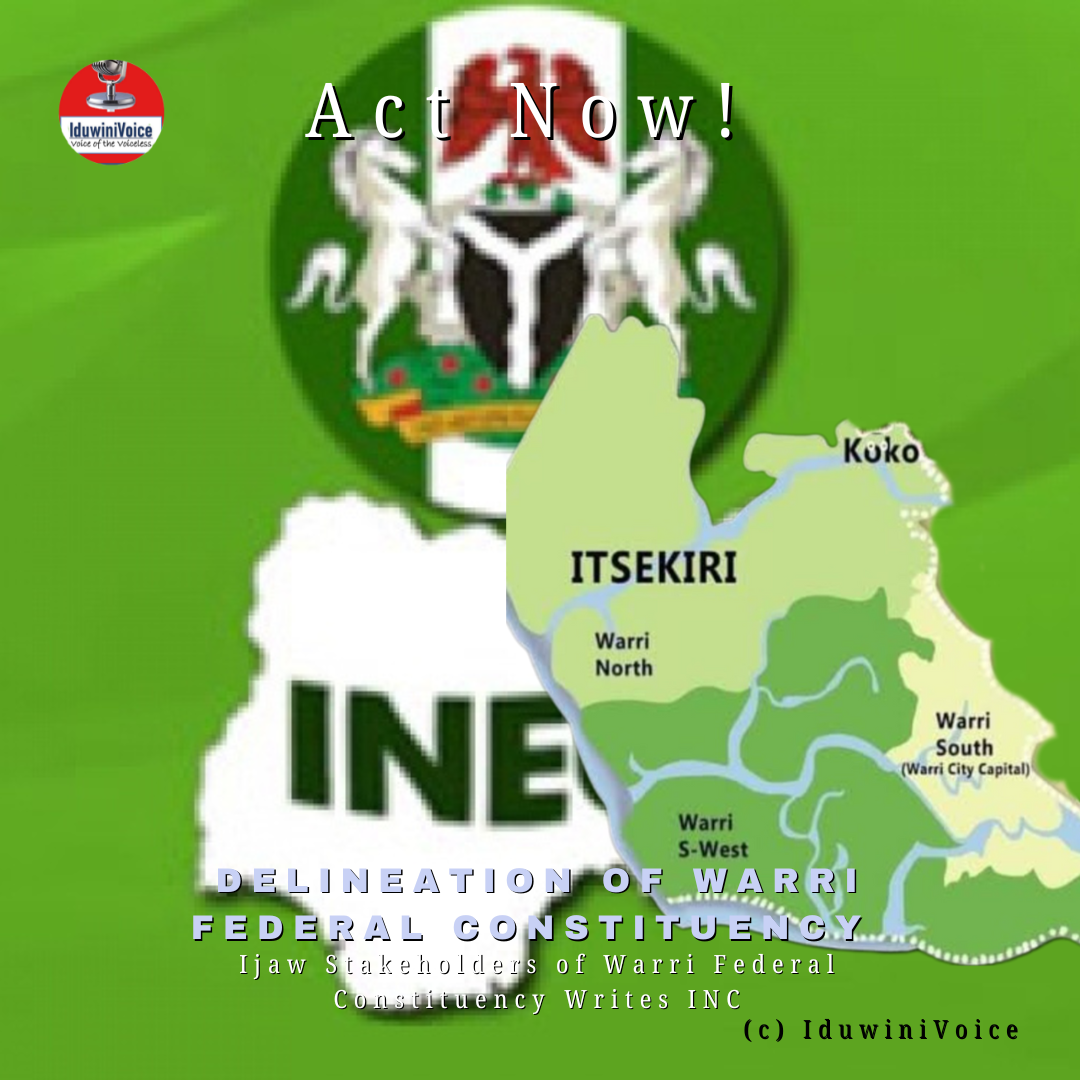
The Truth Advocates Of Niger Delta have written an Open Letter to INEC, the Federal Government, and the global community, demanding the immediate release of Warri Ward Delineation report and condemning elites interference, historical distortions, and constitutional violations against the Ijaw people.
Read details below:
“OPEN LETTER TO INEC, THE FEDERAL GOVERNMENT, AND THE GLOBAL COMMUNITY
From: The Truth Advocates Of Niger Delta
Title: “Truth Is Not Tribal – Stop Delaying Justice in Warri”
INTRODUCTION:
“When lies stand too long, they begin to sound like law”
“We write this letter not as agitators, but as children of a wounded truth, a truth long buried beneath colonial favoritism, royal propaganda and elite manipulation. Once again, the Itsekiri political class has taken to the public square, releasing a deceptive publications, manipulatives tactics, which dares to label the Ijaw people as “tenants” in their own ancestral lands. Such arrogant falsehoods are not just offensive; they are historically, legally and morally bankrupt.
“In a region soaked with the memory of injustice and survival, this is not the time for games. This is not the time for myths masked as history. This is not the time to twist public discourse with recycled colonial lies or stage-manage royalty as a weapon of political suppression.
“Let it be made clear: the Ijaw people of Warri Federal Constituency will not be lectured into silence. We will not be intimidated into accepting a borrowed throne, a forged map or a manipulated process.
“We come armed with evidence, not emotion. With archival records, not fantasies. With Supreme Court judgments, not tribal decrees. And we have come to speak for our ancestors, for our children and for the truth whose time has come again.
“This letter is not a plea. It is a rebuttal. It is not a protest. It is a declaration of resistance to historical theft and political blackmail. The truth must now walk unchained. And if this system dares to delay justice one more day, it must also be ready to answer for what comes next.
Let the facts speak. Let the lies collapse. Let the land remember.
“Everybody Sat at the Table — Nobody Should Flip It Now”
The process was inclusive from start to finish. Nobody was sidelined. INEC has the maps, the minutes, the signatures, the evidence. Every ethnic group was invited. Every group responded. Every group participated. But now, as the outcome edges closer to reflecting the demographic truth, suddenly those who once smiled at the process now cry foul. Let it be clear: those now playing the victim card are not doing so because of injustice, they are doing so because they can no longer suppress the numbers. The facts are stubborn: Ijaw communities not only outnumber Itsekiri settlements, they also host the majority of polling units, settlements and landmass in the Warris
INEC Ward Assessment Survey, 2022:
“Ijaw and Urhobo communities host more polling units and settlement clusters than Itsekiri enclaves.”
“The irony is loud, the very people who participated in this process and signed off on its methods, are now trying to flip the table because the mirror of data no longer flatters their dominance. This is not about fairness. It’s about fear, the fear of finally facing democracy without distortion.
“Hands Off the Process: Warning to Power Brokers Behind the Shadows”
“We will not sit idly by while unelected Itsekiri elites and power brokers attempt to hijack a constitutional process that was hard-won through lawful engagement and a Supreme Court victory. We call out, without hesitation, Mrs. Daisy Danjuma, Senator Oluremi Tinubu, and others lurking behind the curtains of influence, political actors who have never lived in our riverine communities, never participated in our sufferings and never attended the public hearings that led to INEC’s delineation efforts. These women did not walk the creeks of Ogbe-Ijoh, Gbaramatu, Isaba, Egbema etc. They did not submit memoranda to INEC. They did not participate in the verification tours of 2022–2023. Yet today, they move between Aso Rock and Abuja boardrooms, pressuring INEC to delay the release of a lawful report simply because it no longer protects a fraudulent ward structure that has kept Ijaw people politically suppressed for decades.
Premium Times, March 3, 2024:
“INEC’s final report on Warri wards stalls amid pressure from political elites close to the Presidency.”
Supreme Court Judgment – SC/CV/1033/2023 (Timinimi v. INEC):
“INEC’s prolonged inaction on the delineation process constitutes a violation of the Electoral Act and an infringement on the rights of underrepresented communities.”
“The involvement of these elites is not hidden, it is whispered in political circles and backed by the sudden and suspicious paralysis of a commission that had already concluded fieldwork and received all necessary inputs. Warri is not their inheritance. INEC is not their servant. The Constitution of Nigeria does not recognize tribal queenship, nor does it bend to whispers from those who are terrified that demographic justice will unseat decades of colonial privilege. The courts have spoken. The communities have spoken. The data has spoken. It is only these shadowy influencers who still cling to fear because they know that true delineation will expose the minority rule their crown depends on.
CO 554/120/5 – British Colonial Report, 1936:
“The agitation for the title ‘Olu of Warri’ has created tension in areas not historically under Itsekiri rule.”
Prof. Obaro Ikime – Groundwork of Nigerian History (1980):
“The political advantage granted to Itsekiri through colonial structures was disproportionate to their actual demographic spread.”
“Let it be known: Daisy Danjuma is not INEC. Oluremi Tinubu is not the Nigerian Constitution. The Itsekiri crown is not a federal institution. Warri belongs to all who have built it, suffered for it and defended it, not just those who inherited a title built on cartographic fraud. If this process is stalled again by shadow hands, then they, not the Ijaw people, will be held responsible for whatever national consequences follow. The law must prevail, not favoritism, not fear and certainly not the manipulations of privileged women hiding behind ancestry to silence a court-backed truth.
“OPC and Other Saboteurs: Stay Clear or Be Dragged by Consequences”
“We warn, without apology and without mincing words: OPC and every external saboteur must stay clear of Warri. This is not your land, not your fight and not your jurisdiction. You were not part of the pain, you were not part of the process and you will not be allowed to disrupt the justice we have lawfully pursued.
“You were absent from the INEC delineation hearings.
You have no ancestral ties to Ogbe-Ijoh, Gbaramatu, Agbassa or Okere.
You are not party to Timinimi v. INEC (SC/CV/1033/2023).
You do not know the creeks. You do not know the struggle.
And you will not be allowed to hijack the future of a people you do not understand.
“If you think that releasing provocative letters, issuing threats or marching under the banner of regional chauvinism will stop a Supreme Court-backed process, then your arrogance is only matched by your ignorance. This is not Lagos politics, this is Warri. And in Warri, we do not bow to strangers. We confront them.
“Let it be made clear: any further attempt by OPC or their sponsors to interfere in the ongoing delineation exercise will be treated not as civil dissent, but as a direct threat to peace, justice and constitutional order in the Niger Delta.
“We have warned once. There will be no second warning. If you cross the line, you will be met with consequences.
We are peaceful. We are lawful. But we are not weak.
Respect your boundaries or be dragged by the consequences.
“You Cannot Hide Under Royalty to Suppress Truth”
“We reject, with historical certainty and legal clarity, the manipulative tactic of using the title “Olu of Warri” as a shield to obstruct constitutional justice and suppress demographic truth. The attempt to invoke emotional reverence for a throne whose origin is rooted in colonial deception is not only dishonest, it is dangerous. The title “Olu of Warri” was not an ancient reality but a colonial creation in 1952, when British administrators, under pressure from the Itsekiri elite, deliberately altered the accurate tribal title “Olu of Itsekiri” to “Olu of Warri”, in order to extend influence over areas never historically or culturally under Itsekiri control. This was met with immediate resistance by the Ijaw and Urhobo peoples, who rightly rejected the imposed sovereignty of a king they never accepted.
CO 554/120/5 – British Colonial Office File, 1952:
“The change to ‘Olu of Warri’ has generated intense resistance from the Ijaw and Urhobo who are not subjects of the Olu.”
“Prof. Philip A. Igbafe, “Benin Under British Administration,” (1979):
“The Olu’s authority was historically confined to Itsekiri-speaking communities and was never recognized across the multi-ethnic Warri region.”
“This throne does not speak for Warri. It does not represent the Ijaw or Urhobo peoples. It cannot rewrite history and it cannot override a court ruling. Yet, we continue to see the Itsekiri establishment invoke this crown, embellished with colonial mythology as if it were a federal institution capable of overruling the Supreme Court’s decision in Timinimi v. INEC (SC/CV/1033/2023). But Nigeria is a constitutional republic, not a monarchy. Our democracy is governed by law, not inherited titles. The Olu of Warri may command cultural reverence among his people, but he does not and cannot wield authority over territories historically and legally affirmed to belong to others.
Shell v. Tiebo VII (1996) 4 NWLR (Pt. 445) 657:
“The Supreme Court ruled in favor of the Ijaw people of Gbaramatu as rightful owners of the Escravos land, rejecting Itsekiri ownership claims.
Chief E.E. Sillo & Ors v. Military Governor of Mid-Western State (1973):
“The court struck down Itsekiri attempts to claim Ogbe-Ijoh land, reaffirming Ijaw ownership.
Ojakovo v. Ajomiwe (1961):
“The court recognized Urhobo ownership of Okere lands, dismissing Itsekiri encroachment.
“So when the Itsekiri elite rally behind the Olu’s throne as though it is a sacred wall against reform, let it be known: you cannot hide under royalty to block a Supreme Court order, delay INEC’s constitutional duty or silence the ancestral rights of the Ijaw peoples. That title has no jurisdiction outside Itsekiri territory. It does not grant you dominion over other nations. It does not bestow the right to distort boundaries, hijack ward structures or control federal institutions through ancestral cosplay.
“The colonial fiction of a pan-Warri monarchy has expired. The legal record is clear. The map is clearer. Warri is not a theocracy. Nigeria is not beholden to a tribal crown. And no king, no matter how adorned or amplified by propaganda, can cancel justice sealed by the Constitution.
“Let the process move forward. Let INEC do its duty. Let the truth breathe. Because this time, no borrowed throne can suppress it.
“Let The Truth Speak”
“You have no population. You have no physical landmass. What you parade around with are fake documents, inflated maps and a manufactured internet presence that collapses under the weight of reality. INEC saw through the lies. INEC walked the land. INEC entered the creeks. INEC countedthe settlements. And what they found was not digital propaganda, they found the truth: that the Ijaw people overwhelmingly occupy the lands of Warri Federal Constituency.
“Your manipulated census figures, ghost communities and political blackmail cannot stand against the facts on the ground. You cannot use colonial relics and forged claims to override the constitutional authority of lawful demarcation.
“Let it be made abundantly clear: INEC must stand by the truth it uncovered. Any attempt to reverse, delay or alter that truth because of ethnic tantrums or elite pressure will not be seen as politics, it will be seen as an assault on justice.
“And justice cannot be negotiated.
Anything short of that truth will be considered a declaration of war on our identity, our rights and our future.
“We are watching. We are counting. And we will not allow fake maps to erase living people. Let the process speak. Let the truth stand.
“The Desperation Of Time Bomb”
“Every covert scheme and overt maneuver to halt the delineation process has been noticed and documented. From clandestine arms stockpiling to shameless gunrunning, from veiled threats to INEC officials to orchestrated media blackmail, the desperation is loud and dangerous. We have seen Itsekiri agitators shuttle from palace to palace, running from one monarch to another across Nigeria in a bid to manufacture tribal sympathy for a fraudulent cause. We have watched the strategic mobilization of ethnic militias and the release of inflammatory publications and petitions recklessly addressed to INEC an agency constitutionally protected from tribal interference. All these acts are not the behaviors of a people confident in truth or justice, they are the acts of a group terrified of demographic exposure and legal finality.
Vanguard Newspaper, July 2025:
“OPC letter to INEC warns of unrest in Warri if the delineation result favors other ethnic groups.”
Timinimi v. INEC (SC/CV/1033/2023):
“The Commission is compelled by law to conclude and publish the outcome of the delineation process in accordance with population distribution and constitutional equity.”
“We say this without mincing words: every manipulation is being tracked, every move is being watched like a ticking time bomb. We do not wish for conflict. We do not pray for a repeat of 1997, 2003, or the other dark chapters of ethnic unrest in Warri. But if push comes to shove, if justice is denied and the Supreme Court is undermined, we will not fold our arms and let history erase us again.
“Let those orchestrating delays understand this clearly: we are peace-loving but we are not powerless. We are patient but we are not blind. We are committed to democracy but we are not cowards. If truth is once again ambushed in the name of tribal appeasement, the consequences will not be poetic and the architects of injustice will bear the blame before God, history, and the Nigerian people.
“Let INEC publish the final delineation. Let the Constitution prevail. And let all those who still believe they can bully a federal process with crowns, chaos and covert threats know, we are ready to defend truth with everything our ancestors left in our blood.
“Stop Betraying History”
“The truth is not for sale, and it cannot be buried under crowns, propaganda or centuries of revisionism. The Itsekiri elite continue to repeat a worn-out lie, that they are the aboriginal owners of Warri lands, that they were never strangers and that their monarchy predates all others. But history, real history, not the fairy tales printed in royal pamphlets says otherwise. Ginuwa, your so-called founder, was not a king sent to found a kingdom. He was a Benin fugitive, exiled with a few followers after internal strife in the palace. He was given refuge, not territory. He entered a land already inhabited by the Ijaw, Urhobo and other aboriginal Niger Delta peoples who had settled in the riverine zones for centuries before his arrival.
Prof. P.A. Talbot, “The Peoples of Southern Nigeria,” Vol. II (1926):
“The Itsekiri trace their origin to a Benin prince who settled among Ijaw and other tribes in the lower Niger region.”
National Archives CSO 26/Vol. 6/08549:
“Initial land agreements show Ijaw and Urhobo chiefs as the signatories and landlords, with the Itsekiri mentioned only as witnesses or settlers.”
“The claim that Itsekiri gave wives, land and sanctuary to the Ijaw is a complete inversion of historical reality. It was the Ijaw who allowed Ginuwa to stay. It was Ijaw communities who permitted settlement through treaties and customary recognition, not conquest.
CO 554/124/3 – Governor’s Dispatch to London, 1938:
“The Itsekiri do not possess proprietary rights over Ijaw or Urhobo territory; their claims are political in nature, not customary.”
“Your claims of ownership have already been crushed repeatedly in the courts. From Shell v. Tiebo VII (1996) where the Supreme Court affirmed Ijaw ownership of the Escravos lands, to Sillo v. Military Governor of Midwestern State (1973) which reaffirmed Ogbe-Ijoh as Ijaw territory, the legal system has repeatedly exposed the myth of Itsekiri overlordship.
“Even colonial officers acknowledged the fraud when the title “Olu of Warri” was introduced in 1952 to expand your influence beyond your ethnic boundary.
CO 554/120/5 – British Colonial Office File, 1952:
“The change to ‘Olu of Warri’ has generated intense resistance from the Ijaw and Urhobo who are not subjects of the Olu.”
“So let us speak plainly. You were strangers, not sovereigns. You were harbored, not crowned by the people. You were protected, not enthroned. And now, centuries later, you betray the memory of those who gave you space by claiming to be their landlords?
“Stop the betrayal. Stop twisting what your ancestors couldn’t even write down. We are not fooled by garments, palace gates or media declarations. You do not own what you were given by grace. And no crown made in exile can claim the lands of a people who have lived here since before the rise of Benin itself.
“We are not rewriting history. We are restoring it. And this time, the truth will speak so loudly that not even stolen titles can silence it.
“Delay is betrayal”
Today, INEC has become the chief enabler of ethnic injustice in Warri. The Supreme Court ruling in Timinimi v. INEC (SC/CV/1033/2023) was crystal clear: complete the ward delineation for Warri South-West in accordance with the Constitution, population spread and democratic equity. There was no ambiguity, no conditionality, no room for tribal bargaining.
Supreme Court Judgment (SC/CV/1033/2023):
“INEC cannot indefinitely delay the exercise. Continued inaction violates the Constitution and disenfranchises communities entitled to equitable representation.”
“But what have we witnessed since that judgment? Deafening silence. INEC, a federal commission that should be above ethnic and political interference, is now acting like a captured institution, mute, docile, evasive. The body that once claimed to be the “umpire of democracy” now flinches at the roar of a borrowed crown. And we ask, without apology: who is holding INEC hostage? Who is threatening the Commission into silence?
“We know the answer. We’ve seen the visits. We’ve tracked the lobbyists. We’ve read the letters from elites with no electoral constituency, no connection to the creeks, and no loyalty to constitutional justice. It is a clique of unelected Itsekiri power brokers, backed by shadowy Abuja influence, who are twisting arms behind the scenes, begging for delay because the truth terrifies them.
Premium Times, March 3, 2024:
“Pressure from political allies of the Itsekiri elite is behind INEC’s delay in releasing the final delineation report for Warri.”
“Let’s be clear: delay is not neutrality; it is complicity. INEC’s failure to act is fueling suspicion, tension and ethnic division. Every day of silence is another match near the keg. And if conflict erupts again, if Warri burns as it did in 1997, it will be because INEC betrayed justice in slow motion.
“You cannot claim independence while bowing to tribal lobbyists. You cannot preach democracy while undermining the court. The Supreme Court has spoken. The Constitution is not tribal. Delineation is not a gift to be negotiated, it is a legal duty. INEC must rise or it will fall with the very crisis it is now nurturing through cowardice.
“Let the wards be released. Let the truth be drawn on the map. Let justice speak before silence becomes violence and uncontrollable violence.
“Our Final Warning”
“We warn: the patience of our people is not infinite. For years, the Ijaw people of Warri Federal Constituency have endured marginalization, historical distortions, land dispossession and political manipulation disguised as tradition. We have engaged the system through peaceful means. We have gone to court and won. We have participated in every stage of the INEC delineation process with civility and legality. Yet what do we receive in return? Insults. Lies. Delays. And now, veiled threats hidden behind crowns and press statements.
“We see the coordinated moves, the gunrunning, the regional lobbying, the media blackmail, the politicized letters from the OPC, the closed-door meetings with palace actors. All in a bid to derail a Supreme Court-backed process and protect a false narrative that no longer holds water. We say this without stammering: enough is enough. Do not mistake our civility for weakness. The Ijaw peoples are peace-loving but we are not powerless. We are patient, but not forgetful. We have resisted colonizers before, we will resist internal subjugation again if force.
“Our Demands”
“Our demands are not emotional. They are constitutional, legal and moral:
“We demand that INEC immediately release the final ward delineation report as ordered by the Supreme Court in Timinimi v. INEC (SC/CV/1033/2023).
“We demand that no ethnic group, traditional title or political figure, elected or unelected be allowed to override the rule of law through threats, manipulation or historical fraud.
“We demand that the Nigerian state stop enabling a minority ethnic oligarchy to dominate territories where they are neither the owners nor the majority.
“We demand respect for the ancestral lands of the Ijaw peoples, as reaffirmed in court decisions like Shell v. Tiebo VII (1996), Sillo v. Military Governor (1973), and colonial reports such as CO 554/124/3, which made it clear: “The Itsekiri possess no customary ownership over Ijaw lands.”
“We demand the protection of democracy in Warri, not as a slogan but as a living, breathing reality reflected in ward boundaries, polling units and electoral justice.
“Conclusion”
The truth is not tribal. The Constitution is not ceremonial. The map of Warri must reflect its true people, not the fantasies of those hiding behind a throne created in 1952. The Ijaw communities will no longer be tenants in a land where our ancestors fished, farmed, fought and flourished long before Ginuwa fled Benin.
“Let justice speak now or history will remember those who silenced it.
“Signed:
Dr, Victory Oghenekvwe
Chief, Empire Ebiowei
The Truth Advocates Of Niger Delta”
“Cc:
Chairman, Independent National Electoral Commission (INEC)
President of the Federal Republic of Nigeria
Chief Justice of Nigeria
National Security Adviser
Director-General, Department of State Services (DSS)
Attorney General of the Federation
Delta State Governor
President, Ijaw Youth Council (IYC) Worldwide
President, Urhobo Progress Union (UPU)
Nigerian Bar Association (NBA)
National Human Rights Commission (NHRC)
European Union Observer Mission to Nigeria
African Union Commission
United Nations Office for West Africa and the Sahel (UNOWAS)
British High Commission, Abuja
United States Embassy, Abuja
ECOWAS Election Monitoring Group
Civil Society Legislative Advocacy Centre (CISLAC)
Transition Monitoring Group (TMG)
Premium Times Centre for Investigative Journalism
Global Rights Nigeria
Niger Delta Watchdogs
Stakeholders of Warri Federal Constituency
All Sons and Daughters of the Niger Delta”
In closing, the group insisted that democracy must reflect democratic reality, not colonial myths or Royal manipulation. They warned that continued delay by INEC is no longer seen as neutrality but as betrayal-vowing to defend their ancestral and constitutional rights and legal victories with unwavering resolve.





News
Ajapa Field MOU: Ogulagha Stakeholders Call for Review, Transparency and Alignment with Current Realities

By Charity Ebi
OGULAGHA, DELTA STATE — Nearly two decades after a Memorandum of Understanding (MOU) was signed between Britannia-U Nigeria Limited and Ogulagha Kingdom in Burutu Local Government Area, stakeholders in the oil-bearing community are calling for a comprehensive review of the agreement to reflect present-day economic and industry realities.
The 2007 MOU, tied to operations at the Ajapa Marginal Field, was introduced as a framework for peace, development and mutual benefit. However, community representatives say that while the agreement may have appeared workable at inception, its fixed financial structure has been overtaken by inflation, rising oil revenues and evolving governance standards within Nigeria’s petroleum sector.
Addressing journalists on behalf of stakeholders, Mr. Jude Iyelagha stressed that the concerns being raised should not be misconstrued as an attack on the integrity of Ogulagha’s traditional or political leadership.
“This is not an attempt to indict or insult the credibility of our revered leaders,” Iyelagha clarified. “Rather, it is an encouragement for leaders to revisit the well-documented terms, review them in line with current realities, and ensure they are fully implemented for the benefit of our people.”
Modest Provisions, Expanding Industry
Under the MOU, provisions reportedly included annual allocations for community drugs, scholarships for secondary and tertiary students, training slots at the Petroleum Training Institute (PTI), allowances for trainees, incentives for science teachers and sitting allowances for kingdom committee meetings.
While these figures may have been considered reasonable in 2007, stakeholders argue that their real value has significantly diminished over time due to inflation. Crucially, the sums were fixed and not indexed to oil prices, production output or inflationary trends.
Using conservative production estimates common to marginal fields in the Niger Delta, observers note that annual gross revenues from such operations could run into tens of billions of naira. When juxtaposed with community allocations that reportedly totalled only a few million naira annually at inception, the proportional disparity becomes a central point of concern.
For residents, the issue is less about confrontation and more about fairness.
Development Expectations in a Resource-Rich Area
Ogulagha Kingdom remains one of the oil-producing hubs in Delta State. Yet stakeholders point to ongoing challenges including limited healthcare facilities, youth unemployment, fragile road networks, environmental vulnerability and constrained access to higher education funding.
Community leaders argue that development in oil-bearing areas should translate into tangible infrastructure such as modern health centres, shoreline protection projects, potable water systems, vocational training hubs and structured employment pipelines.
“The frustration is not hostility towards investment,” a stakeholder noted. “It is about proportionality and visible impact.”
Shareholding Claims and Transparency Concerns
Beyond the MOU, a more complex issue has emerged. Leaders within the kingdom assert that Ogulagha may not only be a host community but also a registered shareholder in the Ajapa Marginal Field structure, allegedly documented with the Corporate Affairs Commission.
If such shareholding exists, corporate law provides for certain rights, including access to audited financial statements, notice of Annual General Meetings and entitlement to dividends where declared.
Stakeholders claim that consistent access to production data, audited accounts and dividend clarity has not been fully established, raising questions about governance participation.
Again, Iyelagha emphasised that the intention is not to cast aspersions.
“We believe in dialogue and institutional engagement. What we are asking for is clarity, transparency and alignment with statutory expectations where applicable,” he said.
Petroleum Industry Act and Changing Standards
Analysts observe that the Petroleum Industry Act (PIA) has introduced more structured host community frameworks and governance mechanisms. Agreements executed before the reform era, they argue, may require review to align with contemporary standards of transparency and proportionality.
Stakeholders maintain that revisiting the 2007 framework would not only protect the long-term interests of the kingdom but also strengthen investor-community relations.
Company Response Awaited
Efforts to obtain official comments from Britannia-U Nigeria Limited were unsuccessful at the time of filing this report. The company’s response, when received, will be reflected in subsequent updates.
For now, the central appeal from Ogulagha stakeholders is measured and deliberate: a call for leaders to examine documented agreements, align them with present realities, and ensure that promises made translate into visible, sustainable benefits for the kingdom.
As one community voice put it, “Oil is finite, but our people and our future must endure.”

By Favour Bibaikefie
Historical medical records have revealed that indigenous surgeons in the Buganda Kingdom of present-day Uganda were successfully carrying out cesarean sections as early as 1879 — a period when the procedure was still considered highly risky in many parts of Europe.
The account was documented by British medical practitioner and explorer Robert William Felkin, who witnessed and later published details of the operation in the Edinburgh Medical Journal in 1884 under the title “Notes on Labour in Central Africa.”
According to Felkin’s observations, the procedure involved the use of banana wine as a cleansing agent, herbal preparations to manage pain, and cauterization with heated metal to control bleeding. Both mother and child reportedly survived the surgery — an outcome that drew significant attention from European medical circles at the time.
Felkin described the process as orderly and deliberate, noting that the practitioners demonstrated familiarity with anatomy, sterilization methods available to them, and post-operative care. The documentation challenged prevailing 19th-century assumptions that advanced surgical knowledge was absent in African societies before colonial contact.
Medical historians note that cesarean sections in Europe during the mid-1800s were often fatal due to infection and limited antiseptic knowledge. Antiseptic surgical techniques only became widely accepted in Europe toward the late 19th century following developments associated with figures such as Joseph Lister.
Scholars argue that the Buganda example illustrates a broader pattern of indigenous scientific knowledge that predated colonial rule. In his work, historian highlighted the complexity of African societies prior to European intervention, disputing narratives that framed the continent as lacking innovation or structured knowledge systems.
Experts say the 1879 account underscores the need for a more balanced historical perspective — one that acknowledges Africa’s contributions to medicine, technology, and empirical science long before formal Western medical institutions expanded into the continent.
The rediscovery and renewed discussion of such records continue to prompt debates about how global scientific history is written — and whose knowledge systems are recognized.
Source: African Echo
News
Otuaro Congratulates New IPF Leadership, Urges Confidence and Stronger Advocacy for Ijaw Nation

By Favour Bibaikefie
The Administrator of the Presidential Amnesty Programme (PAP), Chief (Dr.) Dennis Brutu Otuaro, has congratulated the newly inaugurated leadership of the Ijaw Publishers’ Forum (IPF), led by Senior Comrade Austin Ozobo, urging them to remain confident and focused as they steer the affairs of the organisation.
Speaking through Mr. Prebor Presley, Coordinator of the PAP Delta/Edo State Office, Otuaro commended the IPF for consistently projecting the Ijaw and Niger Delta narrative from a rights-based standpoint. He stressed that strengthening indigenous media platforms such as the IPF should be a collective responsibility, given the body’s strategic relevance to the Ijaw nation, the Niger Delta, and Nigeria as a whole.
According to him, the emergence of the new executive comes at a crucial period when the region requires vibrant voices to intensify advocacy for the rights and interests of its people. He encouraged the leadership to consolidate on the achievements of their predecessors and remain steadfast in pursuing the forum’s mandate.
In his acceptance speech, IPF President, Comrade Austin Ozobo, unveiled an ambitious two-year agenda, including plans to establish a permanent secretariat, set up a printing press, and launch indigenous Ijaw radio and television stations. He called on Ijaw sons and daughters to rally behind the organisation in its quest for peace, unity, and development across the Niger Delta.
Highlighting the forum’s advocacy role, Ozobo declared: “Let every headline, every broadcast, every book, every post send one clear message: The Ijaw people will no longer be spectators in their own land.”
In a goodwill message, Princewill Binebai, spokesperson of the Ijaw Youth Council (IYC) Worldwide, congratulated the new executive while cautioning against internal discord. He warned that the Ijaw people must recognise external challenges and avoid becoming divided among themselves.
Also speaking, frontline Ijaw politician, , traced the roots of journalism in Nigeria to the Ijaw ethnic nationality. He expressed disappointment over the absence of some Ijaw political figures at the event, noting that he had hoped it would be more “ceremonious,” with Ijaws asserting their presence as the true owners of Warri.
Reaffirming his commitment, Ozobo pledged to uphold the values of “our great organization and work tirelessly to promote the interests of our organization, the Ijaw Nation and the Niger Delta at large.”
He further stated: “The IPF will continue to advocate for the rights and interests of the Ijaw people, and will continue to promote accurate reporting and storytelling about the over 50 million Ijaw people that are balkanized and marginalized in Nigeria. The Ijaw people have a rich cultural heritage, and it is our responsibility to preserve and promote it.
“We will work with stakeholders to promote peace, unity, and development in the Niger Delta region. We will also provide a platform for Ijaw journalists and publishers to advance and grow in the media profession.”
Calling for unity among leaders, the IPF President appealed: “Ijaw leaders to prioritize Ijaw Nation’s development; we should know where we are coming from. This is not the time for divisive governance, but rather a time for inclusive governance.
“Let us wake up from our slumber and stop doing things that will further divide us or underdevelop the Ijaw Nation.”
He concluded by appreciating stakeholders who have supported the forum and urged collective commitment moving forward. “All well-meaning Ijaw sons and daughters to join and support the organization (IPF) in this journey. Let us work together to build a stronger, more united Ijaw Nation where love, justice and peace will reign.”