
News
REBUTTAL TO THE ITSEKIRI YOUTH PRESS STATEMENT: HISTORICAL DISTORTIONS, LEGAL FALLACIES & POLITICAL BLACKMAIL UNMASKED


Issued by Concerned Ijaw Stakeholders of Warri Federal Constituency
Date: July 26, 2025
We have read with deep irritation and justified contempt, the incoherent and ill-advised press statement released by a group masquerading as Itsekiri youth, who, in their desperation, have chosen to paddle blatant lies, historical distortions and legal falsehoods without the slightest regard for truth, decency or even the fear of God.
Their words reek not only of ignorance but of an arrogant entitlement rooted in colonial deceit, a reckless attempt to rewrite facts in favour of a dying narrative. They speak loudly, but they do not speak rightly. They write forcefully but not truthfully.
To package propaganda as patriotism, to weaponize youth activism as a cloak for ethnic supremacy and to spew lies in the name of a people whose hands are already stained with decades of land grabbing and political manipulation, is not just unfortunate, it is unforgivable.
If they had even a moment of introspection or an ounce of respect for truth, they would be too ashamed to issue such an intellectually lazy and morally bankrupt document called press release
I. “WE REJECT THE INEC DELINEATION”: THE CRY OF A DEFEATED MINORITY
You claim to seek justice under the “extant laws of the Federal Republic of Nigeria,” yet you brazenly reject the constitutional duty of INEC as enshrined in Section 73–74 of the 1999 Constitution (as amended) and Section 112–114 of the Electoral Act, 2022. INEC acted lawfully. It went to the field. It conducted empirical, population-driven delineation based on the present realities of settlements, population growth and polling unit saturation.
INEC’s duty is not to favor any tribe, no matter how loudly they shout “discrimination.” It is to ensure equitable representation and the facts today prove beyond doubt that the Ijaw and Urhobo populations in Warri Federal Constituency far outnumber the Itsekiris, whose ancient dominance was built not on democracy but on colonial favoritism.
II. “WE REJECT BABA BILA AND PROFESSOR RHODA GUMUS”: YOU REJECT DUE PROCESS
You call for a new committee because you disagree with their findings, not because they violated any law. INEC followed its standard procedures. The field reports were conducted across Ijaw, Urhobo and Itsekiri communities and you were present. You did not reject the process then. You only began crying foul when the outcome exposed your numerical inferiority.
Let it be known: “Nemo judex in causa sua” cannot be invoked against officials performing statutory duties unless bias is proven. You offer no proof, just tribal paranoia.
III. “IJAW WARDS INFLATED”: HISTORICAL LIES UNVEILED
Let us remind the world:
The Ijaws are the original inhabitants of Gbaramatu, Ogbe-Ijoh, Isaba, Diebiri, Egbema and several others, long before Ginuwa the fugitive prince washed up on the shores of Ode-Itsekiri in 1480.
Captain Pullen’s Intelligence Report (1908) documented the Ijaw dominance of the creeks in Warri South, Warri South-West and Warri North, particularly around Escravos, Olero and Benin River.
The 1926 Provincial Gazette listed Ogbe-Ijoh and Gbaramatu as autonomous native administrations, not Itsekiri territories.
The Supreme Court ruling in Atake v. Apena & Ors (1994) 9 NWLR (Pt.368) 379 reaffirmed that land ownership and ward creation are not determined by ethnic titles but population and settlement patterns.
It is public knowledge that Ijaw areas like Gbaramatu and Ogbe-Ijoh alone contain more than 45 oil flow stations, dozens of communities and polling units, more than Itsekiris in the same LGA. You had 6 wards when we had 4 because you controlled power, not population. Today, justice has come. Deal with it.
IV. “THE IJAWS HAVE NO LAND IN WARRI SOUTH”: A FALSEHOOD FROM A FAKE CROWN
This is perhaps your boldest lie yet. Let us correct the record:
The Ogbe-Ijoh people’s ownership of areas such as Warri GRA, Miller Waterside (NPA), and Alders Town is well-documented:
Chief Dore Numa, in his correspondence with the colonial government and the Ogbe-Ijoh community, clarified that he executed leases not as an owner, but on behalf of the government:
* Lease B2 (July 30, 1906): 360 hectares covering NPA/Miller areas to Ogbe-Ijoh Market.
* Lease B5 (July 13, 1908): 180 hectares covering Alders Town and its environs.
Warri Assessment Report (1927), Delta State Traditional Rulers and Chiefs Law (1999), and Delta State Community Development Law (2004) affirm Ogbe-Ijoh’s indigenous status and territorial rights within the Warri Urban District..
* Colonial records further cement Ogbe-Ijoh’s historical roots:
1. The Southern Nigeria Civil Service Handbook (1910, p. 28) identifies Warri District natives as the “Ijaw of Ogbe-Ijoh”, attributing the founding of Warri (Ware) to Ewein, an Ijaw ancestor.
2. Warri Urban District Council (1952) recognized Ogbe-Ijoh electoral wards: C1, C2, and GRA Ward F1.
3. Prethoroe’s 1928 Warri Township Assessment Report confirms the township was established on Ogbe-Ijoh land.
4. In 1948, colonial visitor Hubbard stated that Warri GRA belonged to the descendants of Ewein of Ogbe-Ijoh.
5. In 1955, Ogbe-Ijoh, alongside parts of Urhobo and Itsekiri, received four autonomous wards: Alders Town (B3), Ogbe-Ijoh (C1 & C2), and Government Area (F1).
The Itsekiri land title in Warri South was created not by history but by military conquest and colonial protection, a point noted by Major A. R. L. Glover (1943): “The Itsekiris were placed over people they neither owned nor outnumbered.”
V. NO COURT HAS EVER BANNED THE IJAWS FROM CONTESTING LAND IN WARRI SOUTH
It is with seething indignation and unshakable truth that we address the latest insult laced in historical ignorance and legal dishonesty, the claim that Ijaws have been barred by a competent court from contesting land ownership in Warri South, and that we have no single community therein.
This lie must be buried, not just with words but with facts, legal records, and ancestral bloodlines that long predate any “Olu of Warri” or Itsekiri invention.
The Itsekiri keep repeating this fabrication like a mantra hoping it becomes truth. But truth is not built on repetition, it is built on record.
There is no ruling by any High Court, Appeal Court or Supreme Court that bars the Ijaw people from asserting ownership or customary claims in Warri South LGA.
In fact, court history affirms the contrary.
> Suit No. W/89/71 — Eyin Pessu & Ors v. Chief Numa & Ors (1971):
The court held that “The entire Warri territory cannot be said to belong exclusively to the Itsekiris.”
This judgment completely debunks the narrative of Itsekiri exclusivity over Warri lands.
The court case often cited by the Itsekiri was never heard on merit and no pleadings or witness was entertained before both parties withdrew and the court never gave Ogbe-Ijoh lands to Itsekiri, reason Ogbe-Ijoh continues to enjoy their traditional and customary ownership rights over NPA, Miller, GRA and Alders Town.
VI. “INEC’S REPORT IS FRAUDULENT”: YET YOU OFFER NO ALTERNATIVE FACTS
You allege fraud but provide no map, no counter-survey, no population data, no polling unit analysis, nothing but emotion and propaganda. Yet INEC published settlement-based data from the field, including physical verification, satellite imagery and community inputs.
Where is your own alternative data?
INEC’s job is not to guard your tribal pride, it is to reflect demographic and electoral realities and the current proposal does that.
VIII. THE NSA HAS NO BUSINESS INTERFERING IN INEC’s CONSTITUTIONAL MANDATE — INEC ACTED ON SUPREME COURT AUTHORITY IN SC.413/2016: TIMINIMI VS INEC
Let it be made crystal clear: The Office of the National Security Adviser (NSA) is not, has never been and can never become part of INEC’s legal or constitutional framework. The NSA has zero jurisdiction over electoral boundary delineation. Any interference is not only illegal but an assault on Nigeria’s democracy.
The Independent National Electoral Commission (INEC) acted fully within the powers granted to it under Section 73 of the 1999 Constitution and in compliance with the Supreme Court judgment in Suit No. SC.413/2016 — Timinimi vs INEC, which upheld INEC’s exclusive authority to create, review and implement ward delineations without political or tribal interference.
Let the record reflect that Ijaw, Urhobo and Itsekiri stakeholders were all consulted and represented during the INEC field exercises. No tribe was excluded. No one was blindfolded. All were involved.
Therefore, the sudden outcry by Itsekiri elements and their palace puppets is not about justice, it is about losing grip on a monopoly built on colonial gerrymandering and military-era manipulation.
If the NSA truly seeks peace, it should redirect its energy toward the Itsekiri elite, whose track record includes:
Incitement of uninformed youths to violence
Gunrunning operations in Asaba and Warri
Drug trafficking networks cloaked as “security volunteers”
Violent threats against national institutions over a lawful democratic process
Let it be known: this country cannot be held hostage by one ethnic group’s refusal to accept democratic equity. No tribe is above the law. No crown is above the Constitution. And no federal office must be used to sanitize injustice.
If the NSA is serious about peace, then it must call the Olu of Itshekiri and his agents to order, not INEC.
IX & X. “WE WILL SHUT DOWN IOCs”: THIS IS ECONOMIC TERRORISM, NOT DIALOGUE
This is a direct threat to the Federal Republic of Nigeria. You have declared economic war because a democratic institution did not bend to your lies. That is economic blackmail, sabotage and treasonable felony under Section 40 of the Criminal Code Act.
Let the NSA, DSS and Presidency take notice: no tribe can hold Nigeria hostage over ward delineation. Your desperation reeks of fear, fear of finally standing on a level playing field.
XI. “WE REJECT POLLING UNIT ‘GREEK GIFTS’”: YOU’RE REJECTING PROGRESS
It is not a Greek gift; it is an equalizer. For decades, Itsekiris disproportionately enjoyed more polling units than the Ijaws and Urhobos despite the Ijaws having more voters. What you fear now is competition in a real democracy. You are addicted to unmerited advantage.
XII. “WE DEMAND TOTAL REVIEW”: YOU WANT TO REWRITE FIELD REPORTS TO SUIT YOUR MINORITY AGENDA
INEC did its job. You were consulted. You sent representatives. They signed attendance sheets. The field officers visited Gbaramatu, Ogbe-Ijoh, Orere, Egbema, Egbokodo, Ubefan, Diebiri, Ode-Itsekiri and over 100 communities. The results are not forged, they are simply not flattering to your long-held Illusion of majority
CONCLUSION: THE TRUTH IS STRONGER THAN PROPAGANDA
This is not 1920 when Lugard could gift you overlordship. This is 2025. The Ijaw and Urhobo people of Warri have awakened, organized and pursued their rights through legal, democratic and peaceful means.
Your threats will not change the map.
Your lies will not change the law.
Your crocodile tears will not suppress the voice of justice.
INEC, DSS, PRESIDENCY, TAKE NOTE:
The Ijaw and Urhobo people are the majority in Warri Federal Constituency and they have waited long enough.
Ward delineation is a constitutional right, not a tribal negotiation.
Any delay or reversal will be seen as ethnic appeasement and injustice.
Let the map speak. Let the numbers speak. Let the truth prevail.
Signed:
Chief Tiemopere Joshua
(President)
Chief Ebikeke T. Goodstime
(Secretary)
Ijaw Stakeholders of Warri Federal Constituency
Cc:
INEC Chairman
NSA
Presidency
DSS
Civil Society
Nigerian Media
International Observers
Host Communities of Nigeria Producing Oil and Gas (HOSCON)
Niger Delta Watchmen
Urhobo Progress Union
Ijaw National Congress (INC)
Global Community



News
Ajapa Field MOU: Ogulagha Stakeholders Call for Review, Transparency and Alignment with Current Realities

By Charity Ebi
OGULAGHA, DELTA STATE — Nearly two decades after a Memorandum of Understanding (MOU) was signed between Britannia-U Nigeria Limited and Ogulagha Kingdom in Burutu Local Government Area, stakeholders in the oil-bearing community are calling for a comprehensive review of the agreement to reflect present-day economic and industry realities.
The 2007 MOU, tied to operations at the Ajapa Marginal Field, was introduced as a framework for peace, development and mutual benefit. However, community representatives say that while the agreement may have appeared workable at inception, its fixed financial structure has been overtaken by inflation, rising oil revenues and evolving governance standards within Nigeria’s petroleum sector.
Addressing journalists on behalf of stakeholders, Mr. Jude Iyelagha stressed that the concerns being raised should not be misconstrued as an attack on the integrity of Ogulagha’s traditional or political leadership.
“This is not an attempt to indict or insult the credibility of our revered leaders,” Iyelagha clarified. “Rather, it is an encouragement for leaders to revisit the well-documented terms, review them in line with current realities, and ensure they are fully implemented for the benefit of our people.”
Modest Provisions, Expanding Industry
Under the MOU, provisions reportedly included annual allocations for community drugs, scholarships for secondary and tertiary students, training slots at the Petroleum Training Institute (PTI), allowances for trainees, incentives for science teachers and sitting allowances for kingdom committee meetings.
While these figures may have been considered reasonable in 2007, stakeholders argue that their real value has significantly diminished over time due to inflation. Crucially, the sums were fixed and not indexed to oil prices, production output or inflationary trends.
Using conservative production estimates common to marginal fields in the Niger Delta, observers note that annual gross revenues from such operations could run into tens of billions of naira. When juxtaposed with community allocations that reportedly totalled only a few million naira annually at inception, the proportional disparity becomes a central point of concern.
For residents, the issue is less about confrontation and more about fairness.
Development Expectations in a Resource-Rich Area
Ogulagha Kingdom remains one of the oil-producing hubs in Delta State. Yet stakeholders point to ongoing challenges including limited healthcare facilities, youth unemployment, fragile road networks, environmental vulnerability and constrained access to higher education funding.
Community leaders argue that development in oil-bearing areas should translate into tangible infrastructure such as modern health centres, shoreline protection projects, potable water systems, vocational training hubs and structured employment pipelines.
“The frustration is not hostility towards investment,” a stakeholder noted. “It is about proportionality and visible impact.”
Shareholding Claims and Transparency Concerns
Beyond the MOU, a more complex issue has emerged. Leaders within the kingdom assert that Ogulagha may not only be a host community but also a registered shareholder in the Ajapa Marginal Field structure, allegedly documented with the Corporate Affairs Commission.
If such shareholding exists, corporate law provides for certain rights, including access to audited financial statements, notice of Annual General Meetings and entitlement to dividends where declared.
Stakeholders claim that consistent access to production data, audited accounts and dividend clarity has not been fully established, raising questions about governance participation.
Again, Iyelagha emphasised that the intention is not to cast aspersions.
“We believe in dialogue and institutional engagement. What we are asking for is clarity, transparency and alignment with statutory expectations where applicable,” he said.
Petroleum Industry Act and Changing Standards
Analysts observe that the Petroleum Industry Act (PIA) has introduced more structured host community frameworks and governance mechanisms. Agreements executed before the reform era, they argue, may require review to align with contemporary standards of transparency and proportionality.
Stakeholders maintain that revisiting the 2007 framework would not only protect the long-term interests of the kingdom but also strengthen investor-community relations.
Company Response Awaited
Efforts to obtain official comments from Britannia-U Nigeria Limited were unsuccessful at the time of filing this report. The company’s response, when received, will be reflected in subsequent updates.
For now, the central appeal from Ogulagha stakeholders is measured and deliberate: a call for leaders to examine documented agreements, align them with present realities, and ensure that promises made translate into visible, sustainable benefits for the kingdom.
As one community voice put it, “Oil is finite, but our people and our future must endure.”
By Favour Bibaikefie
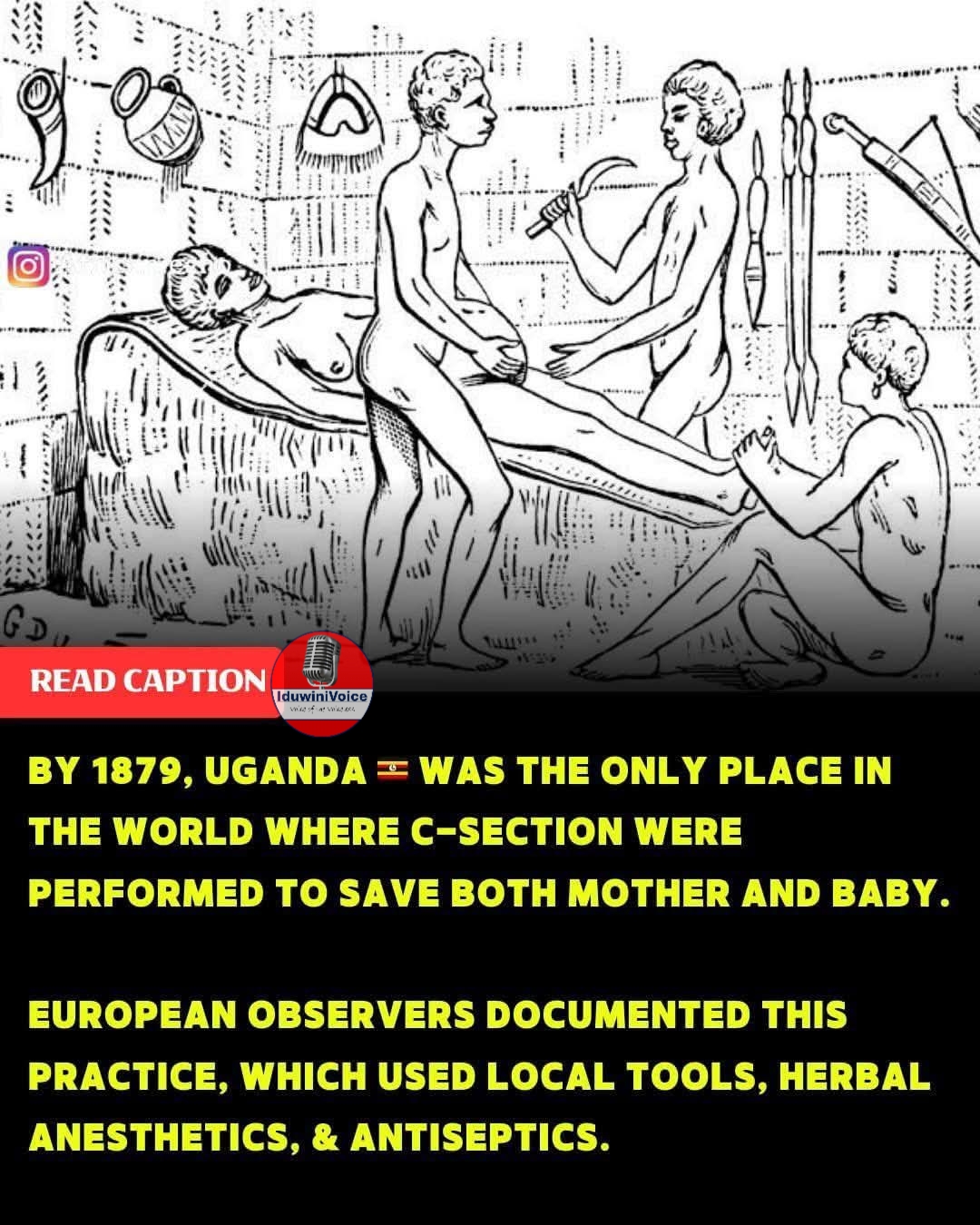
Historical medical records have revealed that indigenous surgeons in the Buganda Kingdom of present-day Uganda were successfully carrying out cesarean sections as early as 1879 — a period when the procedure was still considered highly risky in many parts of Europe.
The account was documented by British medical practitioner and explorer Robert William Felkin, who witnessed and later published details of the operation in the Edinburgh Medical Journal in 1884 under the title “Notes on Labour in Central Africa.”
According to Felkin’s observations, the procedure involved the use of banana wine as a cleansing agent, herbal preparations to manage pain, and cauterization with heated metal to control bleeding. Both mother and child reportedly survived the surgery — an outcome that drew significant attention from European medical circles at the time.
Felkin described the process as orderly and deliberate, noting that the practitioners demonstrated familiarity with anatomy, sterilization methods available to them, and post-operative care. The documentation challenged prevailing 19th-century assumptions that advanced surgical knowledge was absent in African societies before colonial contact.
Medical historians note that cesarean sections in Europe during the mid-1800s were often fatal due to infection and limited antiseptic knowledge. Antiseptic surgical techniques only became widely accepted in Europe toward the late 19th century following developments associated with figures such as Joseph Lister.
Scholars argue that the Buganda example illustrates a broader pattern of indigenous scientific knowledge that predated colonial rule. In his work, historian highlighted the complexity of African societies prior to European intervention, disputing narratives that framed the continent as lacking innovation or structured knowledge systems.
Experts say the 1879 account underscores the need for a more balanced historical perspective — one that acknowledges Africa’s contributions to medicine, technology, and empirical science long before formal Western medical institutions expanded into the continent.
The rediscovery and renewed discussion of such records continue to prompt debates about how global scientific history is written — and whose knowledge systems are recognized.
Source: African Echo
News
Otuaro Congratulates New IPF Leadership, Urges Confidence and Stronger Advocacy for Ijaw Nation

By Favour Bibaikefie
The Administrator of the Presidential Amnesty Programme (PAP), Chief (Dr.) Dennis Brutu Otuaro, has congratulated the newly inaugurated leadership of the Ijaw Publishers’ Forum (IPF), led by Senior Comrade Austin Ozobo, urging them to remain confident and focused as they steer the affairs of the organisation.
Speaking through Mr. Prebor Presley, Coordinator of the PAP Delta/Edo State Office, Otuaro commended the IPF for consistently projecting the Ijaw and Niger Delta narrative from a rights-based standpoint. He stressed that strengthening indigenous media platforms such as the IPF should be a collective responsibility, given the body’s strategic relevance to the Ijaw nation, the Niger Delta, and Nigeria as a whole.
According to him, the emergence of the new executive comes at a crucial period when the region requires vibrant voices to intensify advocacy for the rights and interests of its people. He encouraged the leadership to consolidate on the achievements of their predecessors and remain steadfast in pursuing the forum’s mandate.
In his acceptance speech, IPF President, Comrade Austin Ozobo, unveiled an ambitious two-year agenda, including plans to establish a permanent secretariat, set up a printing press, and launch indigenous Ijaw radio and television stations. He called on Ijaw sons and daughters to rally behind the organisation in its quest for peace, unity, and development across the Niger Delta.
Highlighting the forum’s advocacy role, Ozobo declared: “Let every headline, every broadcast, every book, every post send one clear message: The Ijaw people will no longer be spectators in their own land.”
In a goodwill message, Princewill Binebai, spokesperson of the Ijaw Youth Council (IYC) Worldwide, congratulated the new executive while cautioning against internal discord. He warned that the Ijaw people must recognise external challenges and avoid becoming divided among themselves.
Also speaking, frontline Ijaw politician, , traced the roots of journalism in Nigeria to the Ijaw ethnic nationality. He expressed disappointment over the absence of some Ijaw political figures at the event, noting that he had hoped it would be more “ceremonious,” with Ijaws asserting their presence as the true owners of Warri.
Reaffirming his commitment, Ozobo pledged to uphold the values of “our great organization and work tirelessly to promote the interests of our organization, the Ijaw Nation and the Niger Delta at large.”
He further stated: “The IPF will continue to advocate for the rights and interests of the Ijaw people, and will continue to promote accurate reporting and storytelling about the over 50 million Ijaw people that are balkanized and marginalized in Nigeria. The Ijaw people have a rich cultural heritage, and it is our responsibility to preserve and promote it.
“We will work with stakeholders to promote peace, unity, and development in the Niger Delta region. We will also provide a platform for Ijaw journalists and publishers to advance and grow in the media profession.”
Calling for unity among leaders, the IPF President appealed: “Ijaw leaders to prioritize Ijaw Nation’s development; we should know where we are coming from. This is not the time for divisive governance, but rather a time for inclusive governance.
“Let us wake up from our slumber and stop doing things that will further divide us or underdevelop the Ijaw Nation.”
He concluded by appreciating stakeholders who have supported the forum and urged collective commitment moving forward. “All well-meaning Ijaw sons and daughters to join and support the organization (IPF) in this journey. Let us work together to build a stronger, more united Ijaw Nation where love, justice and peace will reign.”