
News
DELINEATION: “EXERCISE IS CONSTITUTIONAL AND MORAL; NO MORE SUPREMACY, BUT BROTHERLY COEXISTENCE” – IJAW GROUP TUTORS ITSEKIRIS


Warri, Nigeria – July 16, 2025: The Ijaw Stakeholders of Warri Federal Constituency have issued a bold and historic statement declaring full support for the ongoing delineation process by the Independent National Electoral Commission (INEC), describing it as a long-awaited correction to decades of historical distortion, political marginalization, and territorial misrepresentation.
In a strong worded release,the stakeholders challenged the legitimacy of Itsekiri land claims and monarch authority, asserting that the truth of Warri’s founding peoples and rightful landowners can no longer be buried beneath colonial narratives and elite manipulation. Read full release:
“PRESS RELEASE
“Issued by: Ijaw Stakeholders of Warri Federal Constituency
“Date: 16 July 2025
“HEADLINE:
“THE LIE IS DEAD, THE LAND SPEAKS: DELINEATION IS HERE TO STAY, AND SO IS THE TRUTH
“TO WHOM MUCH LAND IS GIVEN, MUCH LIES HAVE BEEN TOLD
“For decades, a small ethnic group has wrapped itself in borrowed robes and built castles of influence upon swamps of fiction. The Itsekiris, by a mix of colonial favoritism, media mischief and oil-backed lobbying, have projected themselves as landlords over a territory they neither founded nor truly occupied in majority. They have distorted maps, fabricated history and declared themselves monarchs over a land that was already thriving with Ijaw and Urhobo civilizations before Ginuwa ever arrived at Ijala, an Ijaw town, not an Itsekiri creation.
“But history does not remain silent forever. The ground speaks. The creeks cry out. The people rise. And the truth long suppressed under the boots of colonial policies and oil politics has finally found its voice through facts, maps, judgments, census data and the awakening of ancestral memory.
“Today, we declare without any iota of doubt that the delineation of Warri Federal Constituency is not only constitutional, it is a moral correction, a historical rebalancing and a political rebirth.
“THE TRUTH HAS BEEN UNSEALED: KEY EXPOSÉS
“No Land, No Numbers, No Legitimacy
“Let it be told loud and clear, the Itsekiris have no ancestral claim over the majority of Warri land. From Gbaramatu to Ogbe-Ijoh, Okerenkoko to Isaba, these lands were never under the control of the Olu of Warri. In fact, Colonial Officer M.C. Smart (1933) stated explicitly:
“There is no historical evidence that the Olu or his agents exercised political control over Gbaramatu or the Forcados River areas.” (Intelligence Report, NAI CSO 26/2 27036)
“Census data also exposes the demographic fraud. While the Ijaws and Urhobos number in the hundreds of thousands, Itsekiris barely make up 5% of the population in Warri Federal Constituency. Their loud voice is not from the people, it is from privileged positioning and outside funding.
“The Manufactured Monarchy and the Fake Crown
“Until 1952, the title was simply “Olu of Itsekiri” a modest title rightly confined to a small ethnic domain. But in a colonial act of deception, the name was changed to “Olu of Warri”, creating the illusion of sovereignty over a land never owned.
“The Itsekiris were not the first settlers of Warri Division. Their claims to exclusive ownership are historically baseless.” — Prof. E.J. Alagoa, Niger Delta Oral Traditions and History
“That title change was resisted by Urhobo and Ijaw leaders of the time. Today, we renew that resistance and we demand the immediate reversal of the title back to its truthful form.
“The Ward Delineation: A Verdict of Justice
“The Independent National Electoral Commission (INEC), after due consideration of population density, indigenous habitation, and administrative justice, has undertaken the constitutional exercise of delineation. The Itsekiris, sensing the exposure of their long-standing fraud, now resort to blackmail, media lobbying and legal stalling.
“But the game is up.
“We affirm that the delineation result must be announced. It is not just a democratic exercise, it is historical reparation.
“It was once said:
“In the past, the man has been first; in the future, the system must be first.” — Frederick W. Taylor
“Falsehood may run for years, but truth walks in one day and takes over the house.” — Ijaw Proverb
“The greatest injustice in the Niger Delta is not oil theft — it is land theft.” — Late Chief Harold Dappa-Biriye
“Let justice roll down like waters, and righteousness like an ever-flowing stream.” — Amos 5:24 (Holy Scripture)
“OUR FINAL ADVICE TO THE ITSEKIRIS
“Enough of the media manipulations. Enough of the legal distractions. Enough of clinging to a throne built on quicksand. You cannot hold the majority hostage forever.
“We advise you: accept the truth and let justice reign. Coexistence is possible but not at the cost of false supremacy. You are not landlords. You are not founders. You are, by all historical accounts, tenants who must now learn to live in truth or be remembered for lies.
“CALL TO ACTION
“We call on:
“INEC: Proceed without fear or favour. The delineation must be concluded and gazetted.
“The Presidency and National Assembly: Stand firm for constitutional equity.
The International Community: Monitor the manipulation tactics and support indigenous land rights.
“The Nigerian People: Reject false narratives. Support the voice of history.”
Sign:
Chief Tiemopere Joshua (President)
Chief Ebikeke T. Goodstime (Secretary)
Ijaw Stakeholders
IJAW STAKEHOLDERS OF WARRI FEDERAL CONSTITUENCY
As the struggle for the truth and equity intensifies, the Ijaw Stakeholders have urged INEC to act boldly and without fear, while calling on the federal government, international observers, and Nigerian public to support a rebalancing rooted in constitutional fairness nd historical facts. With the tides of history turning, the statement concludes with a passionate appeal: coexistence remains possible-but only on the foundations of truth,not illusion.
News
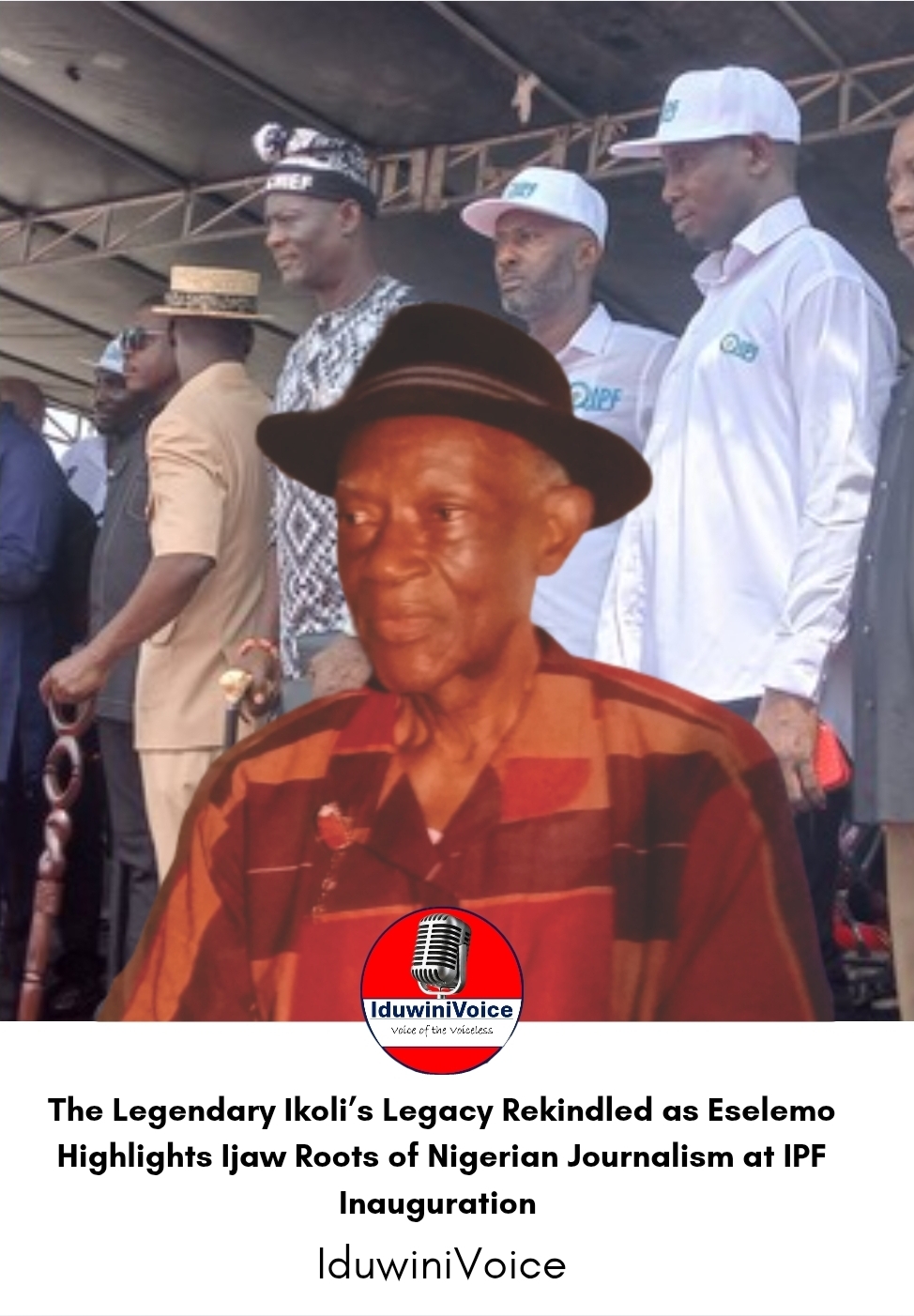
The Legendary Ikoli’s Legacy Rekindled as Eselemo Highlights Ijaw Roots of Nigerian Journalism at IPF Inauguration
By Favour Bibaikefie
WARRI — The enduring legacy of Ernest Sisei Ikoli took centre stage last Thursday in Warri as prominent Ijaw leader, Prince Collins Eselemo, a politician, foremost Ijaw nationalist and an advocate for Resource Control, declared that Nigerian journalism was built on foundations laid by Ijaw pioneers.
Speaking at the inauguration of the new National Executive Council of the Ijaw Publishers’ Forum (IPF), Eselemo asserted that the history of journalism in Nigeria cannot be told without acknowledging Ikoli’s towering contributions.
Ikoli, born in 1893 in Twon-Brass, present-day Bayelsa State, is widely recognised as one of the founding figures of modern Nigerian journalism. He became the first editor of the Daily Times of Nigeria in 1926, shaping public discourse during the colonial era through bold editorials and nationalist advocacy.
At the IPF second inauguration ceremony held last week at Ogbe-Ijoh, Warri, Eselemo maintained that Ikoli’s role in the nationalist struggle and media development underscores what he described as the intellectual heritage of the Ijaw people. He noted that Ikoli’s early association with John Payne Jacksonat the Lagos Weekly Record helped sharpen a nationalist press culture that later influenced a generation of political leaders.
Historical records show that Ikoli founded The African Messenger in 1921 before later editing The Daily Service, the mouthpiece of the Nigerian Youth Movement (NYM), which he co-founded alongside Hezekiah Oladipo Davies and J.C. Vaughan. The NYM later attracted nationalist figures including including Nnamdi Azikiwe and Obafemi Awolowo.
As president of the NYM, Ikoli was elected into the Legislative Council in 1942 and 1946, where he advocated educational reforms and greater Nigerian representation in governance. His philosophy of “one Nigeria, one Africa, one destiny” reflected a pan-African outlook that transcended ethnic lines.
Eselemo’s remarks at the IPF ceremony come amid renewed conversations about the contributions of minority ethnic groups to Nigeria’s political and media history. He urged contemporary publishers to emulate Ikoli’s courage, professionalism and commitment to truth.
Ikoli was awarded the Officer of the Order of the British Empire (OBE) in 1954 and lived to witness Nigeria’s independence on October 1, 1960, before passing away weeks later on October 21.
Today, his memory is preserved through scholarly works, the Bayelsa State “Earnest Ikoli Press Centre, and the Ernest Sisei Ikoli Foundation in Lagos, reinforcing Eselemor’s argument advanced in Ogbe-Ijoh, Warri — that the story of Nigerian journalism remains incomplete without acknowledging its Ijaw pioneers.
News
Ajapa Field MOU: Ogulagha Stakeholders Call for Review, Transparency and Alignment with Current Realities

By Charity Ebi
OGULAGHA, DELTA STATE — Nearly two decades after a Memorandum of Understanding (MOU) was signed between Britannia-U Nigeria Limited and Ogulagha Kingdom in Burutu Local Government Area, stakeholders in the oil-bearing community are calling for a comprehensive review of the agreement to reflect present-day economic and industry realities.
The 2007 MOU, tied to operations at the Ajapa Marginal Field, was introduced as a framework for peace, development and mutual benefit. However, community representatives say that while the agreement may have appeared workable at inception, its fixed financial structure has been overtaken by inflation, rising oil revenues and evolving governance standards within Nigeria’s petroleum sector.
Addressing journalists on behalf of stakeholders, Mr. Jude Iyelagha stressed that the concerns being raised should not be misconstrued as an attack on the integrity of Ogulagha’s traditional or political leadership.
“This is not an attempt to indict or insult the credibility of our revered leaders,” Iyelagha clarified. “Rather, it is an encouragement for leaders to revisit the well-documented terms, review them in line with current realities, and ensure they are fully implemented for the benefit of our people.”
Modest Provisions, Expanding Industry
Under the MOU, provisions reportedly included annual allocations for community drugs, scholarships for secondary and tertiary students, training slots at the Petroleum Training Institute (PTI), allowances for trainees, incentives for science teachers and sitting allowances for kingdom committee meetings.
While these figures may have been considered reasonable in 2007, stakeholders argue that their real value has significantly diminished over time due to inflation. Crucially, the sums were fixed and not indexed to oil prices, production output or inflationary trends.
Using conservative production estimates common to marginal fields in the Niger Delta, observers note that annual gross revenues from such operations could run into tens of billions of naira. When juxtaposed with community allocations that reportedly totalled only a few million naira annually at inception, the proportional disparity becomes a central point of concern.
For residents, the issue is less about confrontation and more about fairness.
Development Expectations in a Resource-Rich Area
Ogulagha Kingdom remains one of the oil-producing hubs in Delta State. Yet stakeholders point to ongoing challenges including limited healthcare facilities, youth unemployment, fragile road networks, environmental vulnerability and constrained access to higher education funding.
Community leaders argue that development in oil-bearing areas should translate into tangible infrastructure such as modern health centres, shoreline protection projects, potable water systems, vocational training hubs and structured employment pipelines.
“The frustration is not hostility towards investment,” a stakeholder noted. “It is about proportionality and visible impact.”
Shareholding Claims and Transparency Concerns
Beyond the MOU, a more complex issue has emerged. Leaders within the kingdom assert that Ogulagha may not only be a host community but also a registered shareholder in the Ajapa Marginal Field structure, allegedly documented with the Corporate Affairs Commission.
If such shareholding exists, corporate law provides for certain rights, including access to audited financial statements, notice of Annual General Meetings and entitlement to dividends where declared.
Stakeholders claim that consistent access to production data, audited accounts and dividend clarity has not been fully established, raising questions about governance participation.
Again, Iyelagha emphasised that the intention is not to cast aspersions.
“We believe in dialogue and institutional engagement. What we are asking for is clarity, transparency and alignment with statutory expectations where applicable,” he said.
Petroleum Industry Act and Changing Standards
Analysts observe that the Petroleum Industry Act (PIA) has introduced more structured host community frameworks and governance mechanisms. Agreements executed before the reform era, they argue, may require review to align with contemporary standards of transparency and proportionality.
Stakeholders maintain that revisiting the 2007 framework would not only protect the long-term interests of the kingdom but also strengthen investor-community relations.
Company Response Awaited
Efforts to obtain official comments from Britannia-U Nigeria Limited were unsuccessful at the time of filing this report. The company’s response, when received, will be reflected in subsequent updates.
For now, the central appeal from Ogulagha stakeholders is measured and deliberate: a call for leaders to examine documented agreements, align them with present realities, and ensure that promises made translate into visible, sustainable benefits for the kingdom.
As one community voice put it, “Oil is finite, but our people and our future must endure.”
By Favour Bibaikefie
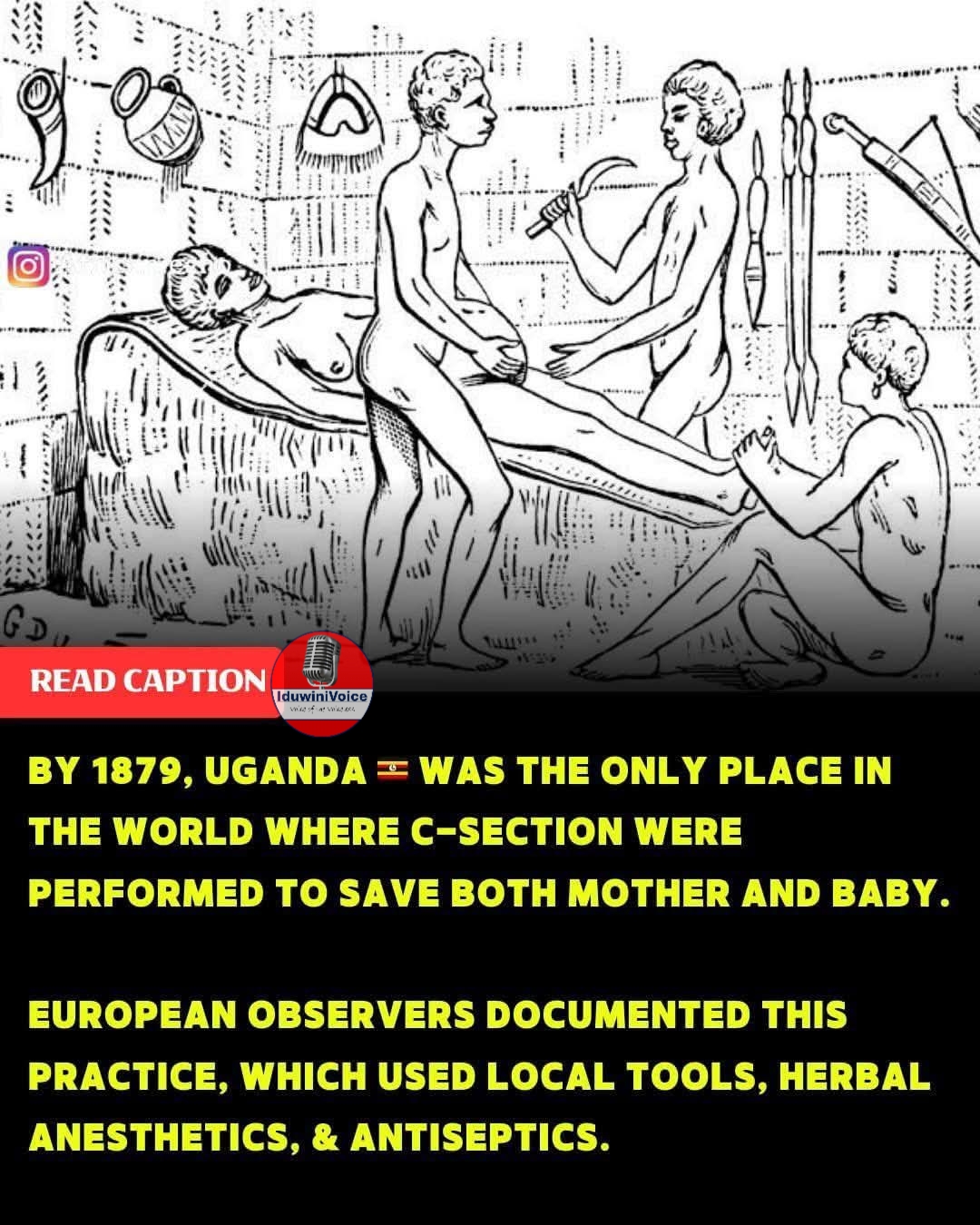
Historical medical records have revealed that indigenous surgeons in the Buganda Kingdom of present-day Uganda were successfully carrying out cesarean sections as early as 1879 — a period when the procedure was still considered highly risky in many parts of Europe.
The account was documented by British medical practitioner and explorer Robert William Felkin, who witnessed and later published details of the operation in the Edinburgh Medical Journal in 1884 under the title “Notes on Labour in Central Africa.”
According to Felkin’s observations, the procedure involved the use of banana wine as a cleansing agent, herbal preparations to manage pain, and cauterization with heated metal to control bleeding. Both mother and child reportedly survived the surgery — an outcome that drew significant attention from European medical circles at the time.
Felkin described the process as orderly and deliberate, noting that the practitioners demonstrated familiarity with anatomy, sterilization methods available to them, and post-operative care. The documentation challenged prevailing 19th-century assumptions that advanced surgical knowledge was absent in African societies before colonial contact.
Medical historians note that cesarean sections in Europe during the mid-1800s were often fatal due to infection and limited antiseptic knowledge. Antiseptic surgical techniques only became widely accepted in Europe toward the late 19th century following developments associated with figures such as Joseph Lister.
Scholars argue that the Buganda example illustrates a broader pattern of indigenous scientific knowledge that predated colonial rule. In his work, historian highlighted the complexity of African societies prior to European intervention, disputing narratives that framed the continent as lacking innovation or structured knowledge systems.
Experts say the 1879 account underscores the need for a more balanced historical perspective — one that acknowledges Africa’s contributions to medicine, technology, and empirical science long before formal Western medical institutions expanded into the continent.
The rediscovery and renewed discussion of such records continue to prompt debates about how global scientific history is written — and whose knowledge systems are recognized.
Source: African Echo