
News
AS NIGERIA’S YOUNGEST GOVERNOR, ALFRED DIETTE-SPIFF BECOMES AN OLD MAN.

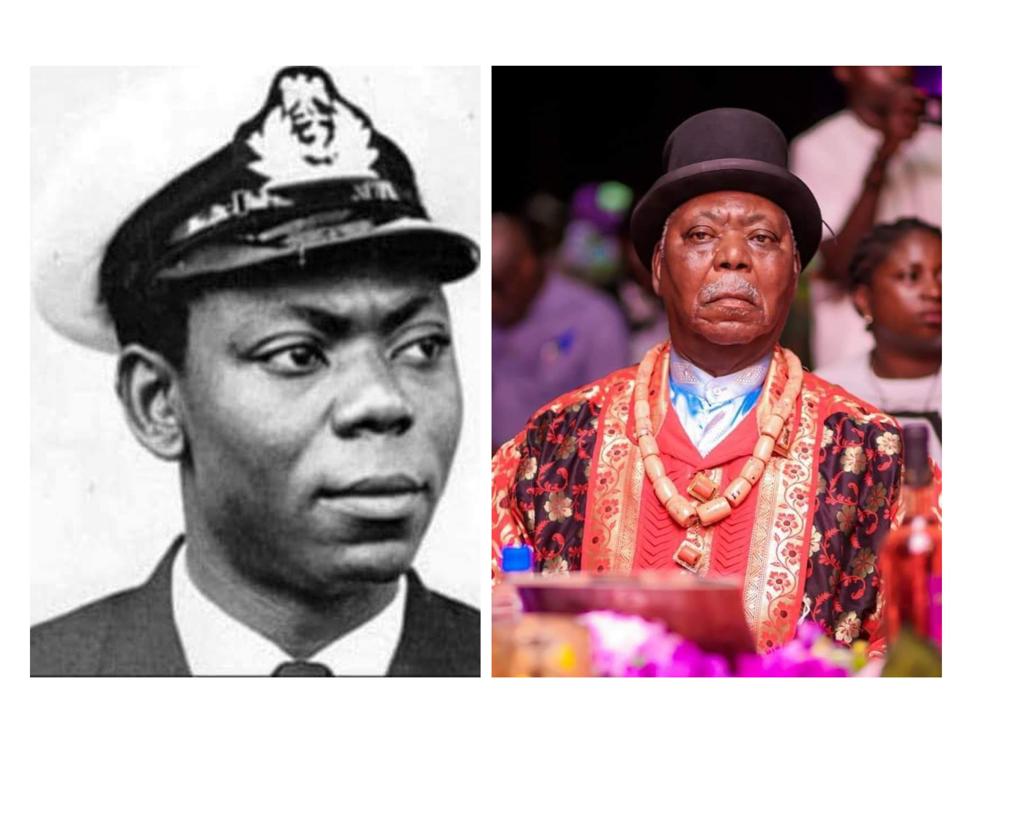
AS NIGERIA’S YOUNGEST GOVERNOR, ALFRED DIETTE-SPIFF BECOMES AN OLD MAN
BY: GODKNOWS BOLADEI IGALI
The date, May 27th, 1967 will always remain a landmark in the annals of Nigeria’s history for a number of reasons. First, on that date, the country’s third Head of State and second military ruler, then Col. Yakubu Gowon took the courage to create 12 States out of the 4 regions which had existed hitherto. Secondly and of equal significance was the fact, that on that date, Nigeria’s youngest State Governor ever in the person of Lt. Commander, Alfred Papapriye Diette-Spiff was appointed amongst others, to head his own state – Rivers State at the adolescent youthful age of thirty three days to his 25th birthday. Then, a lanky naval officer standing at six feet, three inches (1.90 metres), today, fifty-six years down the lane, Pa Diette-Spiff clocked 81 years on July 30th, 2023.
- The significance of Spiff’s present octogenarian debut contrasts significantly with when he was catapulted to national limelight a year after Nigeria’s first military coup. It came at the time, with a great promise and hope for the teeming youth of the country, many of whom today, over five decades later, are made to nurse a sense of exclusion and shut out from the process of building the country which they rightly deserve to be at the vortex.
- Today, Spiff has transmuted from being a smart white cladded military officer to become a colourfully robed traditional monarch over the people of his hometown, Brass, which situates at the Atlantic oceanOcean. He has also garnered other accolades including longest serving Chairman of Bayelsa State Council of Traditional Rulers, Chairman of Council of Traditional Rulers of Oil Producing Communities (TROMCOM), Co-Chairman of the Board of Trustees of the Pan Niger Delta Forum (PANDEF), life member of the Board of Trustees of the IBB Golf Course, amongst others.
CAN OF WAHALA: JANUARY 1966 TO MAY 1967
- The lives of Spiff and his erstwhile boss, General Yakubu Gowon have many resembles. Philosophers through the course of history have debated on the place of fate in the lives of men, in particular great people. The celebrated playwright, William Shakespeare once asserted in his classic play, “Julius Caesar” of the dialogue between Brutus and Cassius that: “there is a tide in the affairs of men which, taken at the flood leads to fortune”. This circumstance which an equally youthful military officer, now 88 years old Gen. Yakubu Gowon found himself in 1967 leading to the creation of States was very peculiar. Then at just 32 years of age, he inherited the reins of a fractured country as a new Head of State after three two military coups and an armed insurrections. The first was the very bloody January 15, 1966 coup led by some mid-level officers of the Nigerian Army, some of whom were his classmates and personally connected, both professionally and emotionally. That coup decapitated the country’s leadership, especially from the north. Next was the less reported but audacious military armed insurrection tagged the “12 Days Revolution” by Ijaw fighters led by one Isaac Adaka Boro (later Major), an erstwhile police officer and student activist. This happened on February 23rd, 1966, just two weeks after the bloody military coup and intended at establishing a Niger Delta Republic.
- As if that was not enough, there was the third “counter coup” which coincidentally took place on from 29th July 1966 which was the eve of Spiff’s 24th birthday of Spiff, being July 30th, 1966. Gowon had benefitted from the first coup by being named as Chief of Army Staff, directly under Nigeria’s first military Head of State, Gen. Johnson Aguiyi-Ironsi (1924-1966). This counter coup organised by “loyal northern officers” brought Gowon up to inherit his immediate boss’s seat. On this note, the much withdrawn and saintly Col. Gowon from a relatively unknown Ngas (Angas) ethnic group in the hills of Jos Plateau was given the role of steering the ship of the Nigerian stateState. Unlike Ironsi who was the most ranking senior officer at the time, Gowon’s ascension to lead the country was itself surrounded by a veil of contradictions as there were other more senior military officers such as Commodore Edet Akinwale Wey, Brigadier Babafemi Ogundipe, Col. Robert Adeyinka Adebayo.
- As the spate of insecurity continued, efforts at rebuilding the broken walls of confidence in the nation became his greatest challenge. Help came, as Nigerian leaders were invited to Aburi, eastern region of Ghana by J.A. Akrah, a fellow military coupist and former course mate of most of them at Sandhurst Military Academy in the United Kingdom, to talk among themselves and agree on how to keep Nigeria together. Delegates were not just Gowon and Lt. Col. Odumegwu Ojukwu, Governor of Eastern Region, the most aggrieved on account of pogroms which had occurred in the northern part of Nigeria but also Governors of the three other regions.
- Unfortunately, the detailed Aburi process failed. The option left for Gowon at this time was to embark on fundamental restructuring of the country by improving upon the regional structure which had existed. Rather than creating more regions, what he did was to establish, by military decree, 12 states out of the 4 regions which were in existence. This was a major stratagem to douse the build-up of tension in the country by widening the political space for those who had clamoured for some measure of internal self-governance.
- With the new structure, the erstwhile Western Region was left almost intact except Lagos which was excised to be an autonomous State and Federal Capital. The Mid-West region continued as Mid-West State. Further south, two autonomous states, known as Rivers and South Eastern State were created in addition to East Central State out of the former Eastern region. Up north, Kwara and Benue-Plateau States was created to cater for the clusters of minority groups in the Middle Belt, while the extreme north became separated into the North East, North Central and North Western States.
SPIFF AND THE ORIGINS OF HIS RIVERS STATE
- In this gale of appointments, the spotlight beamed on the hitherto unknown southmost tip of the country which had now become known as Rivers State. The state itself was an inflorescence of diverse ethnic groups, most outstanding being the Ijaws who occupy the coastal and the swampy crude oil bearing regions of Nigeria. Other ethnic groups of note in the new State were the Ikwerres, and the Etches, both of which are Iboid in identity, and the Ogonis.
- The creation of Rivers State had actually come against the backdrop of years of agitations from the smaller ethnic groups in the former Eastern region who were very discontented with what was termed as marginalisation in the politics and affairs of the region. Such forms of agitation hobbled around what was known as a request for “Calabar-Ogoja-Rivers State” or “COR Province” out of the former Eastern Region. Niger Delta leaders, including such personalities as Chief Harold Dappa Biriye, founder of the Niger Delta Congress Party, Prof. Eyo Ita who at a time was Leader of Government Business in the Eastern Region, and legal luminaries – Dr. Udo Udoma and Dr. Okoi Arikpo, Chief Melford Okilo, and others from their fold among the minorities of the Eastern Region led the trail. It was part of this quest that enamoured these personalities from the Niger Delta at the London Constitutional Conference of 1957 to demand the colonial government to grant them an autonomous province without which their people will suffer political discrimination and deprivation of development. The British constituted a Commission which was set up on 27 November 1957, headed by British law maker, Sir (later Lord) Henry Willinks (1894-1973). In its report, the Commission agreed that the fears of the Nigerian minorities in the south were well founded and needed to be addressed. But, coming just on the eve of the country’s independence, it reluctantly indicated:
i. the problems of domination cannot be solved by setting more or new states but fundamental human rights should be entrenched in the constitution to allay such fears.
ii. The Commission further recommended that the concerns of the minorities could also be assuaged by creating Special Councils for them and that the Niger Delta area should be declared a special zone with a board appointed for that purpose. (This led to the creation of the Niger Delta Development Board which was announced in 1961).
- Taking the work of Sir Willinks forward, the move by Gowon on May 27th, 1967 was partly to address the existing cries for some form of internal self-expression. Secondly, it was definitely to take away the carpet from under the feet of Lt Col Ojukwu by fragmenting the former Eastern region. the separatists in the Eastern Region, led by Ojukwu. Naturally, the creation of Rivers State came with great euphoric outburst and more so, as a young, promising and dynamic Governor had been appointed for the State.
HOW SPIFF GOT THE PLUM JOB
- Conjectures of all manners have been advanced as to why Gowon and his cabal saw more worth in giving such responsibilities over a war-ravaging area to a 25-year old. Like Gowon, the young, indifferent, jolly good youngster, Spiff was a child of circumstance. No wonder, beyond Shakespeare, the wise man had stated in Ecclesiastic’s Chapter 9 verse 11 of the Holy Bible: “I have seen something else under the sun. The race is not to the swift or the battle to the strong, nor does food come to the wise or wealth to the brilliant or favour to the learned but time and chance happens to them all”. This definitely holds true for Spiff as he was definitely not the oldest nor the most senior military officer from Rivers State. Indeed, at the time of his appointment, Col. George Kurubo (1934-2000) from the coastal town of Bonny in the State was already Nigeria’s first indigenous Chief of Air Staff but soon moved to Moscow as Nigeria’s Ambassador to the Soviet Union. In the Nigerian Navy itself, there were more senior officers such as Commodore Edwin Kentebe (1931-1985) and Admiral Bossman Soroh (1928-2006) who later became Chief of Naval Staff in 1975. Spiff was almost a son to both of them and a few others.
- So, definitely, time and chance and the inscrutable Grace of God worked in favour of Spiff who according to records, was not particularly close to Gowon or had any godfather. So, what happened and a greatly didactive? But he had created a niche as a young naval officer within the service which was quietly noticed by many. However, appointing a 25-year old was quite audacious.
- Growing up, Spiff’s life had been exposed to the most challenging and personally rewarding of opportunities. Both of his parents were civil servants, a career that was greeted with postings within parts of Eastern Nigeria, as well as in Western the former British Southern Cameroons when that area was administered from Nigeria as a Trust Territory of the United Nations. At the time, his father was serving the colonial government as the Postmaster for Western Southern Cameroons. He therefore started his primary school in 1947 at Government Primary School, Buea on the foot of 4,700 metres high Mount Cameroon. Thereafter, he got admitted to the famous St. Joseph College, Sasse in Buea, Cameroon which was established in 1939. He studied along with many who later became leading political figures in Anglophone Cameroon as well as Chief Tom Ikimi, Nigeria’s one-time Minister of Foreign Affairs, equally born in Kumba, Cameroon.
- As part of his formative years in Cameroon, young Spiff had the opportunity to be involved in activities of Man O’War Bay in the town of Victoria (Limbe) where one of the biggest youth camps in Anglophone West Africa existed. This obviously propelled a great interest for the sea and the adventurous life for mountaineering and aviation all of which he still practisespractices till date. According to accounts, the senior Spiff saw the future of his child and from his twiddling years nicknamed him “The Captain”. On completion of his secondary education, he got employed and trained as a Meteorological Officer then under the Ministry of Transport in Lagos. He was thereafter posted to Ikeja Airport, Lagos and worked for some time before moving on to the Waterways Department as a Marine Officer in Training. As a marine cadet, Spiff was deployed to Elder Dempster Shipping Line and found himself aboard several ships. This was before he proceeded to the United Kingdom to study at Britannia Royal Naval College at Dartmouth whose reputation from its takeoff in 1863 remains vintage. This paved the way for him to join what was then known as Merchant Navy and eventually got transferred to the Nigerian Navy in 1962. Finally, he was commissioned as Ship’s Diving Officer in 1964. Early in his career, he was opportuned to command two major ships, “NNS“ and “NNS Benin”.
HOW THE “BOY GOVERNOR” OUTPERFORMED ALL
- Mounting the saddle, Spiff is credited to have performed most exceptionally in Rivers State and stood out in the country. Since the territory of state was then occupied by the rebel Biafra side, his government operated from Lagos until late 1968 when he moved to Port Harcourt. He started off the huge task of infrastructural development and more than 50 years later, his impact is still visible in Port Harcourt and around the two successor states, Rivers and Bayelsa. These include the Rivers State secretariat complex which is a cluster of six units of 9-storey buildings. The most noticeable is a so-called “Point Block” which stands at 20-storey high and for many years was regarded as the tallest structure in the South-South of Nigeria.
- Pa SpiffHe is also credited to have been the brain behind the building of the College of Science and Technology in Port Harcourt which was slightly short of his original dream of establishing a university for his people. That was in 1972 when the flood gate for such state-owned institutions was not lifted. What was approved for him was good enough and became the main breeding ground for training the next generation of persons from old Rivers State. This school was later upgraded to the Rivers State University of Science and Technology and is currently known as Rivers State University. He also established the Government Sea School, Isaka, which gave the state a head-start in flooding the Nigerian Navy and Merchant Navy with cadet officers.
- Spiff’s efforts were also robust in other aspects of human capacity development where he left an indelible mark. He also came up with the most robust scholarship and bursary scheme. He was the first Nigerian Governor to give scholarships in hundreds to eligible young people of his state to all parts of the world and ensured that the full amount needed for their full study durations was paid upfront. This worked out well as his exit from office as Governor in 1975 did not in any way affect the beneficiaries of his scholarship from continuation of studies.
- In addition and to his credit, Spiff has to his credit, initiating ofinitiated the construction of the present Port Harcourt International Airport which was quite outstanding. At that time, there was already a city airport which was holed up in the town. His vision was an international airport similar to what was obtainable in Lagos at the time.
- In the field of commerce and industry, he initiated what is still known as the Rivers State Palm Estate, built to take advantage and promote the palm oil resource of the area. In historical sense, this area and much of the South-South had been known as Oil Rivers Protectorate as far back as 1886. He also established a holding financial conglomerate known as PABOD (an acronym formed from Port Harcourt, Ahoada, Brass, Ogoni and Degema Divisions, which at the time were the existing local government structures in the state). The PABOD conglomerate still exists as one of the most enduring business houses in the country, with investments that spread into all areas of commercial, industrial and finance activities. The state under him also established the Pan African Bank which at the time became one of the leading indigenous banks in the country until the era of consolidation in July, 2004. The West African Glass Factory which again took advantage of the huge sand deposits found around the coastal areas of the state was built and produced several products such as glasses for industrial and for household use.
EXIT FROM POWER AND FORCED RETIREMENT
- As Spiff progressed in Rivers State, the government of Yakubu Gowon became increasingly accused of vacillating on its promise to return Nigeria to democratic rule with unvoiced tension gathering steam around the country. According to accounts, some officers such as Brigadier Murtala Mohammed who later became a General and Head of State expressed increasing impatience with Gowon and hungered for power. Indeed, the altercations and the simmering love lost between Gowon and Mohammed were palpable, with an atmosphere that was rife for any eventuality. Not surprising, the military coup of July 29, 1975 ousted the Government of Gowon just at the ages of 41 years. This affected Spiff, a day before his 33rd birthday and all the other Governors of the 12 States. Being military men, Spiff and his contemporaries were rounded up and sadly, stripped of their military ranks and sent on immediate retirement. No less was the injustice suffered in the seizure of all his hard-earned properties that subjected him at the time to a state of great personal challenge after such high elevation.
OPENING OF NEW HORIZONS
- The exit from political power at a relatively young age created vast opportunities for Spiff to engage in active business. He was able to apply himself in different aspects of businesses which have continued till today with modest level of success. More prominently, however, was his elevation into aristocracy which he rightly deserved as his father by inheritance rights, later became a traditional ruler of his hometown, Twon Brass, titled “Amangi”. Spiff in 1978 became crowned as the “Amanyanabo” or King of that coastal port city. Located on the Atlantic springboard, it is perhaps in addition to Bonny, one of the biggest coastal settlements in Nigeria’s extreme coast. His community, Brass, had been a major entry port during the times of Trans-Atlantic Sslave Ttrade and the Oil Palm trade. At thisIn contemporary time, it wasBrass remains also one of the main export terminals of crude oil business in Nigeria, hosting one of the foremost bases for Agip Oil Company as well as the proposed Brass Liquefied Gas Company, Brass Fertilizer Company and the Brass Shipyard.
- In course of time, King Spiff was elevated by his peers to Chair chair the Bayelsa State Council of Traditional Rulers, a position which he held for a whooping period of about 10 years. Being a former ranking military officer who had ruled one of the original 12 states of the country, he brought much colour and respectability to that traditional institution. He enjoyed the respect of his top military constituency who later came to rule in high capacities including former Presidents Olusegun Obasanjo, Ibrahim Babangida, Abdulsalami Abubakar and not the least Muhammadu Buhari. He had also headed the Traditional Rulers of Oil Minerals Producing Communities of Nigeria (TROMPCON) which brings together all his colleagues from the entire nine oil producing states in the country. He also chaired the platform called the Niger Delta Dialogue which aimed at conflict resolution, conflict management and peace-making in the troubled oil producing areas.
- Another major area that Spiff has contributed at making peace and contributing to peace in Nigeria is the role he played in the formation of the Pan Niger Delta Forum (PANDEF) which brings together the entire people of the Niger Delta. He remains the Co-Chairman of the Board of Trustees of that body. In that capacity, Spiff has also served as the Chairman of the Council of Ijaw Traditional Rulers and Leaders, a powerful body that is at the apex of deciding all matters pertaining to Nigeria’s fourth largest ethnic group who are indigenous in 6 states.
- At national level, Spiff served as member of Federal Government boards and agencies over the years. At present, he is Chancellor of the Nigeria Maritime University (NMU), Okerenkoko in Delta State from being the Chancellor of Bayero University, Kano. In other respects, King Spiff was elected and serves as the National Chairman of the Nigerian Association of Auctioneers since December 2019.
THE FLIP SIDE OF LIFE
- Like all persons that found themselves in military government, especially at the time when people like Spiff served, the temptation for excessive outburst was quite rife. For example, it was widely publicised following an article published in the defunct Nigeria Observer newspaper of 1973 “Spiff ordered his aide, Ralph Iwowari to publicly shave the head of a Nigerian Observer, Minere Amakiri, reporter and had him beaten with 24 lashes of the cane for publishing a story about an impending teachers’ strike on Spiff’s birthday which he considered an insult.” However, exit from power at a young age gave him ample time to square up and make retrieve with the concerned persons, all of whom were from the straddling communities.
ENDING NOTES
- As Nigeria celebrates the 81st birthday of this extraordinary individual, it is evident that his has been nothing short of awe-inspiring. What an a life?; His accomplishments in various fields stand as a testament of his unwavering determination, relentless pursuit of excellence, and boundless creativity despite the undulating vissicitudes of life. From breaking barriers and redefining what is possible, to leaving an indelible mark on countless lives, his legacy is one of inspiration and admiration. He got one of the most plum jobs in Nigeria as a young man, on merit and proved his mettle and outpaced all others while in that office. What was his secret? He focused on the job and got the best of minds and energy to work with him. But then, Spiff’s life and achievements is a metaphor, indeed testament of what Nigeria youth can still do, if given the opportunity. Perhaps we need to try them again!
- Happy 81st birthday celebration to a true icon of human potential!
Dr. Igali, an award winning writer is an Ambassador and retired Federal Permanent Secretary
(Ambigali.com)






News
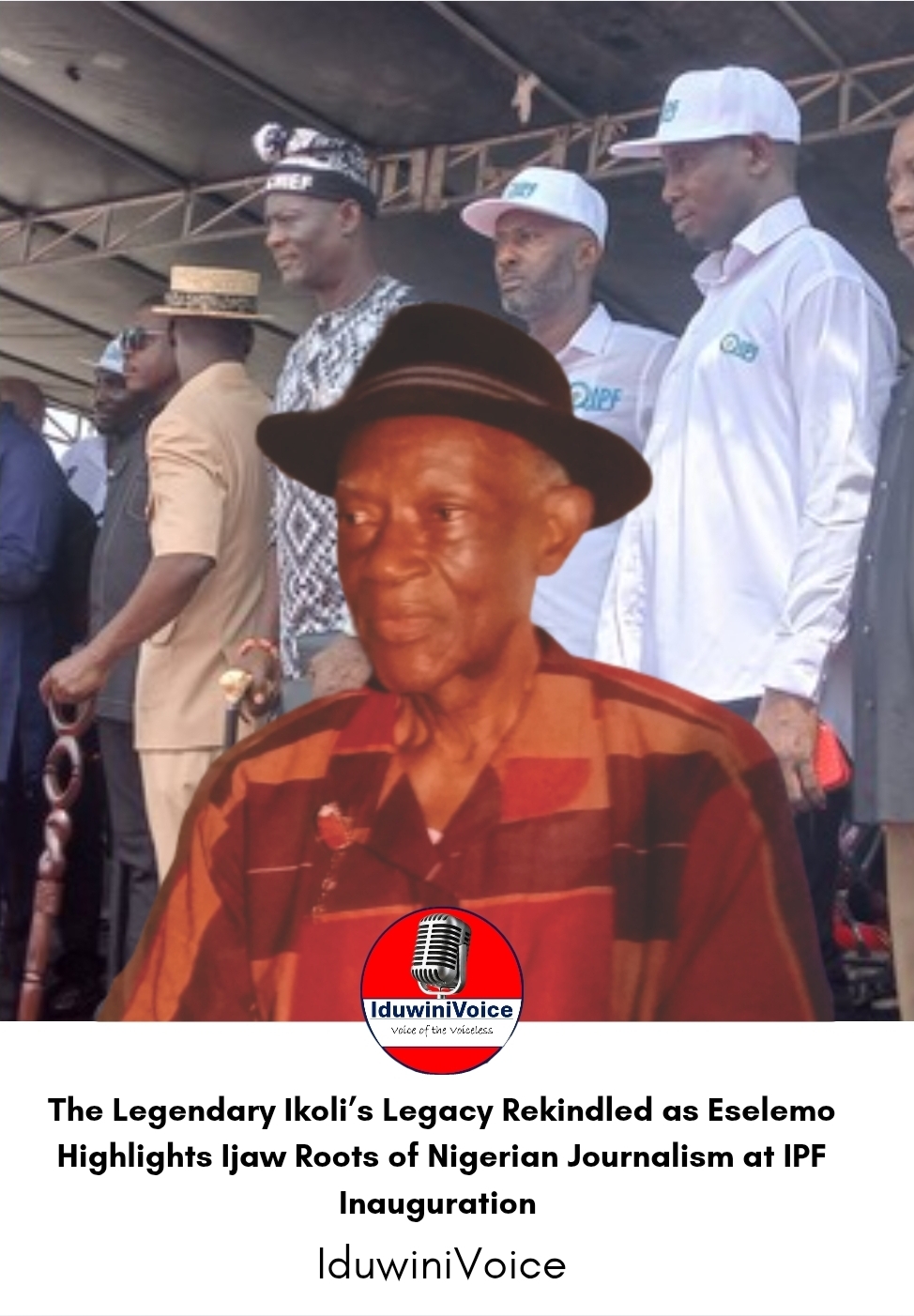
The Legendary Ikoli’s Legacy Rekindled as Eselemo Highlights Ijaw Roots of Nigerian Journalism at IPF Inauguration
By Favour Bibaikefie
WARRI — The enduring legacy of Ernest Sisei Ikoli took centre stage last Thursday in Warri as prominent Ijaw leader, Prince Collins Eselemo, a politician, foremost Ijaw nationalist and an advocate for Resource Control, declared that Nigerian journalism was built on foundations laid by Ijaw pioneers.
Speaking at the inauguration of the new National Executive Council of the Ijaw Publishers’ Forum (IPF), Eselemo asserted that the history of journalism in Nigeria cannot be told without acknowledging Ikoli’s towering contributions.
Ikoli, born in 1893 in Twon-Brass, present-day Bayelsa State, is widely recognised as one of the founding figures of modern Nigerian journalism. He became the first editor of the Daily Times of Nigeria in 1926, shaping public discourse during the colonial era through bold editorials and nationalist advocacy.
At the IPF second inauguration ceremony held last week at Ogbe-Ijoh, Warri, Eselemo maintained that Ikoli’s role in the nationalist struggle and media development underscores what he described as the intellectual heritage of the Ijaw people. He noted that Ikoli’s early association with John Payne Jacksonat the Lagos Weekly Record helped sharpen a nationalist press culture that later influenced a generation of political leaders.
Historical records show that Ikoli founded The African Messenger in 1921 before later editing The Daily Service, the mouthpiece of the Nigerian Youth Movement (NYM), which he co-founded alongside Hezekiah Oladipo Davies and J.C. Vaughan. The NYM later attracted nationalist figures including including Nnamdi Azikiwe and Obafemi Awolowo.
As president of the NYM, Ikoli was elected into the Legislative Council in 1942 and 1946, where he advocated educational reforms and greater Nigerian representation in governance. His philosophy of “one Nigeria, one Africa, one destiny” reflected a pan-African outlook that transcended ethnic lines.
Eselemo’s remarks at the IPF ceremony come amid renewed conversations about the contributions of minority ethnic groups to Nigeria’s political and media history. He urged contemporary publishers to emulate Ikoli’s courage, professionalism and commitment to truth.
Ikoli was awarded the Officer of the Order of the British Empire (OBE) in 1954 and lived to witness Nigeria’s independence on October 1, 1960, before passing away weeks later on October 21.
Today, his memory is preserved through scholarly works, the Bayelsa State “Earnest Ikoli Press Centre, and the Ernest Sisei Ikoli Foundation in Lagos, reinforcing Eselemor’s argument advanced in Ogbe-Ijoh, Warri — that the story of Nigerian journalism remains incomplete without acknowledging its Ijaw pioneers.
News
Ajapa Field MOU: Ogulagha Stakeholders Call for Review, Transparency and Alignment with Current Realities

By Charity Ebi
OGULAGHA, DELTA STATE — Nearly two decades after a Memorandum of Understanding (MOU) was signed between Britannia-U Nigeria Limited and Ogulagha Kingdom in Burutu Local Government Area, stakeholders in the oil-bearing community are calling for a comprehensive review of the agreement to reflect present-day economic and industry realities.
The 2007 MOU, tied to operations at the Ajapa Marginal Field, was introduced as a framework for peace, development and mutual benefit. However, community representatives say that while the agreement may have appeared workable at inception, its fixed financial structure has been overtaken by inflation, rising oil revenues and evolving governance standards within Nigeria’s petroleum sector.
Addressing journalists on behalf of stakeholders, Mr. Jude Iyelagha stressed that the concerns being raised should not be misconstrued as an attack on the integrity of Ogulagha’s traditional or political leadership.
“This is not an attempt to indict or insult the credibility of our revered leaders,” Iyelagha clarified. “Rather, it is an encouragement for leaders to revisit the well-documented terms, review them in line with current realities, and ensure they are fully implemented for the benefit of our people.”
Modest Provisions, Expanding Industry
Under the MOU, provisions reportedly included annual allocations for community drugs, scholarships for secondary and tertiary students, training slots at the Petroleum Training Institute (PTI), allowances for trainees, incentives for science teachers and sitting allowances for kingdom committee meetings.
While these figures may have been considered reasonable in 2007, stakeholders argue that their real value has significantly diminished over time due to inflation. Crucially, the sums were fixed and not indexed to oil prices, production output or inflationary trends.
Using conservative production estimates common to marginal fields in the Niger Delta, observers note that annual gross revenues from such operations could run into tens of billions of naira. When juxtaposed with community allocations that reportedly totalled only a few million naira annually at inception, the proportional disparity becomes a central point of concern.
For residents, the issue is less about confrontation and more about fairness.
Development Expectations in a Resource-Rich Area
Ogulagha Kingdom remains one of the oil-producing hubs in Delta State. Yet stakeholders point to ongoing challenges including limited healthcare facilities, youth unemployment, fragile road networks, environmental vulnerability and constrained access to higher education funding.
Community leaders argue that development in oil-bearing areas should translate into tangible infrastructure such as modern health centres, shoreline protection projects, potable water systems, vocational training hubs and structured employment pipelines.
“The frustration is not hostility towards investment,” a stakeholder noted. “It is about proportionality and visible impact.”
Shareholding Claims and Transparency Concerns
Beyond the MOU, a more complex issue has emerged. Leaders within the kingdom assert that Ogulagha may not only be a host community but also a registered shareholder in the Ajapa Marginal Field structure, allegedly documented with the Corporate Affairs Commission.
If such shareholding exists, corporate law provides for certain rights, including access to audited financial statements, notice of Annual General Meetings and entitlement to dividends where declared.
Stakeholders claim that consistent access to production data, audited accounts and dividend clarity has not been fully established, raising questions about governance participation.
Again, Iyelagha emphasised that the intention is not to cast aspersions.
“We believe in dialogue and institutional engagement. What we are asking for is clarity, transparency and alignment with statutory expectations where applicable,” he said.
Petroleum Industry Act and Changing Standards
Analysts observe that the Petroleum Industry Act (PIA) has introduced more structured host community frameworks and governance mechanisms. Agreements executed before the reform era, they argue, may require review to align with contemporary standards of transparency and proportionality.
Stakeholders maintain that revisiting the 2007 framework would not only protect the long-term interests of the kingdom but also strengthen investor-community relations.
Company Response Awaited
Efforts to obtain official comments from Britannia-U Nigeria Limited were unsuccessful at the time of filing this report. The company’s response, when received, will be reflected in subsequent updates.
For now, the central appeal from Ogulagha stakeholders is measured and deliberate: a call for leaders to examine documented agreements, align them with present realities, and ensure that promises made translate into visible, sustainable benefits for the kingdom.
As one community voice put it, “Oil is finite, but our people and our future must endure.”

By Favour Bibaikefie
Historical medical records have revealed that indigenous surgeons in the Buganda Kingdom of present-day Uganda were successfully carrying out cesarean sections as early as 1879 — a period when the procedure was still considered highly risky in many parts of Europe.
The account was documented by British medical practitioner and explorer Robert William Felkin, who witnessed and later published details of the operation in the Edinburgh Medical Journal in 1884 under the title “Notes on Labour in Central Africa.”
According to Felkin’s observations, the procedure involved the use of banana wine as a cleansing agent, herbal preparations to manage pain, and cauterization with heated metal to control bleeding. Both mother and child reportedly survived the surgery — an outcome that drew significant attention from European medical circles at the time.
Felkin described the process as orderly and deliberate, noting that the practitioners demonstrated familiarity with anatomy, sterilization methods available to them, and post-operative care. The documentation challenged prevailing 19th-century assumptions that advanced surgical knowledge was absent in African societies before colonial contact.
Medical historians note that cesarean sections in Europe during the mid-1800s were often fatal due to infection and limited antiseptic knowledge. Antiseptic surgical techniques only became widely accepted in Europe toward the late 19th century following developments associated with figures such as Joseph Lister.
Scholars argue that the Buganda example illustrates a broader pattern of indigenous scientific knowledge that predated colonial rule. In his work, historian highlighted the complexity of African societies prior to European intervention, disputing narratives that framed the continent as lacking innovation or structured knowledge systems.
Experts say the 1879 account underscores the need for a more balanced historical perspective — one that acknowledges Africa’s contributions to medicine, technology, and empirical science long before formal Western medical institutions expanded into the continent.
The rediscovery and renewed discussion of such records continue to prompt debates about how global scientific history is written — and whose knowledge systems are recognized.
Source: African Echo